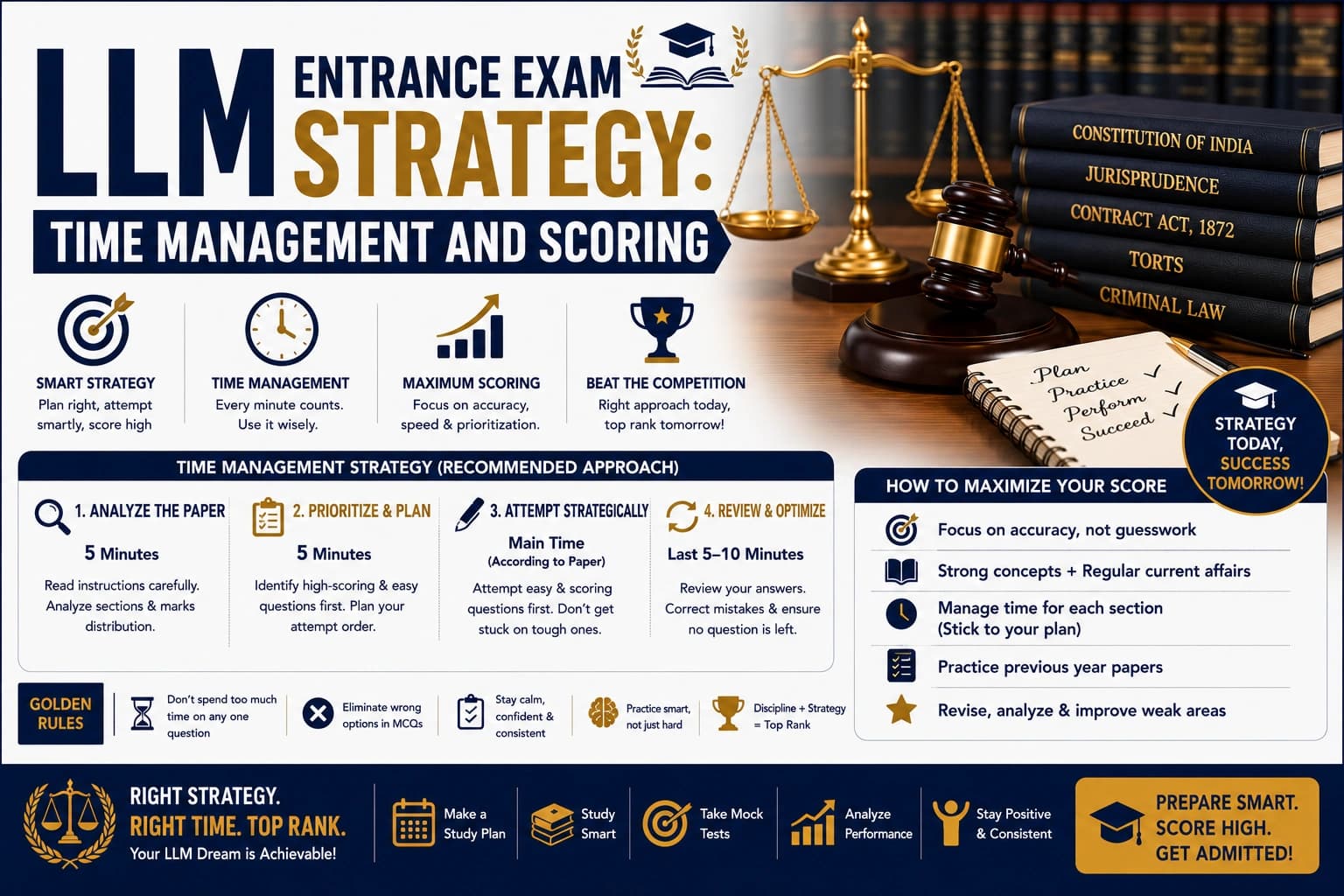
Two candidates with genuinely similar legal knowledge can walk out of the same LLM entrance exam with meaningfully different scores — and the difference is often strategy, not preparation depth. How you allocate time, which questions you attempt first, and how you handle uncertainty under pressure all affect your final score independently of how much you know.
This guide covers practical time management and scoring strategy for LLM entrance exams like CLAT PG, so your preparation actually translates into your best possible score on exam day.
Why Strategy Matters as Much as Knowledge
Understanding why strategy is a genuinely separate skill from knowledge helps justify practicing it deliberately.
The Gap Between Knowing and Scoring
You can know the correct answer to a question and still lose marks by spending too long reaching it, running out of time for easier questions later, or second-guessing yourself under pressure. Strategy is what closes this gap between raw knowledge and actual exam performance.
How Strategy Compounds Under Exam Pressure
Small inefficiencies — a few extra seconds per question, minor hesitation before moving on — compound significantly across a full-length, timed exam. What feels trivial in isolated practice can meaningfully affect your total attempted questions under real exam conditions.
Understanding Section-Wise Time Allocation
A deliberate time budget, planned in advance, outperforms improvising on the day.
Estimating Time Per Question Type
Based on your own practice performance, estimate roughly how long different question types genuinely take you — reading comprehension passages typically take longer per question than direct factual or reasoning questions. Build your time allocation around your own actual pace, not a generic assumption.
Building in Buffer Time
Always reserve some buffer time — for reviewing flagged questions, handling an unexpectedly difficult section, or a final quick review pass — rather than planning to use every available minute on first-attempt questions alone.
Choosing Your Attempt Order
The order you attempt sections and questions in is itself a strategic decision.
Starting with Your Strongest Section
Beginning with the section you're most confident in builds early momentum and secures marks efficiently before you encounter more challenging material, rather than risking early time loss on your weakest area first.
Deciding When to Skip and Return
Develop a clear personal rule for when to skip a difficult question and move on — many successful candidates use a strict time cap per question (attempted in practice beforehand) and mark questions to revisit later rather than getting stuck mid-exam.
Scoring Strategy: Accuracy vs Speed
Balancing these two factors correctly is central to maximizing your score.
Understanding Negative Marking Impact, If Applicable
If your specific exam applies negative marking, understand exactly how it's calculated for that exam and factor this into your guessing strategy — confirm the current negative marking policy directly from the official exam notification, since specifics can vary between exams and years.
When Guessing Makes Sense vs When It Doesn't
Where negative marking applies, guessing purely at random is generally riskier than making an educated guess after eliminating clearly incorrect options. Where no negative marking applies, attempting every question, even with limited certainty, is generally the better default strategy.
Managing Reading-Heavy Sections Efficiently
Comprehension-based sections often consume disproportionate time if not approached deliberately.
Skimming vs Deep Reading
Practice distinguishing between passages that require careful, close reading and those where skimming for structure and key points is sufficient to answer the associated questions accurately — this judgment itself improves with deliberate practice.
Extracting Answers Without Over-Reading
Train yourself to locate the specific information a question is asking for within a passage, rather than re-reading the entire passage in full for every question tied to it, which wastes significant time across a full exam.
Building Exam-Day Stamina Through Practice
Sustained focus across a long exam is a genuine skill that benefits from deliberate practice.
Simulating Full-Length Conditions
Practice complete, full-length previous papers under realistic timed conditions, not just shorter section-wise practice, since maintaining focus and pacing across the entire exam duration is different from performing well on shorter practice sets.
Managing Fatigue During Long Papers
Notice where your own performance tends to dip during long practice sessions (often toward the final third of the exam), and practice specific techniques — brief mental resets, deliberate pacing adjustments — to counter this during your actual attempt.
Common Time Management Mistakes
A few recurring patterns cost candidates marks unnecessarily.
Getting Stuck on Difficult Questions
Spending disproportionate time on a single difficult question, hoping the answer will eventually become clear, is one of the most common and costly mistakes. Stick to your predetermined time cap and move on, returning later only if time allows.
Spending Too Long Reviewing at the End
Conversely, some candidates spend excessive review time re-checking already-confident answers, at the cost of attempting remaining unanswered questions. Prioritize your remaining time toward unattempted questions before extensive review of ones you're already confident about.A Sample Time Management Framework
Adapting the Framework to Your Own Strengths
A reasonable starting framework: attempt your strongest section first, allocate time per question based on your own practiced pace with a strict per-question cap, flag and skip questions beyond that cap rather than lingering, and reserve final minutes specifically for flagged questions and unattempted items rather than open-ended review. Adjust this framework based on your own practice data rather than following it rigidly if your actual strengths point elsewhere.
Frequently Asked Questions
1. How important is time management compared to subject knowledge for LLM entrance exams?
Both matter significantly — strong subject knowledge with poor time management can still result in a lower score than expected, since exam performance depends on translating knowledge into attempted, correct answers within a fixed time limit.
2. Should I attempt questions in the order they appear, or choose my own order?
Choosing your own order — typically starting with your strongest section — often works better than strictly following the paper's sequence, since it builds early momentum and secures marks efficiently.
3. Is guessing a good strategy for LLM entrance exams?
It depends on whether negative marking applies to your specific exam. Where it does, educated guessing after eliminating clearly wrong options is generally safer than random guessing; where it doesn't, attempting every question is usually the better default.
4. How can I improve my speed on reading comprehension sections?
Practice distinguishing between passages needing careful reading versus quick skimming, and train yourself to locate specific answer information within a passage rather than re-reading it in full for every question.
5. How do I know if my time management strategy is actually working?
Track your practice test scores and completion rates over multiple full-length attempts, adjusting your section timing and attempt order based on where you're consistently losing time or marks.
6. What's the most common time management mistake candidates make?
Getting stuck on a single difficult question for too long, at the cost of time needed for easier, more scorable questions later in the exam.
Ready to build your exam strategy alongside your preparation? Review full details on the Master of Laws (LLM) page, browse our LLM Admission Guide, or explore Best LLM Specializations to plan your target programs. Revisit your BA LLB Course foundation, check Law Admission guidance, or use Compare Universities to finalize your shortlist.
Still refining your exam strategy? Reach out to our counsellors directly:
🌐 Website: www.vidyapun.com 📞 Call / WhatsApp: +91 96438 02216