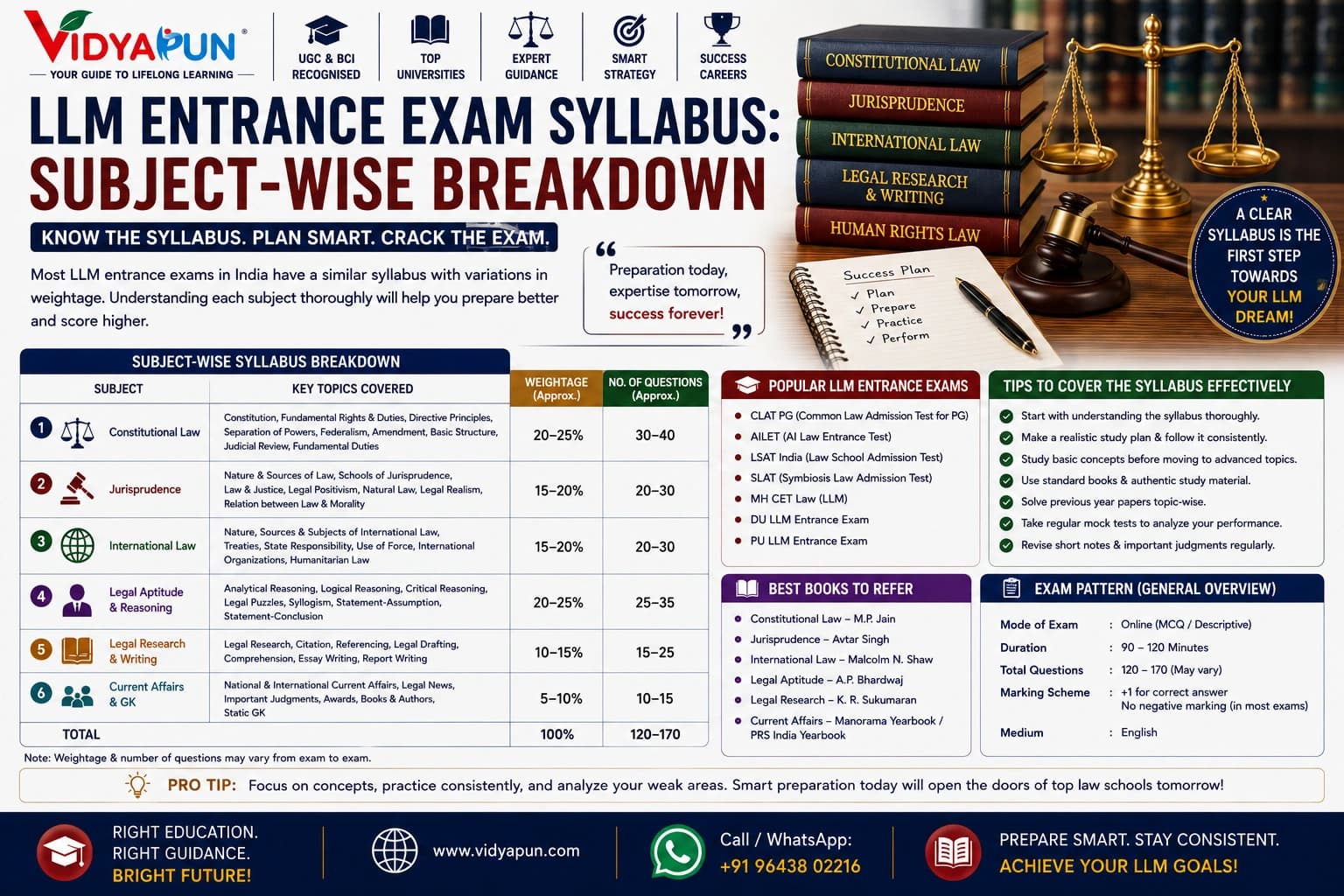
Knowing your Master of Laws (LLM) entrance exam syllabus in detail — not just the broad subject names — makes the difference between efficient preparation and wasted study hours on the wrong material. This guide breaks the syllabus down subject by subject, covering the core areas tested across CLAT PG, AILET PG, and most university-level LLM entrance exams.
Understanding the LLM Entrance Exam Syllabus Landscape
Before diving into individual subjects, it helps to understand how much overlap exists across different exams.
CLAT PG vs AILET PG vs University Exams
While CLAT PG, AILET PG, and individual university entrance exams differ in format and specific weightage, they draw from a largely overlapping pool of core LLB subjects, meaning solid preparation in the subjects below will serve you well across multiple exams.
Common Core Across Most Exams
Constitutional law, jurisprudence, and contract law consistently carry significant weightage across nearly every LLM entrance exam in India, making them the highest-priority subjects if your preparation time is limited.
Constitutional Law: Core Topics to Know
Constitutional law is typically the single most heavily weighted subject across LLM entrance exams.
Fundamental Rights and Directive Principles
Focus especially on Fundamental Rights (Part III) and Directive Principles of State Policy (Part IV), including how courts have interpreted and balanced these provisions in landmark cases — this is one of the most consistently tested areas.
Constitutional Interpretation and Landmark Cases
Be familiar with key doctrines like basic structure, judicial review, and separation of powers, along with the landmark cases that established them, since questions frequently test application of these doctrines to hypothetical scenarios.
Jurisprudence: Legal Theory Fundamentals
Jurisprudence tests conceptual understanding of law itself, which can feel abstract compared to other subjects but is highly scorable with the right preparation.
Schools of Legal Thought
Know the major schools of jurisprudence — natural law, positivism, legal realism, and sociological jurisprudence — along with their key thinkers, since comparative questions between schools are common.
Concepts of Law, Justice, and Rights
Understand core jurisprudential concepts like the nature of law, theories of justice, and the concept of rights, as these form the conceptual backbone for many application-based questions.
Law of Contracts and Torts
Contract and tort law together form a substantial, consistently tested portion of most LLM entrance syllabi.
Essentials of a Valid Contract
Cover the essential elements of a valid contract (offer, acceptance, consideration, capacity, free consent), along with void and voidable agreements, since these fundamentals are tested both directly and through applied fact patterns.
Tort Law Principles and Liability
Focus on general principles of tortious liability, defences, and specific torts like negligence and defamation, which appear regularly in application-based questions requiring you to apply the law to a given scenario.
Criminal Law Syllabus Breakdown
Criminal law tests both foundational principles and the ability to apply them to fact-specific situations.
General Principles and Indian Penal Code Basics
Understand general principles of criminal liability (mens rea, actus reus, stages of crime) alongside key offences under India's criminal statutes, since these fundamentals underpin most criminal law questions.
Landmark Criminal Law Judgments
Be familiar with landmark judgments that have shaped criminal law interpretation, as exams frequently test whether you understand how a legal principle was applied in an actual case, not just the principle in isolation.
Family Law, Property Law, and Other Core Subjects
Beyond the heavily weighted subjects above, several other core LLB subjects also appear regularly.
Family Law Essentials
Cover the basics of marriage, divorce, maintenance, and succession across India's personal law systems, since family law questions frequently test comparative knowledge across different personal laws.
Property and Transfer of Property Basics
Understand core concepts like ownership, possession, and the essentials of a valid transfer of property, which come up periodically, particularly in university-specific entrance exams with a broader syllabus.
International Law and Emerging Topics
Some exams, particularly university-specific ones, extend into international and emerging legal areas.
Public International Law Basics
Cover foundational concepts like sources of international law, state sovereignty, and international treaties and organisations, which appear more frequently in exams for universities with strong international law programmes.
Emerging Areas: Cyber Law and Environmental Law
Some university entrance exams also test awareness of emerging legal areas like cyber law and environmental law, reflecting the growing importance of these fields in Indian legal education.
How to Use This Syllabus Breakdown for Preparation
Knowing the syllabus is only useful if it shapes how you actually prioritise your study time.
Mapping the Syllabus to Your Study Plan
Use this breakdown to allocate more preparation time to the consistently high-weightage subjects (constitutional law, jurisprudence, contracts) early in your preparation, before moving to subjects with more variable weightage across different exams.
Final Thoughts
The LLM entrance exam syllabus is broad, but it isn't evenly weighted — constitutional law, jurisprudence, and contract law consistently carry the most weight across CLAT PG, AILET PG, and most university exams, making them the smartest place to concentrate early preparation. Once those core subjects feel solid, layer in criminal law, family law, property law, and (for university-specific exams) international and emerging law topics based on your target exam's specific syllabus.
Want help mapping this syllabus to a personalised study plan for your target universities? Book Free Counselling with Vidyapun's admission experts.
Frequently Asked Questions
Q1. Which subjects carry the most weightage in LLM entrance exams?
A: Constitutional law, jurisprudence, and contract law consistently carry the heaviest weightage across most LLM entrance exams, including CLAT PG and AILET PG.
Q2. Is the syllabus the same for CLAT PG, AILET PG, and university-specific exams?
A: Not exactly — while there's significant overlap in core subjects, specific weightage and additional topics (like international or emerging law areas) can vary by exam, so it's worth checking each exam's official syllabus.
Q3. How important is jurisprudence for LLM entrance exams?
A: Very important — jurisprudence tests conceptual understanding of law itself and is a consistently tested subject, though it's often under-prepared by candidates who focus mainly on more fact-heavy subjects.
Q4. Do LLM entrance exams test case law directly?
A: Yes, particularly in constitutional and criminal law, where questions often test whether you understand how a legal principle was applied in a specific landmark judgment.
Q5. Should I prepare family law and property law for LLM entrance exams?
A: It depends on your target exam — these subjects appear less consistently than constitutional law or jurisprudence but are still tested in several university-specific exams, so check the specific syllabus for your target universities.
Q6. How should I prioritise my study time across this syllabus?
A: Focus first on the consistently high-weightage subjects — constitutional law, jurisprudence, and contracts — before allocating remaining time to subjects with more variable weightage across different exams.
🌐 Website: www.vidyapun.com 📞 Call / WhatsApp: +91 96438 02216