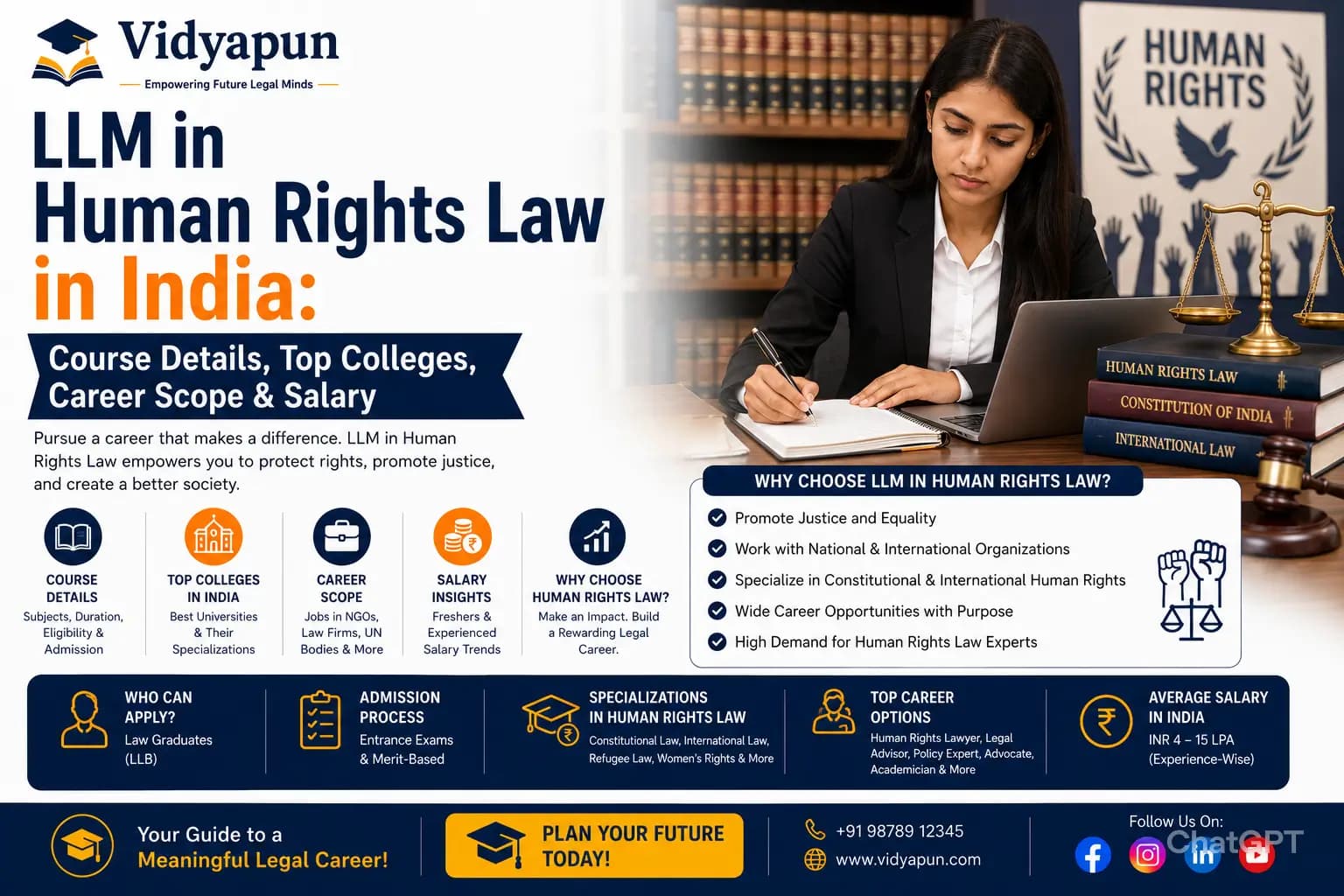
If you've just wrapped up your LLB and you're passionate about justice, equality, and protecting the vulnerable — an LLM in Human Rights Law might be exactly the path you're looking for. India's legal landscape is evolving rapidly, and the demand for trained human rights lawyers has never been higher.
But where do you begin? What colleges are worth considering? What does the course actually cover? And more importantly — what does life look like after the degree?
This guide breaks it all down for you in plain language.
What Is LLM in Human Rights Law?
The LLM (Master of Laws) in Human Rights is a two-year postgraduate law specialization that dives deep into the legal frameworks protecting individuals and communities from abuses of power. Unlike a general LLM, this specialization focuses specifically on:
- Fundamental rights under the Indian Constitution
- International human rights instruments and treaties
- Rights of marginalized communities — women, children, refugees, Dalits, LGBTQ+ persons
- Labour rights, criminal justice reform, and gender justice
- The role of national and international institutions in protecting civil liberties
The course is a balance of theory and practice. You'll study the history and philosophy of human rights alongside real-world case law from Indian courts, the UN Human Rights Council, and international tribunals.
Think of it this way — if an LLB is your foundation, an LLM in Human Rights Law is where you learn to use the law as a tool for actual social change.
LLM Human Rights Law: Quick Course Overview
| Detail | Information |
|---|---|
| Full Form | Master of Laws in Human Rights |
| Duration | 1 to 2 Years |
| Eligibility | LLB or BA LLB with 50–55% marks |
| Entrance Exams | CLAT PG, AILET, SLAT, University-Level Tests |
| Average Fees | ₹50,000 – ₹3,00,000 per year |
| Average Salary | ₹6 LPA – ₹20 LPA |
| Mode | Regular / Distance Learning |
| Career Roles | Human Rights Lawyer, Legal Consultant, NGO Advisor, Judge, Professor |
Eligibility Criteria for LLM in Human Rights
Before you start filling out application forms, make sure you meet these basic requirements:
Academic Qualification: You need a Bachelor of Laws (LLB) degree — either 3-year or 5-year integrated BA LLB — from a recognized university.
Minimum Marks:
- General/OBC category: 50–55% in graduation
- SC/ST/PWD category: 45–50% in graduation
Entrance Exam Score: Most reputed government law universities require you to clear CLAT PG (Common Law Admission Test for Postgraduate). Some institutions conduct their own entrance exams.
One common question students ask — Can I do LLM in Human Rights without LLB? The answer is no. The LLB or equivalent degree is a mandatory prerequisite. There are no shortcuts here.
Entrance Exams You Should Know About
Getting into a good college for LLM Human Rights Law in India often comes down to your entrance exam performance. Here's what to keep in mind:
CLAT PG — This is the main national-level test conducted by the Consortium of NLUs. It's the gateway to all National Law Universities in India and tests your legal reasoning, case analysis, and comprehension skills.
AILET PG — Conducted by National Law University, Delhi. Highly competitive and specifically for admission to NLU Delhi.
SLAT — Symbiosis Law Admission Test for postgraduate programs at Symbiosis International University.
University-Specific Tests — Many private and state universities conduct their own entrance tests or rely on merit-based admissions.
Pro tip: Start your CLAT PG preparation at least six months in advance. The paper is not just about knowing law — it tests how you think through complex legal situations.
LLM Human Rights Law Syllabus: What Will You Study?
The curriculum is structured to give you both theoretical grounding and practical tools. Here's a general idea of what the two-year program looks like:
Year 1 — Core Foundations:
- Constitutional Law and Human Rights in India
- International Human Rights Law and Instruments
- Research Methodology in Legal Studies
- Human Rights Theory and Philosophy
- Rights of Women and Gender Justice
Year 2 — Specialization and Application:
- Rights of the Child and Child Protection Laws
- Refugee Law and Internal Displacement
- Criminal Justice and Human Rights
- Environmental Rights and Sustainable Development
- Dissertation/Research Project
The dissertation component is particularly important — it's your chance to contribute original thinking to a real human rights issue. Choose a topic you genuinely care about; the research becomes far more meaningful.
Top Colleges Offering LLM in Human Rights Law in India
India has over 23 institutions offering this specialized postgraduate program. Here are some of the most well-regarded ones:
1. National Law School of India University (NLSIU), Bangalore One of the country's most prestigious law schools, established in 1986. NLSIU specializes in human rights and constitutional law. Fees for the LLM program are approximately ₹1,26,200 per year. Admission is through CLAT PG.
2. National Law Institute University (NLIU), Bhopal A leading NLU known for its strong legal research environment and focus on social justice issues including human rights.
3. Rajiv Gandhi National University of Law (RGNUL), Punjab Offers an excellent LLM program with faculty deeply embedded in human rights research and international law.
4. Banaras Hindu University (BHU), Varanasi One of India's oldest and most respected central universities with a strong law school and research tradition.
5. Amity Law School, Noida A popular private university option with good placement support and a broad human rights curriculum.
6. Guru Gobind Singh Indraprastha University, Delhi Accessible and well-connected to the Delhi legal ecosystem — useful if you plan to practice in the capital.
7. Sharda University, Greater Noida Offers a focused one-year LLM in Human Rights with admission open for 2026. Good option for students looking for a shorter, intensive program.
8. Symbiosis Law School, Pune Offers European Union Law and Human Rights as compulsory components, giving the curriculum a strong international dimension.
Distance Learning Option: Several universities — including IGNOU and Bharati Vidyapeeth — offer LLM Human Rights through distance mode. The syllabus mirrors the regular program, and the degree carries equal academic value.
Career Options After LLM in Human Rights Law
This is where things get genuinely exciting. An LLM in Human Rights opens doors that most law degrees simply don't reach.
1. Human Rights Lawyer / Advocate Represent victims of rights violations in courts, tribunals, and commissions. You could work independently, with a law firm, or with an NGO.
2. Legal Consultant with NGOs and Civil Society Organizations like Amnesty International, Human Rights Watch, and hundreds of Indian NGOs actively hire lawyers who understand international and domestic human rights frameworks.
3. Public Prosecutor / Government Legal Officer State governments and the central government hire human rights LLM graduates for roles in the National Human Rights Commission (NHRC), State Human Rights Commissions, and the Ministry of Law and Justice.
4. Academician / Law Professor If you enjoy teaching and research, universities are always looking for qualified faculty with postgraduate degrees. You can also pursue a PhD in Human Rights Law after your LLM.
5. International Organizations Graduates with strong academic records have opportunities to work with bodies like UNICEF, UNHCR, WHO, and the United Nations Human Rights Council — particularly in legal advisory or research roles.
6. Civil Judge / Judicial Services After clearing the relevant state judicial services exam, an LLM significantly strengthens your judicial candidacy.
7. Policy Analyst and Legal Researcher Think tanks, government bodies, and research institutions hire human rights specialists to analyze legislation, draft policy recommendations, and produce academic research.
Salary After LLM in Human Rights Law in India
Let's talk numbers — because that matters too.
Salaries after an LLM in Human Rights Law vary significantly based on the sector, location, and your experience level. Here's a realistic picture:
| Job Role | Average Annual Salary |
|---|---|
| Human Rights Lawyer | ₹5 – ₹12 LPA |
| Legal Consultant (NGO/Private) | ₹6 – ₹15 LPA |
| Public Prosecutor | ₹6 – ₹10 LPA |
| Law Professor / Academician | ₹5 – ₹12 LPA |
| Legal Advisor (International Body) | ₹10 – ₹25 LPA |
| Corporate Legal Advisor | ₹8 – ₹20 LPA |
Metro cities like Delhi, Mumbai, and Bangalore generally offer higher compensation. Roles with international organizations — especially UN bodies — are among the most competitive but also the most financially rewarding in this space.
Is LLM in Human Rights Law Worth It in 2025?
Honestly? Yes — if it aligns with your values and long-term career vision.
Here's the practical reality: India is experiencing growing public discourse around civil liberties, minority rights, environmental justice, and LGBTQ+ protections. Courts are receiving a higher volume of constitutional and human rights cases than ever before. Organizations working at the intersection of law and social justice are expanding.
What this means for you is that having specialized knowledge — not just a general LLB — genuinely sets you apart. You become someone who doesn't just understand law, but understands why certain laws exist and how to challenge the ones that don't.
The degree also gives you credibility if you want to write, research, or teach — roles that shape how future lawyers think about rights and justice.
Frequently Asked Questions (FAQs)
Q1. What is the full form of LLM in Human Rights? LLM stands for Master of Laws (Legum Magister). When pursued with a Human Rights specialization, it focuses on the legal protection of individuals and communities from rights violations.
Q2. What is the duration of LLM in Human Rights Law in India? The course is typically 2 years. However, some universities like Sharda University offer a 1-year intensive format.
Q3. Can I pursue LLM in Human Rights through distance education? Yes. Several UGC-recognized universities offer LLM Human Rights through distance learning mode. The curriculum and degree value are equivalent to regular programs.
Q4. Which entrance exam is required for LLM in Human Rights at NLUs? CLAT PG is the primary entrance exam for National Law Universities. Other universities may require AILET PG, SLAT, or their own entrance test.
Q5. What is the minimum eligibility for LLM in Human Rights? You need an LLB degree with at least 50% marks (45% for reserved categories) from a recognized university.
Q6. What government jobs can I get after LLM in Human Rights? You can work with the National Human Rights Commission (NHRC), State Human Rights Commissions, Ministry of Law and Justice, as a Public Prosecutor, or qualify for Civil Judge roles through judicial services exams.
Q7. Can LLM Human Rights graduates work abroad? Yes. With a strong academic profile and relevant experience, graduates can pursue roles with international bodies like UNICEF, UNHCR, Amnesty International, and the United Nations.
Q8. Is there PhD scope after LLM in Human Rights Law? Absolutely. Many graduates go on to pursue a PhD or MPhil in Human Rights Law, Constitutional Law, or International Law. This is ideal if you're interested in an academic or research career.
Final Thoughts
An LLM in Human Rights Law in India is more than just an academic qualification — it's a commitment to understanding and defending the rights that define a just society. Whether your goal is courtroom advocacy, policy work, international organizations, or academia, this degree gives you the specialized foundation you need.
The opportunities are real, the demand is growing, and if you're someone who genuinely cares about using law as a force for good — this is a worthy investment of two years of your life.
Ready to take the next step? Start by shortlisting colleges based on your CLAT PG score, location preference, and fee budget. Compare their curriculum, faculty, and placement records — then make an informed decision. The right program is out there, and it's waiting for someone exactly like you.
If you found this guide helpful, share it with fellow law students who are exploring their postgraduate options. And if you have questions about specific colleges or the CLAT PG exam pattern, drop them in the comments — we'd be happy to help.
Website: www.vidyapun.com
Call / WhatsApp: +91 96438 02216