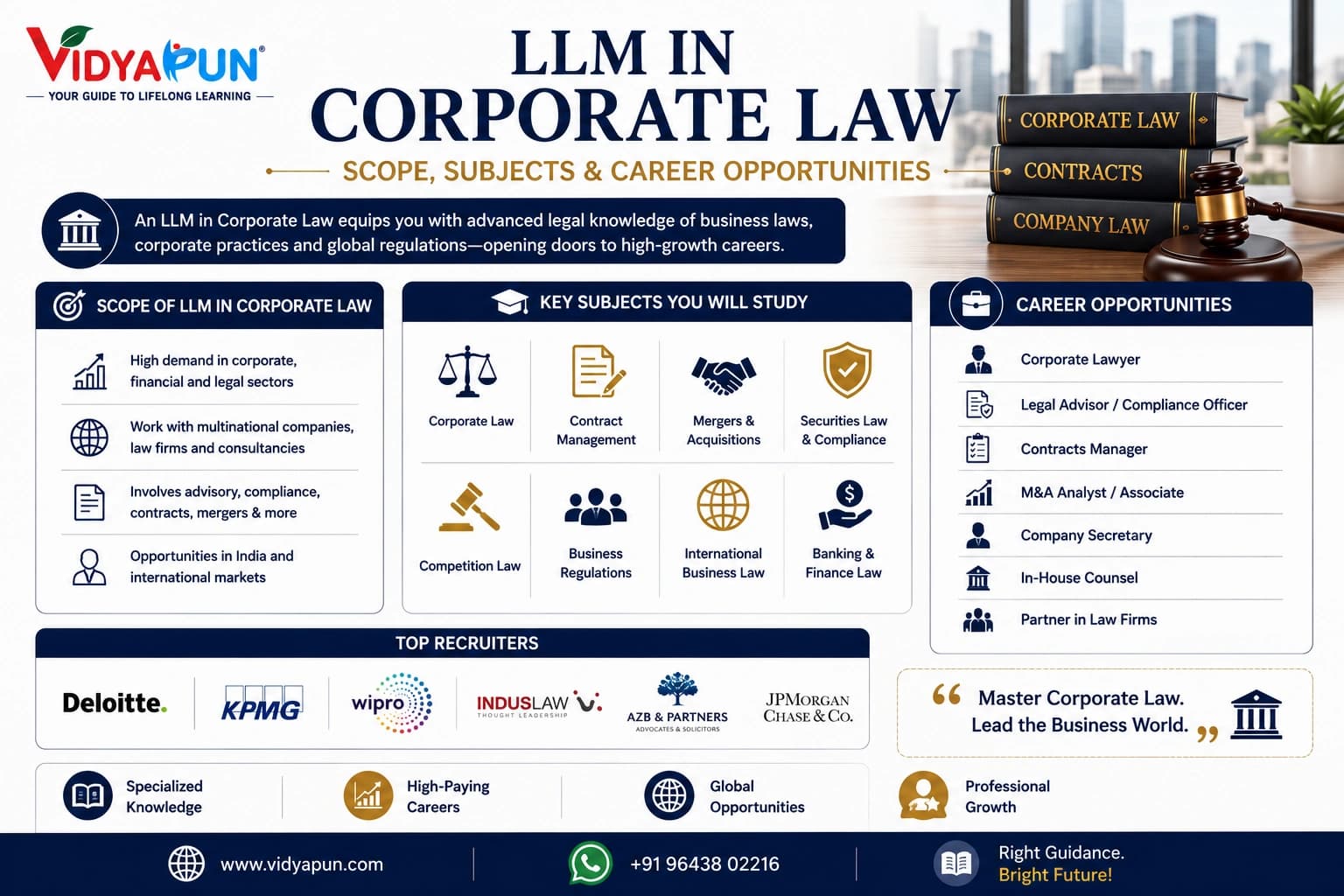
An LLM in Corporate Law is consistently one of the most sought-after specializations for Master of Laws (LLM) applicants — and for good reason, given India's expanding corporate and startup economy. This guide covers what the specialization actually involves: the subjects you'll study, the skills you'll build, and the career paths and salary range it realistically opens up.
What Is an LLM in Corporate Law?
Before deciding on this specialization, it's worth understanding exactly what it covers beyond what you touched on during your LLB.
Scope of Corporate Law as a Specialization
An LLM in Corporate Law goes deep into company formation, governance, mergers and acquisitions, securities regulation, and corporate compliance — areas that receive only introductory coverage during a general LLB.
How It Differs From General LLB Corporate Law Exposure
While your LLB likely included a foundational company law paper, an LLM specialization builds substantially more depth, including transactional practice, regulatory nuance, and often a research component focused on a specific area of corporate law.
Why Choose Corporate Law as Your LLM Specialization
Corporate law remains one of the most consistently in-demand legal specializations in India.
Growing Demand in India's Business Economy
As Indian companies expand, raise capital, and navigate increasingly complex regulation, demand for lawyers with specialised corporate law training has grown steadily across both law firms and in-house legal teams.
Strong Placement and Salary Potential
Corporate law specialists are generally among the more competitively compensated LLM graduates, particularly those who build genuine transactional experience during internships alongside their coursework.
Core Subjects Covered in an LLM in Corporate Law
The specific curriculum varies by university, but most programmes cover similar core ground.
Company Law and Corporate Governance
Expect in-depth study of company formation, director duties, shareholder rights, and corporate governance frameworks — the foundational layer for nearly everything else in the specialization.
Mergers, Acquisitions, and Securities Law
M&A structuring, due diligence processes, and securities regulation typically form a significant part of the curriculum, reflecting the transactional work most corporate lawyers actually do day to day.
Eligibility and Admission Process
Eligibility for this specialization generally follows standard LLM admission norms, without major additional requirements.
Eligibility Requirements
You'll need a recognised LLB degree meeting the university's minimum percentage requirement — the same baseline eligibility that applies to LLM admission generally, without additional prerequisites specific to corporate law.
Entrance Exams and Application Process
Admission typically follows the same routes as general LLM admission — CLAT PG, university-specific exams, or merit-based admission — with your specialization choice usually indicated during application or counselling rather than requiring a separate exam.
Skills You'll Build During the Programme
The specialization is designed to build a specific, practice-ready skill set.
Contract Drafting and Due Diligence
You'll develop strong contract drafting skills alongside due diligence capabilities — reviewing and analysing documents for legal and commercial risk — both central to real corporate legal practice.
Regulatory and Compliance Analysis
Understanding how to interpret and apply regulatory requirements (company law, securities regulation, competition law) to real business scenarios is a core skill this specialization is specifically designed to build.
Career Opportunities After an LLM in Corporate Law
This specialization opens up a genuinely wide range of career paths.
Law Firm Roles in Corporate Practice
Corporate law firms actively recruit LLM graduates with this specialization for transactional teams handling M&A, private equity, and general corporate advisory work.
In-House Counsel and Compliance Roles
Companies increasingly hire in-house legal and compliance professionals with specialised corporate law training, offering an alternative to law firm practice with often more predictable working hours.
Salary Expectations for Corporate Law LLM Graduates
Compensation in this specialization tends to track closely with firm tier and role type.
What Corporate Law LLM Graduates Typically Earn
Corporate law specialists generally earn at or above the broader legal industry average, with the specific range depending heavily on firm tier, city, and whether you're in a law firm or in-house role — an LLM in this specialization often improves your starting position compared to a general LLB alone.
How to Choose the Right University for This Specialization
Not every university offers equally strong corporate law training, so it's worth evaluating carefully.
What to Look for in a Corporate Law LLM Programme
Look at faculty expertise in corporate and commercial law specifically, the depth and currency of the curriculum, and whether the university has strong ties to corporate law firms for internship placement.
Comparing Placement Records and Faculty
Compare verified, recent placement data specifically for corporate law specialists (not just overall LLM placement figures), since this gives a much clearer picture of how well a programme actually prepares students for this specific career path.
Final Thoughts
An LLM in Corporate Law is a strong choice if you're drawn to transactional legal work and want to build genuinely specialised expertise in company law, M&A, and regulatory compliance. It offers strong career and salary potential across both law firm and in-house paths, though the specific outcomes depend heavily on the university's faculty strength, curriculum depth, and placement connections — so evaluate these factors carefully before choosing where to apply.
Ready to explore corporate law LLM programmes that fit your profile? Start Your Application with Vidyapun's guidance.
Frequently Asked Questions
Q1. What does an LLM in Corporate Law actually cover?
A: It covers company law, corporate governance, mergers and acquisitions, securities regulation, and corporate compliance in significantly more depth than a general LLB curriculum.
Q2. What are the eligibility requirements for an LLM in Corporate Law?
A: The same baseline eligibility as general LLM admission — a recognised LLB degree meeting the university's minimum percentage requirement, without additional specialization-specific prerequisites.
Q3. What career options are available after an LLM in Corporate Law?
A: Corporate law firm roles handling M&A and transactional work, and in-house counsel or compliance roles at companies, are the two most common career paths.
Q4. Do corporate law LLM graduates earn more than general LLM graduates?
A: Corporate law specialists generally earn at or above the broader legal industry average, though the specific figure depends heavily on firm tier, city, and whether you're in a law firm or in-house role.
Q5. How do I choose a good university for an LLM in Corporate Law?
A: Look at faculty expertise in corporate and commercial law, curriculum depth, and verified placement data specifically for corporate law specialists rather than overall LLM placement figures.
Q6. Is a separate entrance exam required for the corporate law specialization?
A: No — admission typically follows the same routes as general LLM admission (CLAT PG, university-specific exams, or merit-based admission), with specialization usually selected during application or counselling.
🌐 Website: www.vidyapun.com 📞 Call / WhatsApp: +91 96438 02216