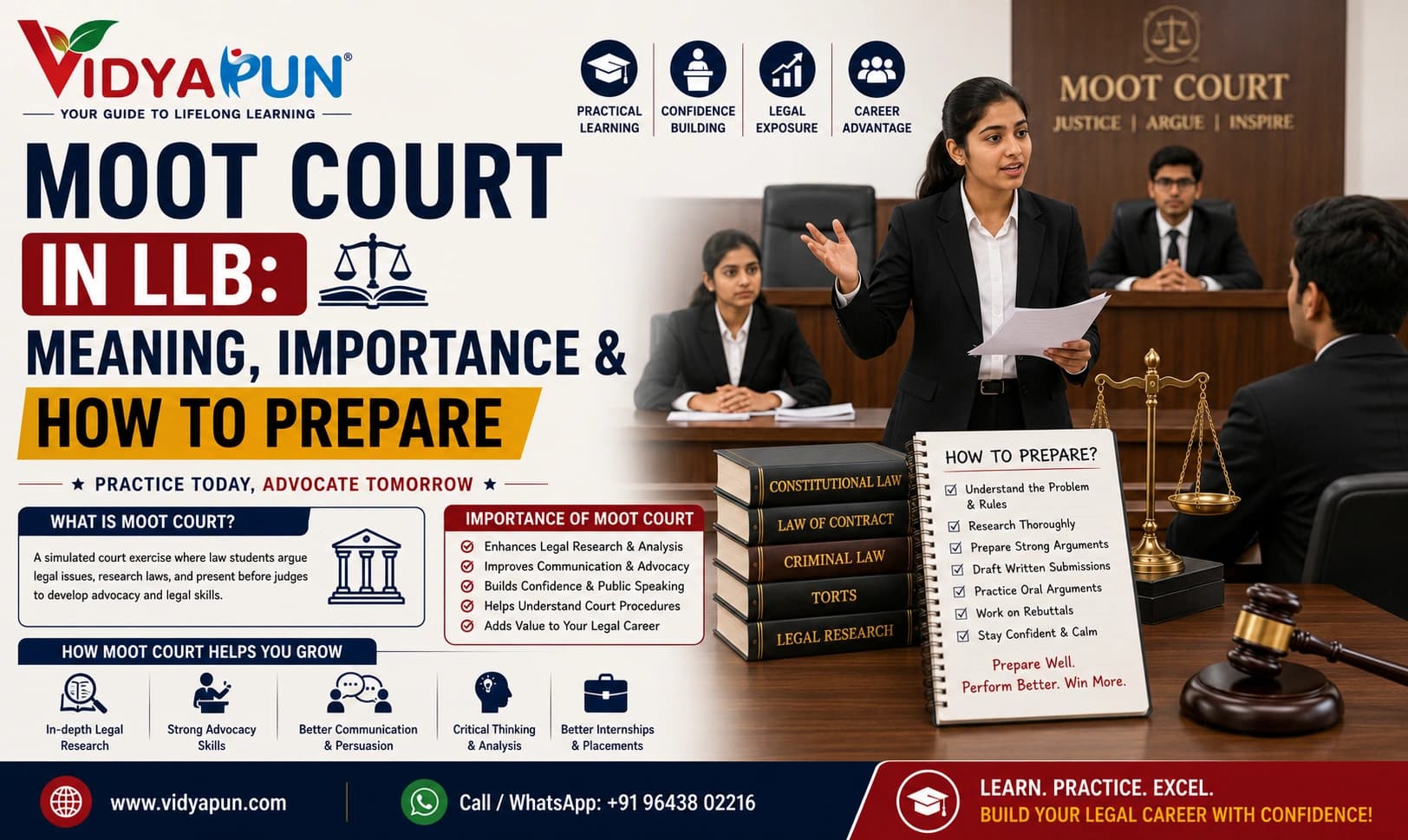
If you've just started your LLB, chances are you've already heard seniors talk about "moots" with a mix of dread and pride. Moot court is one of the most talked-about — and most misunderstood — parts of a law degree. It isn't just an extracurricular activity to pad your resume; it's often the closest a student gets to real litigation before actually stepping into a courtroom.
This guide breaks down what moot court really means, why law schools and recruiters take it so seriously, and how you can prepare for your first competition without feeling overwhelmed.
What Is a Moot Court?
A moot court is a simulated courtroom exercise where law students argue both sides of a hypothetical legal problem — usually called the "moot proposition" — in front of judges who evaluate their research, drafting, and advocacy skills. Unlike a real trial, there are no live witnesses or juries. Instead, participants prepare written submissions called memorials and then present oral arguments, playing the role of counsel for either the petitioner or the respondent.
Moot court exercises are almost always rooted in real legal principles. A problem might involve a constitutional question under the Constitution of India, a contract dispute, or an issue of international law. Because the facts are fictional but the law is real, students learn to apply legal research and reasoning exactly the way a practicing lawyer would.
Why Moot Court Matters in an LLB Program
Most Indian law schools, and the Bar Council of India's curriculum expectations more broadly, treat moot court participation as a core part of legal education rather than an optional add-on. Here's why it carries so much weight:
- It bridges theory and practice. Classroom learning teaches you what the law says; moot court teaches you how to use it.
- It builds courtroom-ready skills. Legal research, memorial drafting, and oral advocacy are all skills you'll need as a practicing lawyer.
- It develops confidence under pressure. Answering rapid-fire questions from moot court judges mirrors the pressure of a real courtroom.
- It strengthens your resume. Recruiters at law firms and chambers routinely ask about moot court experience during interviews.
- It builds a professional network. Competitions bring together students, judges, and practitioners from across the country — and sometimes internationally.
Simply put, moot court is where legal theory starts to feel like a skill you can actually use.
Moot Court vs Mock Trial: Key Differences
Students often confuse moot court with mock trial, but the two are quite different exercises.
| Aspect | Moot Court | Mock Trial |
| Focus | Appellate-style legal argument | Trial-style fact-finding |
| Witnesses | None | Simulated witnesses are examined |
| Core skill tested | Legal research and oral advocacy | Examination and cross-examination technique |
| Format | Written memorial + oral rounds | Full trial simulation |
In short, moot court tests how well you can argue the law, while mock trial tests how well you can argue the facts.
How Moot Court Competitions Work
Most moot court competitions in India follow a similar structure:
- Problem release – Organizers release a moot proposition, usually a few weeks before the deadline.
- Memorial submission – Teams research the problem and submit written memorials for both sides (petitioner and respondent).
- Preliminary oral rounds – Teams argue against each other in front of judges, who score based on research, structure, and advocacy.
- Knockout and final rounds – Top-performing teams advance through elimination rounds, culminating in a final bench.
- Awards – Prizes are usually given for best memorial, best speaker, and overall winning team.
Understanding this flow early helps you plan your preparation timeline instead of scrambling in the final week.
Building Your Moot Court Team and Roles
Moot court is almost always a team activity, typically with two to three members. Common role divisions include:
- Researcher – Focuses on case law, statutes, and legal commentary that support each side's arguments.
- Memorial drafter – Converts research into a structured, persuasively written memorial that follows proper legal citation format.
- Oral advocate(s) – Presents arguments in front of the judges and handles questions on the spot.
In smaller teams, these roles often overlap, but clarity about who owns what — especially in the final week before submission — saves a lot of last-minute stress.
How to Prepare: Research, Memorial Writing, and Oral Advocacy
Legal Research and Case Law
Start by identifying the core legal issues in the moot proposition, then work outward — statutes first, followed by relevant case law and academic commentary. Keep a running research log so you're not searching for the same case twice.
Memorial Writing Tips for Beginners
A strong memorial isn't just about having good arguments — it's about presenting them clearly. A few tips:
- Follow the prescribed citation format exactly; sloppy citations cost easy marks.
- Structure arguments logically, moving from your strongest point to your weakest.
- Avoid restating facts; focus on legal reasoning.
- Proofread for word limits, formatting, and consistency between the two sides' memorials.
Oral Advocacy Skills to Develop
Written work only gets you halfway. In the oral rounds, judges are testing how you think on your feet:
- Practice explaining your strongest argument in under a minute.
- Anticipate the toughest questions the other side — or the bench — might ask.
- Work on pace, tone, and eye contact rather than reading directly from notes.
- Do multiple practice sessions in front of peers or faculty before the actual competition.
Rebuttal and Sur-Rebuttal Strategy
Rebuttals are where advocacy skill really shows. Listen carefully during the opposing side's arguments, note down the two or three weakest points, and address only those — trying to rebut everything usually backfires and eats into your limited time.
Courtroom Etiquette and Dress Code
Most competitions expect formal court attire (typically black-and-white formals) and courtroom etiquette — addressing judges respectfully, not interrupting, and maintaining composure even when challenged. Judges notice this as much as they notice your arguments.
Common Mistakes to Avoid
- Submitting a memorial without checking the citation format against the competition rulebook.
- Memorizing a script instead of understanding the argument, which falls apart under questioning.
- Ignoring time management during oral rounds and rushing the ending.
- Failing to prepare for questions from the opposing side of the argument, not just your own.
- Underestimating how much research time a moot proposition actually needs.
How Moot Court Boosts Your Legal Career
Beyond the competition itself, moot court experience often becomes a genuine career differentiator. It signals to recruiters that you can research rigorously, draft persuasively, and argue confidently — the exact skills expected of a junior associate or litigator. Many students who moot regularly find it easier to transition into litigation, judicial clerkships, or even judiciary exam preparation, since the research and argumentation habits carry over directly.
If you're still exploring your options, it's worth understanding how a moot court record fits into the bigger picture of your legal education. You can explore LLB course details, browse law admission options, or compare the best colleges in India for law before applying.
Frequently Asked Questions
What is moot court and why is it important in LLB?
Moot court is a simulated courtroom exercise where law students argue a hypothetical legal problem in front of judges. It's important because it teaches practical skills — legal research, drafting, and oral advocacy — that classroom learning alone doesn't cover.
How do I prepare for a moot court competition?
Start early: understand the moot proposition, divide research and drafting responsibilities within your team, draft and revise your memorial well before the deadline, and dedicate several sessions to oral practice before the actual rounds.
What are some memorial writing tips for beginners?
Follow the citation format strictly, structure arguments from strongest to weakest, avoid restating facts, and proofread carefully for word limits and consistency between both sides.
What oral advocacy skills should I develop for moot court?
Focus on clear structuring of arguments, confident but respectful delivery, quick thinking under questioning, and staying within your allotted time.
What is the difference between moot court and mock trial?
Moot court focuses on appellate-style legal argument without witnesses, while mock trial simulates a full trial, including witness examination and cross-examination.
How is moot court scored?
Judges typically score based on the quality of legal research, the structure and persuasiveness of the memorial, oral presentation skills, and how well participants respond to questions.
What are some top national moot court competitions in India?
Several university-hosted national and international moot court competitions run each year across constitutional law, criminal law, international law, and arbitration themes; your law school's moot court society is usually the best place to find an updated list.
How does moot court help in a litigation career?
It builds the exact skills litigators use daily — legal research, persuasive drafting, and courtroom advocacy — while also building confidence in speaking under pressure.
What citation format should I use for moot court research?
Always follow the citation style specified in the competition rulebook; consistency matters more than which particular style you use.
How should a moot court team divide roles?
Common divisions include a researcher, a memorial drafter, and one or two oral advocates, though smaller teams often share these responsibilities.
How should I approach analyzing a moot court problem?
Read the proposition multiple times, identify the core legal issues, separate facts from legal questions, and build arguments around the issues most likely to influence the outcome.
What is the best rebuttal and sur-rebuttal strategy?
Focus your rebuttal on the two or three weakest points in the opposing argument rather than trying to respond to everything, and keep it concise given limited time.
Is there a specific dress code and etiquette for moot court?
Yes — most competitions expect formal court attire and courtroom etiquette, including respectful address to judges and composed behavior under questioning.
What do moot court judges expect from participants?
Judges generally expect clear, well-researched arguments, confident delivery, respectful courtroom conduct, and the ability to respond thoughtfully to unexpected questions.
Not sure which law course or college is right for you? Talk to an Admission Expert and get personalized guidance for your LLB journey.
🌐 Website: www.vidyapun.com 📞 Call / WhatsApp: +91 96438 02216