There's a moment many BTech Computer Science graduates reach — usually somewhere around their second or third year of working — where they start wondering whether they should go deeper. Deeper into a specific technology, deeper into research, or simply deeper into the kind of expertise that separates the people solving hard engineering problems from the ones maintaining existing systems.
That moment is usually when the question of MTech in Computer Science comes up seriously.
It's a fair question to sit with. An MTech is a two-year commitment, often requiring a GATE score, and it means stepping away from a salary for a while. But for the right person with the right goals, it's one of the highest-return investments you can make in a technology career in India — both financially and in terms of the depth of work you'll get to do.
This guide breaks down everything you need to make that decision clearly: the specialisations worth considering, the colleges that actually deliver on their promises, what the career scope looks like after an MTech in CS, and what salary expectations are realistic.
What Is MTech in Computer Science?
MTech — Master of Technology — is a two-year postgraduate engineering degree that provides advanced, research-oriented technical education in a chosen specialisation. The MTech in Computer Science builds on your BTech or BE foundation and takes you into significantly deeper territory — algorithms, systems architecture, machine learning theory, network security, compiler design, or whatever specialisation you choose.
Unlike an MCA (Master of Computer Applications) which is more application-focused, the MTech in CS is research and engineering-oriented. It typically involves coursework in the first year, followed by a major research thesis or project in the second year. The thesis component is what separates strong MTech graduates — those who've actually contributed original work to a technical domain — from the rest.
Admission to most reputed MTech programmes in India is through GATE (Graduate Aptitude Test in Engineering) — specifically the CS paper (CSE). A strong GATE score opens doors to IITs, NITs, IIITs, and top-ranked private technical universities.
Why Consider MTech in Computer Science in 2026?
Let's be direct about who this degree is for — and who it isn't.
An MTech in CS makes strong sense if you want to work in research and development roles at technology companies, want to move into specialised high-paying domains like AI/ML engineering, want to eventually pursue a PhD in computer science, are interested in faculty positions at engineering colleges, or want to work in core technical roles at organisations like ISRO, DRDO, or defence research labs.
It makes less sense if your primary goal is to move into product management, business analysis, or general software development — areas where work experience and portfolio often matter more than a postgraduate degree.
With that context clear, here's why the scope for MTech CS graduates is particularly strong right now:
AI and Machine Learning Demand Is Exploding Every major tech company in India and globally is aggressively hiring ML engineers, data scientists, and AI researchers. An MTech with a specialisation in AI/ML gives you both the theoretical foundation and the research credibility that BTech graduates typically lack.
Core Engineering Roles Pay Significantly More Companies like Google, Microsoft, Amazon, and Indian unicorns pay a meaningful premium for engineers who can work on compilers, distributed systems, hardware-software interfaces, and similar deep technical challenges. These roles almost invariably go to people with postgraduate-level expertise.
Research Ecosystem Is Growing India's research and development investment is increasing — both in the private sector (product companies building R&D centres) and the government sector (DRDO, C-DAC, ISRO). MTech graduates with strong thesis work are the primary candidates for these roles.
Teaching Positions Require It If academia appeals to you, an MTech is the minimum qualification for lecturer positions at engineering colleges, and a prerequisite for PhD programmes that lead to assistant professor roles at IITs and NITs.
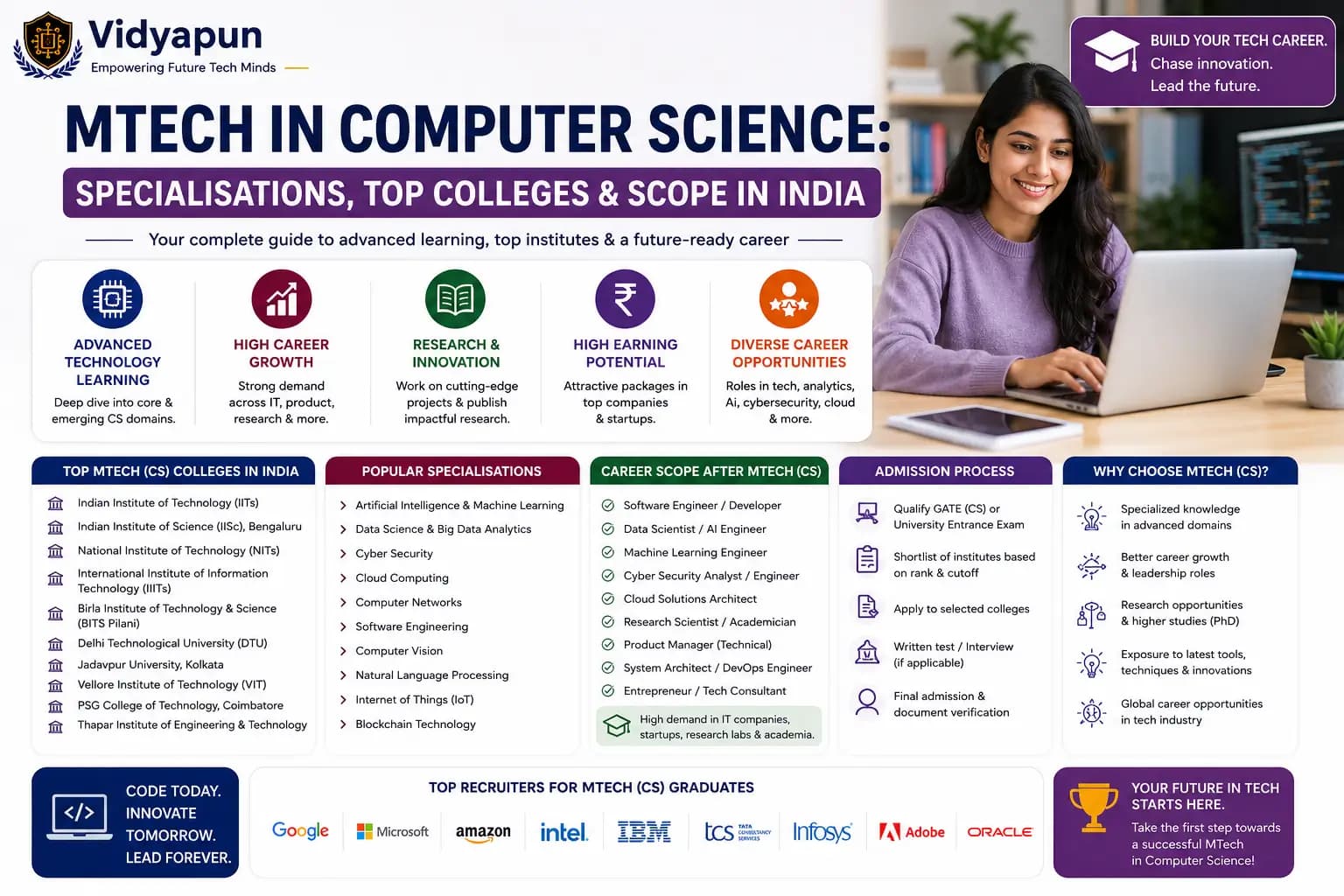
Popular MTech Computer Science Specialisations in India
One of the most important decisions in your MTech journey is choosing the right specialisation. Here are the ones with the strongest current demand and career relevance:
Artificial Intelligence and Machine Learning
The single most in-demand MTech specialisation in 2026. Covers neural networks, deep learning, natural language processing, computer vision, reinforcement learning, and AI ethics. Graduates are absorbed by product companies, research labs, and startups at premium salaries.
Data Science and Big Data Analytics
Focuses on statistical learning, data mining, large-scale data processing frameworks (Hadoop, Spark), and business intelligence. Strong overlap with AI/ML but with more emphasis on data engineering and analytics pipelines.
Cyber Security and Information Security
With cyber threats becoming more sophisticated and India's digital economy expanding rapidly, information security specialists are in exceptionally high demand. This specialisation covers cryptography, network security, ethical hacking, digital forensics, and security architecture.
Computer Networks and Distributed Systems
Covers network protocols, cloud computing architecture, distributed algorithms, and systems design. Highly relevant for infrastructure engineering roles at cloud companies and telecom firms.
Software Engineering
Focuses on software architecture, formal methods, testing, and large-scale system design. More applied than some other specialisations, with strong industry relevance.
Human-Computer Interaction (HCI)
A niche but growing specialisation that sits at the intersection of computer science, psychology, and design. Strong demand at product companies working on user experience.
Computer Vision and Image Processing
Covers signal processing, image recognition, medical imaging, autonomous systems, and video analytics. Relevant for roles in healthcare tech, autonomous vehicles, surveillance, and defence applications.
VLSI Design and Embedded Systems
For those interested in the hardware-software interface — chip design, embedded processors, IoT hardware, and real-time systems. C-DAC, ISRO, and semiconductor companies are major employers here.
Theoretical Computer Science
Algorithms, computational complexity, formal languages, and mathematical foundations of computing. Best suited for students heading toward PhD programmes or research-heavy roles.
Top Colleges for MTech in Computer Science in India
The institution where you do your MTech matters enormously — it shapes your research environment, your thesis quality, your network, and where you can realistically expect to be placed afterward.
IITs (Indian Institutes of Technology)
The IITs are the unambiguous first choice for MTech in CS in India. The research environment, faculty quality, and placement records are in a different league from almost every other option.
- IIT Bombay — exceptional for AI/ML, systems, and theory
- IIT Delhi — strong industry connections, excellent placements with product companies
- IIT Madras — one of the best for research, particularly in distributed systems and HCI
- IIT Kharagpur — large and well-resourced, strong VLSI and networking programmes
- IIT Bangalore (IISc) — technically IISc rather than an IIT, but its MTech (Research) and ME programmes are among the most rigorous in the country
- IIT Kanpur — strong theoretical CS programme, excellent for students interested in PhD
- IIT Hyderabad, Roorkee, Guwahati — newer IITs with improving quality and good industry placements
GATE cutoffs for IIT CS programmes are among the highest — typically requiring scores in the 700+ range (out of 1000) for general category.
NITs (National Institutes of Technology)
NITs offer a strong MTech CS experience at significantly lower fees than IITs, and with GATE cutoffs that are more accessible for most candidates.
- NIT Trichy — consistently ranked the top NIT, strong CS department
- NIT Warangal — excellent faculty and research output
- NIT Surathkal (NITK) — strong in networking and systems
- NIT Calicut — good research culture, strong South India placement network
- NIT Rourkela — solid programme, improving placements
GATE cutoffs for top NITs generally range from 550–700 for general category.
IIITs (Indian Institutes of Information Technology)
IIITs are specifically focused on IT and computer science, which means CS departments here get disproportionate attention and resources.
- IIIT Hyderabad — arguably the best IIIT for CS, exceptional research and startup ecosystem
- IIIT Bangalore — strong industry connections, good placements
- IIIT Allahabad — well-established IIIT with decent CS programme
Top Private Technical Universities
- BITS Pilani — excellent for industry-oriented MTech, strong alumni network
- Thapar Institute of Engineering, Patiala — good private option with solid CS placements
- VIT Vellore — large intake, reasonable quality, good for students without strong GATE scores
- Manipal Institute of Technology — well-known private option, good infrastructure
Specialised Research Institutions
- IISc Bangalore — the gold standard for research. If pure research is your goal, this is the destination.
- C-DAC (Centre for Development of Advanced Computing) — offers PG Diplomas and MTech equivalent programmes with strong industry orientation, particularly in HPC, cybersecurity, and embedded systems.
MTech CS Eligibility and GATE Requirements
Educational Qualification: BTech / BE in Computer Science, Information Technology, Electronics, or a related engineering discipline from a recognised university. Some institutions also accept MCA graduates.
Minimum Marks: Most reputed colleges require 60% aggregate in BTech (55% for SC/ST). Some private universities accept candidates without GATE scores but with lower aggregate requirements.
GATE Score: GATE CS (Paper Code: CS) is the primary admission criterion for IITs, NITs, and IIITs. A valid GATE score is also required for MHRD scholarships (₹12,400 per month stipend) at government-funded institutions — a significant financial benefit that makes the GATE route worth pursuing even if you could get admission without it.
MTech in Computer Science: Fees in India
| Institution Type | Approximate Total Fees (2 Years) |
|---|---|
| IITs | ₹40,000 – ₹1,00,000 (+ GATE stipend covers most costs) |
| NITs | ₹60,000 – ₹1,50,000 |
| IIITs | ₹80,000 – ₹2,00,000 |
| Private Universities | ₹2,00,000 – ₹8,00,000 |
GATE-qualified students at government institutions receive a monthly stipend of ₹12,400 — which, over two years, largely offsets or exceeds the fee outlay. This makes IIT and NIT MTech programmes effectively subsidised or even net-positive financially for many students.
Career Scope After MTech in Computer Science
The career scope after MTech CS in India is genuinely strong — particularly for graduates from IITs, NITs, and IIITs. Here's what the landscape looks like:
Software Development (Senior / Specialised Roles) MTech graduates enter product companies at senior or specialised engineer levels rather than the standard fresher track. Roles at companies like Google, Microsoft, Amazon, Flipkart, and Swiggy are realistic for strong IIT/NIT MTech graduates.
AI/ML Engineering and Research The most in-demand career path right now. MTech graduates with strong AI/ML thesis work are hired by research labs, product companies, and AI-focused startups at premium packages.
Cybersecurity Specialist With India's growing digital economy and increasing cyber threats, MTech graduates in cybersecurity are absorbed by banks, IT companies, government agencies, and dedicated security firms.
Research and Development (R&D) Roles DRDO, ISRO, C-DAC, BARC, and private R&D centres actively recruit MTech CS graduates for technical research roles. These positions are stable, intellectually stimulating, and increasingly well-compensated.
Academia — Lecturer/Assistant Professor An MTech from a reputed institution qualifies you to teach at engineering colleges. Combined with a PhD (which an MTech prepares you well for), you can reach faculty positions at IITs and NITs.
Product Management Somewhat less common but increasingly relevant — MTech graduates with strong communication skills move into technical product management, where deep engineering understanding is a genuine differentiator.
Entrepreneurship and Startups The research and problem-solving depth that a good MTech builds is directly applicable to founding or joining early-stage technology startups — particularly those working on deep tech.
MTech Computer Science Salary in India
| Career Path | Average Starting Salary (INR) |
|---|---|
| Software Engineer – Product Company (IIT Graduate) | ₹18–35 LPA |
| AI/ML Engineer | ₹15–30 LPA |
| Cybersecurity Specialist | ₹10–20 LPA |
| R&D Engineer (DRDO/ISRO/C-DAC) | ₹8–15 LPA |
| Assistant Professor (NIT/State College) | ₹7–14 LPA |
| Data Scientist | ₹12–25 LPA |
IIT MTech graduates placed at top product companies regularly receive packages between ₹20–40 LPA. Salaries at the senior end, with 5–8 years of post-MTech experience in specialised roles, can reach ₹50–80 LPA at FAANG-level companies.
FAQs: MTech in Computer Science India
Q1. Is MTech in Computer Science worth doing in 2026? Yes — particularly if you want to work in specialised high-paying technical domains like AI/ML, cybersecurity, or distributed systems, or if you're targeting R&D roles or an academic career. For general software development, a BTech with strong experience may be sufficient, but an MTech from a top institution meaningfully increases your career ceiling.
Q2. Which GATE score is needed for IIT MTech CS admission? GATE scores above 700 (out of 1000) are generally competitive for top IITs. For NITs and IIITs, scores between 550–700 are more typically in the competitive range. Exact cutoffs vary year to year — check each institution's official admission notice.
Q3. Can I do MTech in CS after MCA? Yes. Many IITs, NITs, and IIITs accept MCA graduates for MTech CS programmes. Eligibility criteria vary by institution — confirm with the specific college's admission guidelines.
Q4. What is the GATE stipend for MTech students? GATE-qualified MTech students at AICTE-approved government-funded institutions receive a stipend of ₹12,400 per month for the duration of the programme (typically two years). This is a significant financial benefit that makes the GATE route considerably more attractive than non-GATE admission to private colleges.
Q5. Which MTech CS specialisation has the highest salary in India? Artificial Intelligence and Machine Learning consistently commands the highest salaries among MTech CS specialisations. Cybersecurity and distributed systems follow closely. Salary also depends heavily on the institution — an MTech from IIT Bombay in any specialisation typically places better than an MTech from a mid-tier private college in AI/ML.
Q6. Is IIIT Hyderabad good for MTech in Computer Science? IIIT Hyderabad is excellent — arguably the best institution for MTech CS outside the IITs. Its research culture, faculty quality, and startup ecosystem are exceptional. It's particularly well-regarded for AI, machine learning, and language technologies research.
Q7. Can an MTech in CS lead to a PhD abroad? Yes, and this is one of the most valuable pathways an Indian MTech opens. A strong thesis from an IIT or IISc is competitive for PhD admissions at top universities in the US, UK, Germany, and Canada. Many Indian MTech graduates have used this route to access fully-funded PhD programmes abroad.
Build the Technical Career You Actually Want
An MTech in Computer Science from the right institution is one of the most powerful moves a BTech engineer can make — if their goals align with what the degree actually provides. The depth of knowledge, the research exposure, the GATE stipend, and the career outcomes at top institutions make it a genuinely high-value investment.
If GATE is the path you're choosing, start your preparation with a clear timeline — most serious candidates need eight to twelve months of focused study for a competitive score. If you're evaluating institutions, use this guide to build a realistic shortlist based on your current academic profile and target specialisation.
The engineers who shape how technology evolves — the ones building the AI systems, securing the infrastructure, and designing the algorithms that power the next generation of products — are the ones who went deeper. An MTech is how you go deeper.
Have questions about GATE preparation, choosing between IIT and NIT for your MTech, or comparing specialisations? Drop them in the comments — we'll help you think it through.
Website: www.vidyapun.com
Call / WhatsApp: +91 96438 02216