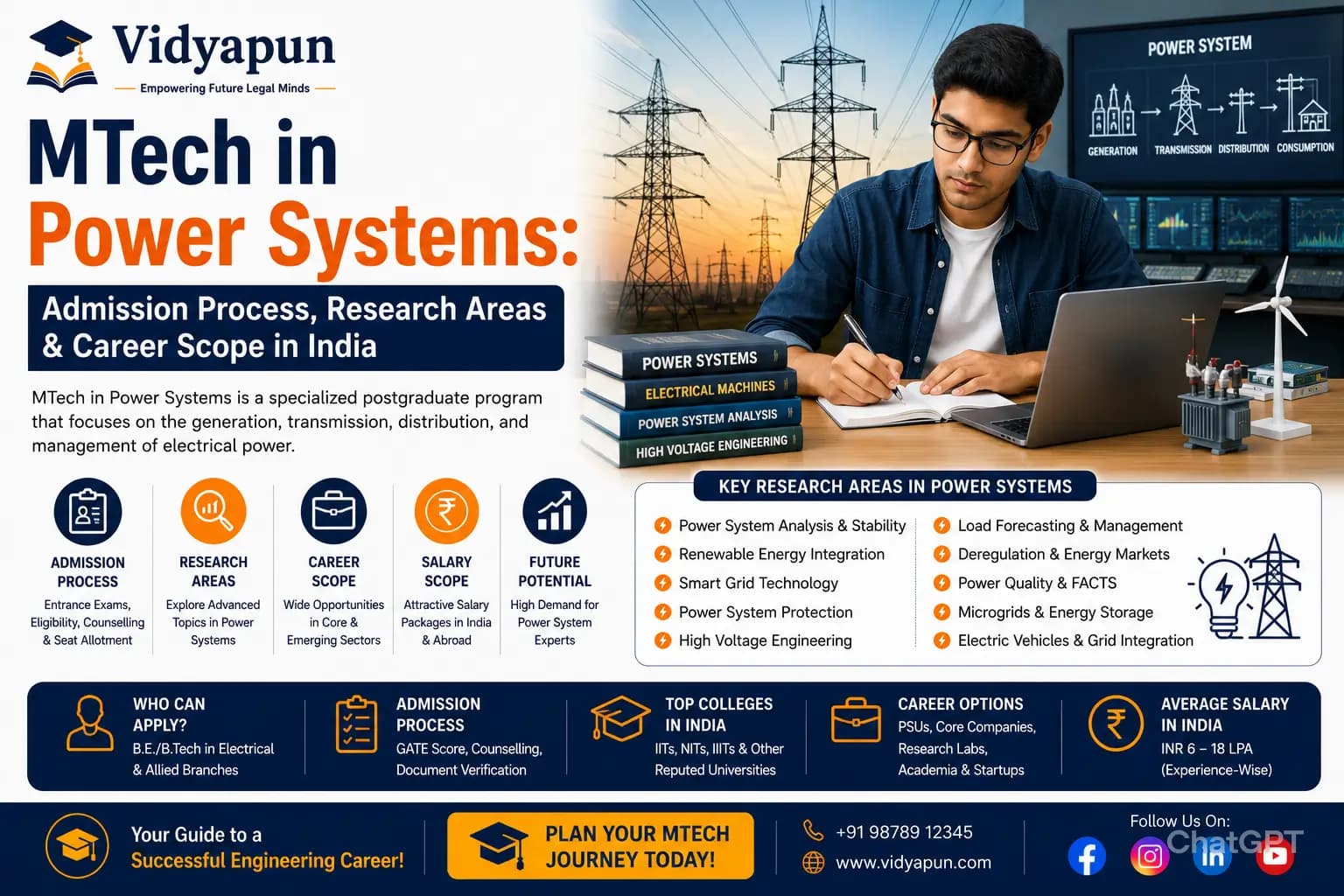
If you have ever thought about building a career that actually keeps the lights on — literally — then MTech in Power Systems might be the path you have been looking for. India is going through one of the biggest energy transitions in its history. From massive solar parks in Rajasthan to offshore wind farms along the Gujarat coast, the country is spending lakhs of crores to modernise its power grid. And behind all of it, there is a growing need for highly trained power systems engineers.
This guide covers everything you genuinely need to know — from MTech Power Systems admission criteria and top colleges in India, to research areas, job roles, and realistic salary expectations. Whether you are a fresh BE/BTech graduate or a working professional eyeing a specialisation upgrade, read on.
What Is MTech in Power Systems?
MTech in Power Systems is a two-year postgraduate engineering programme focused on the generation, transmission, distribution, and management of electrical power. Unlike a general MTech in Electrical Engineering, this specialisation goes deeper into topics like power grid stability, high-voltage systems, smart grid technology, renewable energy integration, and FACTS devices.
The programme is typically structured across four semesters — two semesters of coursework and two semesters dedicated to research or a major project. Some institutes also offer part-time or sponsored MTech options for working engineers.
MTech Power Systems Admission : Eligibility & Process
Eligibility Criteria
Most institutions offering MTech in Power Systems in India require the following:
- A BE/BTech degree in Electrical Engineering, Electrical and Electronics Engineering (EEE), or a closely related discipline
- Minimum aggregate of 55% to 60% marks (varies by institute; SC/ST candidates usually get a 5% relaxation)
- A valid GATE score in Electrical Engineering (EE paper) — this is the primary route for admission to NITs, IITs, and several state universities
GATE Score Requirement
The Graduate Aptitude Test in Engineering (GATE) is the standard gateway for MTech in Power Systems admission in India. A GATE score in the EE paper is accepted by almost all public institutions. The cutoff GATE scores for Power Systems MTech vary significantly:
- IITs: Typically 750+ (highly competitive)
- NITs: Generally 600–750 range
- State universities and private colleges: Often 400–600, and some accept without GATE
For GATE-qualified candidates, admissions also open up MHRD/AICTE scholarships (currently ₹12,400 per month for regular full-time students).
Non-GATE Admissions
Several private universities and deemed institutions offer direct admission based on BTech scores, entrance tests conducted by the university itself, or national-level tests like TANCET (Tamil Nadu), PGCET (Karnataka), or OJEE (Odisha). If you are a working professional, look for part-time or lateral entry MTech Power Systems options.
Top Colleges for MTech in Power Systems in India
Choosing the right college matters a lot — both for the quality of research facilities and for placement opportunities. Here are some of the most reputed institutions:
IITs (Indian Institutes of Technology)
- IIT Bombay, IIT Delhi, IIT Kharagpur, IIT Madras, IIT Roorkee, IIT Kanpur — all offer MTech in Power Systems or closely related specialisations under Electrical Engineering departments. Research infrastructure and industry connections here are top-tier.
NITs (National Institutes of Technology)
- NIT Trichy, NIT Warangal, NIT Calicut, NIT Surathkal, NIT Rourkela — strong MTech Power Systems programmes with good GATE-based admissions and decent placement records.
Other Government Institutions
- Delhi Technological University (DTU), BITS Pilani, Jadavpur University, PSG College of Technology, Andhra University College of Engineering
Private Universities
- VIT Vellore, SRM Institute, Amrita University, Manipal Institute of Technology — offer MTech in Electrical Engineering with Power Systems specialisation; some accept without GATE.
Always check individual institute websites for the latest fee structure, intake, and specialisation availability before applying.
MTech Power Systems Syllabus: Key Subjects
The exact syllabus varies by institution, but most MTech Power Systems programmes in India cover:
- Power System Analysis — load flow, fault analysis, stability studies
- HVDC Transmission and FACTS — high-voltage direct current systems, Flexible AC Transmission Systems
- Power Electronics for Power Systems — converters, inverters, drives
- Renewable Energy Systems — solar PV grid integration, wind energy, energy storage
- Smart Grid Technology — AMI, demand response, cyber-physical systems
- Power System Protection — relays, circuit breakers, coordinated protection schemes
- Energy Management Systems — EMS, SCADA, control centre operations
- Computational Methods in Power Engineering — simulation tools like PSCAD, MATLAB/Simulink, DIgSILENT PowerFactory
Alongside coursework, students undertake lab work, seminars, and a significant research dissertation, which often leads to conference publications or journal papers.
Research Areas in MTech Power Systems
This is where things get genuinely exciting. Power systems research in India is no longer just about conventional grid problems. Current high-impact research areas include:
1. Smart Grid and IoT Integration Building grids that can communicate, self-heal, and optimise energy flow in real time. Research here involves communication protocols, sensor networks, and data analytics for grid operations.
2. Renewable Energy Grid Integration With India targeting 500 GW of non-fossil fuel capacity by 2030, the challenge of integrating intermittent solar and wind power into a stable grid is massive. Research focuses on forecasting, voltage regulation, and frequency control.
3. Energy Storage Systems Battery energy storage (BESS), pumped hydro, and emerging technologies like hydrogen storage — researchers are working on how to size, control, and economically deploy these systems.
4. Power System Protection and Reliability Modern grids with distributed generation are harder to protect. Research explores adaptive relaying, wide-area protection systems, and reliability assessment under new grid conditions.
5. Electric Vehicle (EV) Grid Interaction Vehicle-to-grid (V2G) technology, EV charging infrastructure planning, and its impact on distribution networks — a rapidly growing area given India's EV push.
6. HVDC and Flexible AC Transmission Long-distance power transmission with minimal losses using HVDC links, and using FACTS devices to control power flow dynamically.
7. Microgrids and Distributed Energy Resources Rural electrification and islanded microgrids are a significant research focus in Indian context.
If you plan to pursue a PhD after MTech, or aim for R&D roles, picking a research area early and working on publications during your MTech is strongly recommended.
Career Scope After MTech in Power Systems in India
The career opportunities after MTech Power Systems are genuinely broad. Here is an honest breakdown:
Core Power Sector (Public Utilities)
- POWERGRID (Power Grid Corporation of India) — national transmission utility; recruits MTech graduates through GATE-based merit
- State Electricity Boards (SEBs) and Distribution Companies (DISCOMs)
- NTPC, NHPC, THDC, NEEPCO — generation companies with R&D and engineering roles
- Rural Electrification Corporation (REC), Power Finance Corporation (PFC)
Private Power Companies
- Tata Power, Adani Power, JSW Energy, Torrent Power, Greenko — all are expanding rapidly and need trained power engineers for operations, planning, and grid management.
Renewable Energy Companies
- ReNew Power, Acme Solar, Suzlon, Siemens Gamesa India, GE Renewable Energy — the renewable sector is arguably the hottest hiring ground for power systems engineers right now.
Consulting and Engineering Services
- L&T Power, Sterlite Power, KEC International, Kalpataru Projects — large EPC companies involved in transmission line projects, substation construction, and grid expansion.
PSU and Government Research Labs
- CPRI (Central Power Research Institute), BHEL, CSIR labs, DRDO
Teaching and Research
- With an MTech in Power Systems, you meet the minimum qualification for Assistant Professor positions in engineering colleges (as per UGC norms). Pursuing a PhD opens doors to IITs, NITs, and central universities.
International Opportunities
- Power systems engineers with MTech qualifications and experience are sought after in the Middle East (UAE, Saudi Arabia, Oman), Southeast Asia, and increasingly in European countries as they scale up renewable energy infrastructure.
MTech Power Systems Salary in India: What to Expect
Salaries depend heavily on the institution you graduate from, the sector you enter, and the specific role. Here is a realistic picture:
| Sector / Role | Starting Salary (CTC per annum) |
|---|---|
| POWERGRID / NTPC (E2/E3 grade) | ₹8 – 12 LPA |
| State DISCOM / SEB | ₹5 – 8 LPA |
| Private Power / EPC Companies | ₹6 – 12 LPA |
| Renewable Energy Sector | ₹7 – 15 LPA |
| Consulting / Analytics Firms | ₹8 – 18 LPA |
| IIT / NIT Placement (Top Picks) | ₹12 – 25 LPA |
| Abroad (Middle East / Europe) | ₹20 – 40+ LPA equivalent |
With 5–8 years of experience, senior power systems engineers in India typically earn ₹18–35 LPA in private sector roles, and government sector professionals earn significantly more through allowances and job security benefits.
Is MTech in Power Systems Worth It in 2026?
Honest answer: yes, if you are serious about the power and energy sector. The demand for skilled power systems engineers in India is real and growing — India is adding tens of thousands of MW of new capacity, building new transmission corridors, and rolling out smart metering across the country. Every one of these projects needs people who understand the technical fundamentals deeply.
What MTech does is give you the depth of knowledge and the credentials to access senior roles, R&D positions, and competitive PSU jobs that are harder to reach with just a BTech. If you get a GATE scholarship, the two years are also largely self-funded — making it a financially sound decision.
The one honest caveat: MTech in Power Systems is not a shortcut to software or IT salaries. If your goal is to move into data science or software, this may not be the right path. But if you genuinely want to work on grid infrastructure, renewable energy, or power technology — it is one of the better investments you can make in your engineering career.
Frequently Asked Questions (FAQs)
Q1. Can I do MTech in Power Systems without GATE? Yes. Several private universities and deemed institutions offer MTech in Power Systems without GATE through their own entrance tests or direct merit-based admissions. However, for NITs and IITs, a valid GATE score is mandatory.
Q2. What is the duration of MTech Power Systems in India? It is a two-year (four-semester) full-time programme. Some institutes offer part-time options of three to four years for working professionals.
Q3. Is there a scholarship for MTech in Power Systems? GATE-qualified candidates admitted to AICTE-approved institutions are eligible for the MHRD scholarship of ₹12,400 per month for the duration of the programme (subject to satisfactory academic performance).
Q4. What is the difference between MTech Power Systems and MTech Power Electronics? MTech Power Systems focuses on large-scale electricity networks — generation, transmission, distribution, grid stability, and smart grid technologies. MTech Power Electronics deals more with semiconductor devices, converters, drives, and embedded control. There is overlap, but the career trajectories differ — Power Systems leans toward utilities and grid companies, while Power Electronics is more aligned with industrial drives, EV systems, and consumer electronics.
Q5. Which GATE paper is required for MTech Power Systems? The Electrical Engineering (EE) paper of GATE is required for MTech in Power Systems admission. The syllabus includes power systems as a major section.
Q6. What are the best research topics for MTech Power Systems dissertation in India? Some high-relevance topics currently include smart grid cybersecurity, EV charging impact on distribution networks, optimal placement of FACTS devices, renewable energy forecasting using machine learning, and microgrid control strategies for rural electrification.
Q7. What software tools are used in MTech Power Systems? Common tools include MATLAB/Simulink, PSCAD, DIgSILENT PowerFactory, ETAP, PSS/E (Siemens), and HOMER (for microgrids and renewables). Familiarity with Python for power system data analysis is increasingly valued.
Take the Next Step in Your Power Engineering Career
If MTech in Power Systems aligns with your goals, the best time to start is now. Begin by shortlisting colleges based on your GATE score and research interests. Visit the official websites of your target institutions for the latest admission notifications — most release them between February and May for July admissions.
If you have not yet taken GATE, map out a preparation plan that focuses on Power Systems, Electrical Machines, and Control Systems — these carry the most weightage in the EE paper.
The Indian power sector is going through a transformation that happens once in a generation. The engineers who build their expertise now will have a role to play in it for decades. Your MTech in Power Systems could be the foundation of that career — start building it today.
Website: www.vidyapun.com
Call / WhatsApp: +91 96438 02216