Every time you cross a flyover, walk into a high-rise, or drive through a tunnel — there's a structural engineer behind that experience. Someone who calculated the loads, designed the reinforcement, and made sure the whole thing wouldn't come down.
If that kind of work excites you, MTech in Structural Engineering might be the most direct path to doing it at a serious, professional level.
But let's be honest — a lot of students pick this specialisation without fully understanding what the coursework involves, which colleges are actually worth attending, or what the job market looks like after graduation. This blog covers all three, without the fluff.
What Is MTech in Structural Engineering?
MTech in Structural Engineering is a two-year postgraduate programme that takes your BTech/BE in Civil Engineering and builds significantly on it. While your undergraduate degree gave you a broad foundation, this specialisation goes deep into the behaviour of structures — how they respond to loads, earthquakes, wind forces, temperature changes, and time.
The programme typically covers:
- Advanced Structural Analysis
- Finite Element Methods (FEM)
- Design of Steel and Concrete Structures
- Earthquake Engineering and Seismic Design
- Foundation Engineering and Soil-Structure Interaction
- Structural Dynamics
- Prestressed Concrete Design
- Computational Methods in Structural Engineering
- Structural Health Monitoring
- Repair and Rehabilitation of Structures
What separates MTech from a regular job is the depth of analytical thinking it demands. You stop designing structures by rule of thumb and start understanding why those rules exist — and when to push beyond them.
Why Choose Structural Engineering as Your MTech Specialisation?
India is in the middle of one of the largest infrastructure expansions in the world. Metro rail networks, elevated highways, smart city projects, coastal bridges, and high-rise residential towers — the scale is staggering, and none of it happens without structural engineers who know what they're doing.
Beyond the volume of work, there are specific reasons why structural engineering remains one of the most respected MTech specialisations in civil engineering:
Evergreen demand: Unlike some engineering niches that come and go with technology trends, structural engineering is foundational. Buildings and infrastructure will always need to be designed, analysed, and maintained.
GATE score utility: Structural engineering is one of the most common specialisations chosen by GATE Civil Engineering (CE) qualifiers for MTech admissions. A good GATE score opens doors to IITs, NITs, and other premier institutions.
Research depth: For those inclined toward academia or R&D, structural engineering offers rich research opportunities — from seismic retrofitting to smart materials to computational modelling.
Global mobility: Structural engineering qualifications from Indian premier institutions are respected internationally. Many MTech graduates go on to work in the Middle East, Southeast Asia, Europe, and North America.
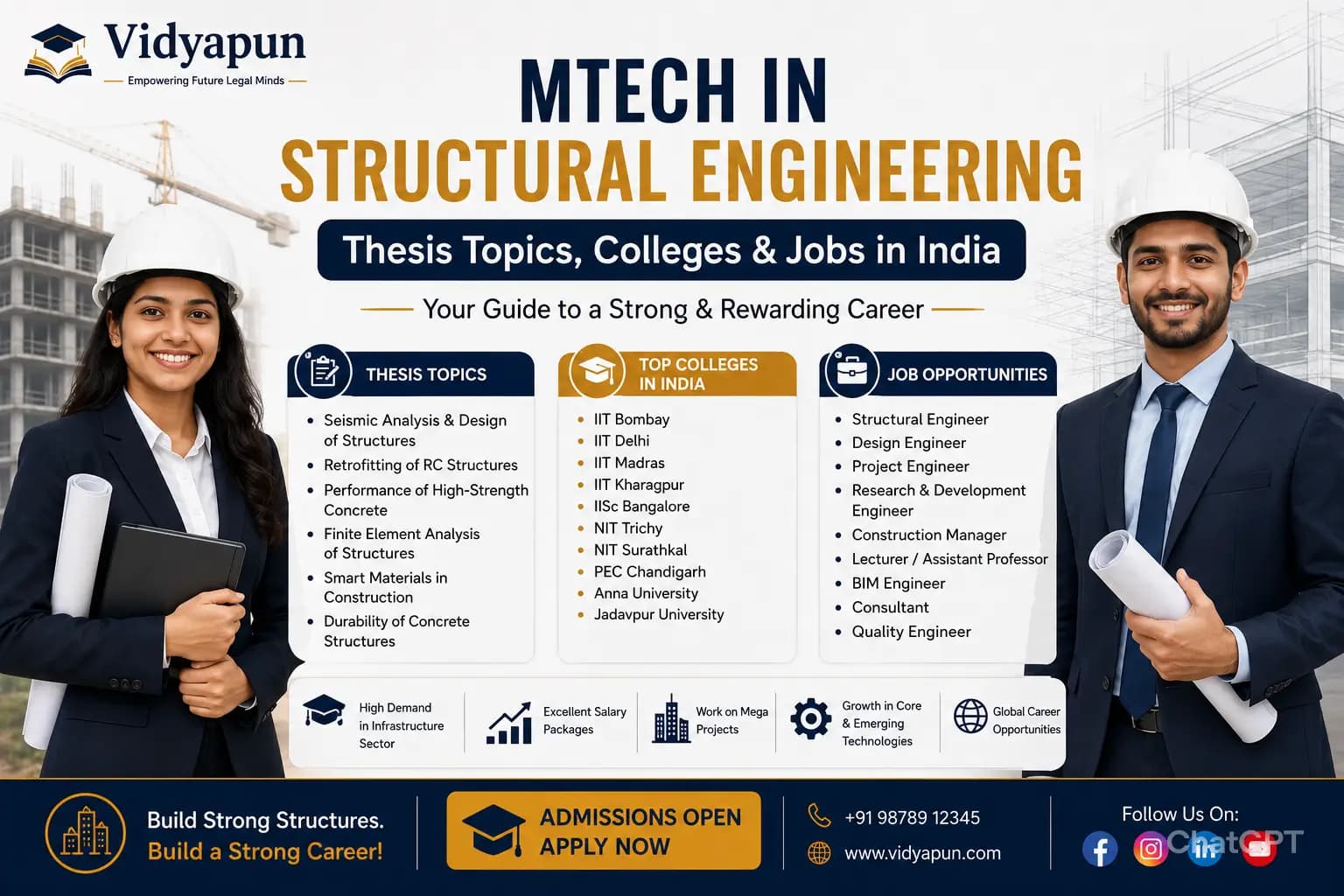
MTech Structural Engineering Thesis Topics in India
The thesis is the most important part of your MTech. It's where you go from learning concepts to contributing something — even if incrementally — to the field. Choosing the right topic matters for both your grades and your career trajectory.
Here are some current and relevant MTech structural engineering thesis topics that are receiving attention in Indian research circles:
Seismic and Earthquake Engineering
- Seismic performance evaluation of irregular RC buildings using pushover analysis
- Effect of soil-structure interaction on the seismic response of multi-storey buildings
- Retrofitting of existing structures for earthquake resistance using base isolation techniques
- Seismic vulnerability assessment of heritage structures in India
Finite Element Analysis and Computational Structural Engineering
- Nonlinear finite element analysis of reinforced concrete beams under cyclic loading
- Parametric study of flat slab behaviour using ANSYS/ABAQUS
- FEM-based analysis of long-span cable-stayed bridges under dynamic loads
Green and Sustainable Structural Materials
- Structural behaviour of concrete using industrial waste as partial cement replacement (fly ash, GGBS, silica fume)
- Performance of geopolymer concrete beams under flexure and shear
- Use of bamboo and recycled steel as sustainable structural materials in low-cost housing
Structural Health Monitoring
- Vibration-based damage detection in RC frame structures
- IoT-enabled real-time structural health monitoring of bridges
- Non-destructive testing (NDT) methods for evaluating existing concrete structures
Tall Buildings and Wind Engineering
- Wind load analysis on tall buildings using CFD simulation
- Behaviour of high-rise structures under combined wind and seismic loads
Repairs, Rehabilitation and Retrofitting
- Effectiveness of CFRP wrapping in strengthening RC columns
- Corrosion-induced deterioration in coastal RC structures and repair strategies
Choosing a topic that aligns with your guide's expertise and your own interest is far more important than picking something that sounds impressive. A well-executed study on something specific will always outperform a half-done study on a trendy topic.
Top Colleges for MTech in Structural Engineering in India
Admission to MTech Structural Engineering in India is primarily through GATE score (Civil Engineering paper). Here are the institutions consistently recognised for quality in this specialisation:
IITs (Indian Institutes of Technology)
- IIT Madras — One of the strongest structural engineering departments in the country, with active research in earthquake engineering and FEM
- IIT Bombay — Known for computational structural engineering and materials research
- IIT Delhi — Strong faculty in structural dynamics and seismic design
- IIT Kharagpur — Comprehensive programme with good industry linkages
- IIT Roorkee — Historical strength in earthquake engineering; Roorkee was the site of the first engineering college in Asia
- IIT Kanpur — Strong in structural mechanics and composite materials
NITs (National Institutes of Technology)
- NIT Trichy — One of the top NITs for civil and structural engineering
- NIT Warangal — Strong research output in structural engineering
- NIT Surathkal (NITK) — Good infrastructure and active structural lab
- NIT Calicut — Known for coastal and marine structural work
- MNIT Jaipur — Solid programme with decent GATE cutoffs
Other Notable Institutions
- BITS Pilani — Strong for those without GATE scores (merit-based admission)
- VIT Vellore — Growing research infrastructure
- PSG College of Technology, Coimbatore — Well-regarded in South India
- COEP Technological University, Pune — One of the older and more respected state engineering institutions
GATE cutoff for structural engineering MTech at IITs typically ranges from 700–800+ for general category, while NITs may start from 600–700 depending on the institution and year.
Jobs After MTech in Structural Engineering in India
Let's talk about what actually happens after you graduate. The career paths are more varied than most students expect.
1. Structural Design Engineer (Consulting Firms)
This is the most direct career path. Structural design consultancies — from large firms like L&T Engineering, Stup Consultants, Mott MacDonald, AECOM, and Jacobs to mid-size Indian practices — hire MTech graduates for design work on buildings, bridges, and infrastructure.
Starting salaries at reputed consultancies range from ₹6–12 LPA, with significant growth as you build project experience.
2. Government Engineering Services (UPSC ESE / State PSC)
The UPSC Engineering Services Examination (ESE) is highly competitive but extremely rewarding. MTech graduates from good institutions regularly crack this exam and join organisations like:
- Central Public Works Department (CPWD)
- National Highways Authority of India (NHAI)
- Railways (Bridge design divisions)
- Military Engineer Services (MES)
- Irrigation and flood control departments
3. Research and Development (CSIR, SERC, DRDO)
The Structural Engineering Research Centre (SERC) in Chennai, under CSIR, is one of India's premier structural research organisations. It regularly recruits MTech graduates for research positions. DRDO also has divisions working on structural applications for defence infrastructure.
4. Assistant Professor / Academic Career
MTech followed by a PhD is the standard route to academia. Given the large number of engineering colleges in India and the faculty shortage, academic careers in structural engineering are genuinely accessible — and offer stability, research freedom, and intellectual satisfaction.
5. Infrastructure Companies (EPC Sector)
Large EPC contractors — L&T Construction, Tata Projects, Shapoorji Pallonji, NCC Ltd — hire structural engineers for project execution roles. These are site-oriented jobs with faster salary growth and exposure to real-scale projects.
6. International Opportunities
Structural engineers with strong academic credentials and MTech from IITs/NITs regularly find opportunities in:
- GCC countries (UAE, Saudi Arabia, Qatar) — massive ongoing infrastructure projects
- Singapore and Southeast Asia
- UK and Europe (with professional licensure like PE or CEng)
MTech Structural Engineering Salary in India
| Job Role | Sector | Approximate Starting Salary |
|---|---|---|
| Structural Design Engineer | Private consultancy | ₹6–10 LPA |
| Assistant Engineer (ESE/PSC) | Government | ₹8–12 LPA (incl. allowances) |
| Research Scientist (SERC/CSIR) | R&D | ₹7–10 LPA |
| Assistant Professor | Academia | ₹8–14 LPA (NIT/IIT scale) |
| Site Engineer (EPC) | Infrastructure | ₹5–8 LPA |
| Structural Engineer (Abroad) | GCC/Europe | ₹15–35 LPA equivalent |
Salaries grow substantially with experience. A structural engineer with 8–10 years of experience in a reputed firm or government role can expect ₹20–40 LPA or more.
Frequently Asked Questions (FAQs)
Q1. What GATE score is required for MTech Structural Engineering at IITs? For top IITs like Madras, Bombay, and Delhi, a GATE score above 750 (out of 1000) in Civil Engineering is generally competitive. For NITs, a score of 600–700 is often sufficient depending on the year and category.
Q2. What is the duration and fee structure of MTech Structural Engineering at IITs? The programme is two years. At IITs, GATE-qualified students receive a stipend of ₹12,400 per month (revised periodically) under the MHRD scheme, making the net cost of studying very low.
Q3. Is MTech Structural Engineering good for UPSC Engineering Services Exam preparation? Yes. The advanced knowledge of structural analysis, design, and materials directly supports the civil engineering paper in UPSC ESE. Many ESE toppers have MTech backgrounds.
Q4. Can I do MTech Structural Engineering without a GATE score? Some private institutions like BITS Pilani, VIT, and SRM offer MTech admissions based on their own entrance tests or merit. However, for IITs and NITs, GATE is mandatory.
Q5. What software skills are important for MTech Structural Engineering students? STAAD.Pro, ETABS, SAP2000, ANSYS, ABAQUS, and AutoCAD are the most widely used. Learning FEM-based analysis software like ABAQUS or ANSYS is particularly valuable for research and high-end consultancy roles.
Q6. What is the scope of MTech Structural Engineering for research abroad? Very good. Graduates from IITs with strong thesis work regularly get admitted to PhD programmes at universities in the US, UK, Germany, Australia, and Canada. Structural engineering research is well-funded globally.
Q7. Is structural engineering a good career long-term in India? Absolutely. With India's infrastructure pipeline valued at trillions of rupees over the next two decades — including the National Infrastructure Pipeline (NIP) and smart city projects — the demand for qualified structural engineers will remain strong for the foreseeable future.
The Bottom Line
MTech in Structural Engineering is one of those degrees where the investment — two years, GATE preparation, thesis work — pays off clearly and consistently. The career paths are real, the salaries are competitive, and the work itself is the kind that leaves something permanent behind.
Whether you want to design earthquake-resistant buildings, research advanced structural materials, crack the UPSC ESE, or eventually teach at an NIT — this programme gives you the technical depth to do any of it seriously.
The key is picking the right institution, choosing a thesis topic you're genuinely curious about, and using the two years to build skills beyond the classroom.
Ready to Take the Next Step?
If you're preparing for GATE Civil Engineering and targeting MTech in Structural Engineering — or if you're already an MTech graduate exploring career options — the right guidance at the right time makes all the difference.
Explore the top colleges, understand the admission process, and start building your roadmap today. Your infrastructure career doesn't have to wait.
Website: www.vidyapun.com
Call / WhatsApp: +91 96438 02216