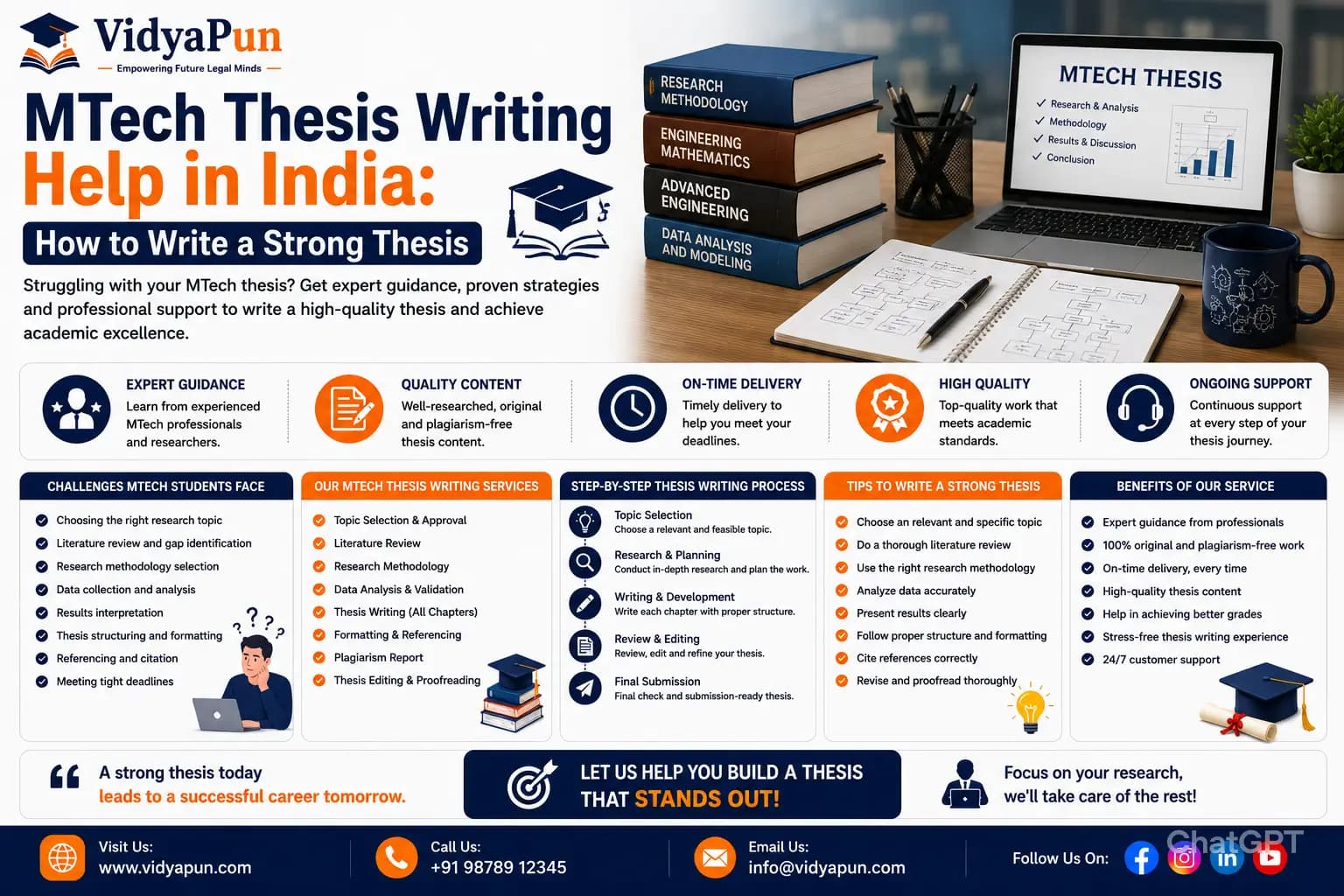
There's a particular kind of stress that hits MTech students somewhere around the second semester — the moment when the coursework is winding down and the thesis looms large on the horizon. You've cleared your subjects, survived lab sessions, maybe even published a paper or two. But the thesis? That's a different beast entirely.
And the frustrating part is that nobody really teaches you how to write one.
Most MTech programs in India spend two years preparing students to be strong engineers and researchers — but very little time is devoted to the craft of actually writing a thesis. The result? Technically capable students producing poorly structured, weakly argued documents that don't do justice to the research they've done.
This guide exists to change that. Whether you're just starting your MTech thesis or you're deep in the middle of it and feeling lost — here's a clear, practical, honest breakdown of how to write a strong MTech thesis in India.
What Is an MTech Thesis and Why Does It Matter?
An MTech thesis is an original research document that demonstrates your ability to independently identify an engineering or technical problem, conduct systematic research, and contribute new knowledge or solutions to your field.
It's not a project report. It's not a literature survey. It's a sustained, structured argument that says: here is a real problem, here is what the existing work says about it, here is what I did differently, and here is what I found.
The thesis typically contributes 40–60% of your final MTech grade depending on the institution. More importantly, it defines your research profile — for PhD admissions, for research-oriented jobs, and for publications. A well-written MTech thesis can lead to journal papers, conference presentations, and even patents. A poorly written one closes those doors.
MTech Thesis vs MTech Project — What's the Difference?
This distinction matters and often confuses students.
An MTech project is typically completion-oriented — you build something, implement a system, or apply existing methods to a new dataset. The emphasis is on deliverable output.
An MTech thesis is research-oriented — it requires an original contribution to knowledge, a clear research gap identified from existing literature, and findings that can withstand peer scrutiny. Most IITs, NITs, and research-focused universities require a full thesis rather than a project report.
Know which one your institution requires. The writing approach, depth of literature review, and evaluation criteria are significantly different.
Step-by-Step Guide to Writing a Strong MTech Thesis in India
Step 1 — Choose the Right Research Topic
Everything starts here. A weak topic makes every subsequent step harder. A strong topic gives your thesis direction, relevance, and momentum.
What makes a good MTech thesis topic?
It must have a clear research gap. Your topic should address something that existing literature hasn't fully solved. You don't need to revolutionize your field — even a novel application of an existing method to a new domain counts as an original contribution.
It should be feasible within your timeframe. MTech students typically have 12–18 months for thesis work. The scope must be realistic. Avoid topics that require massive datasets you can't access or experimental setups your lab doesn't have.
It should align with your guide's expertise. Your thesis supervisor's research background matters. A supervisor who knows your domain can give you meaningful feedback. One who doesn't will approve everything and help you with nothing.
It should have publication potential. The best MTech thesis topics are ones where your findings can be submitted to a journal or conference. This is increasingly important for PhD admissions and academic career building.
Where to find topic ideas:
- Recent papers in IEEE Xplore, Springer, ScienceDirect, and arXiv in your specialization
- Unsolved problems mentioned in the future work sections of existing papers
- Problems your supervisor is currently researching
- Industry challenges in your engineering domain
Step 2 — Conduct a Thorough Literature Review
The literature review is the most underestimated chapter in an MTech thesis. Most students treat it as a chore — summarizing ten papers and moving on. That's a mistake.
A strong literature review does three things:
It shows you understand the field. Reviewers and examiners want to see that you've engaged seriously with existing work — not just skimmed abstracts.
It establishes the research gap. By showing what has been done and where the limitations lie, you set up the justification for your own work.
It defines your theoretical framework. The methods and models you use in your research should emerge logically from what you've reviewed.
Practical tips for the literature review:
Use Google Scholar, IEEE Xplore, Scopus, and Web of Science as primary databases. Focus on papers from the last five to seven years unless citing foundational work. Organize papers thematically — not chronologically. Always read the full paper, not just the abstract. Use reference management tools like Zotero or Mendeley to organize your citations from day one.
A strong MTech literature review is typically 4,000–6,000 words and engages with at least 40–60 relevant papers.
Step 3 — Define Your Research Objectives and Methodology
Once your literature review is drafted, you should be able to clearly state:
- What specific problem are you solving?
- What are your research objectives? (Usually 3–5 clear, measurable objectives)
- What methodology will you use to achieve them?
Your methodology chapter should explain exactly how you conducted your research. For engineering students, this typically includes:
- System design or algorithm development
- Experimental setup and dataset description
- Tools, platforms, and programming languages used
- Evaluation metrics and validation approach
- Any assumptions or constraints
Be precise. Vague methodology chapters are one of the most common weaknesses examiners flag in MTech theses.
Step 4 — Structure Your MTech Thesis Correctly
Here's a standard MTech thesis structure followed at most Indian universities including IITs and NITs:
Chapter 1 — Introduction Background of the problem, motivation for the research, problem statement, research objectives, scope and limitations, and overview of the thesis structure. Keep this chapter concise — typically 8–12 pages.
Chapter 2 — Literature Review Comprehensive review of existing work organized by theme or sub-topic. End with a clear articulation of the research gap your work addresses.
Chapter 3 — Research Methodology / System Design Detailed explanation of your research approach, design choices, tools used, and the experimental or analytical framework.
Chapter 4 — Implementation / Experimental Work The technical core of your thesis. For CS/IT students, this is where you describe your algorithm, system architecture, or model. For ECE/EEE students, this covers circuit design, simulations, or hardware implementation. For mechanical or civil engineering students, this covers simulations, structural analysis, or prototype development.
Chapter 5 — Results and Discussion Present your results clearly — using tables, graphs, and comparative analysis. Discuss what the results mean, how they compare to existing benchmarks, and what their limitations are. This chapter separates average theses from strong ones.
Chapter 6 — Conclusion and Future Work Summarize your contributions, state what your research achieved, acknowledge limitations honestly, and suggest directions for future research.
References / Bibliography Formatted according to your university's prescribed style — IEEE format is standard for most engineering theses in India.
Appendices (if applicable) Code, raw data, additional figures, or experimental details that are too detailed for the main chapters.
Step 5 — Write With Clarity, Not Complexity
This is something very few guides tell MTech students — and it's important.
Technical writing is not about sounding impressive. It's about communicating clearly. Many students believe that using complex sentences and heavy jargon makes their thesis look more scholarly. It doesn't. It makes it harder to read and easier to misunderstand.
Good MTech thesis writing is:
- Precise — every word earns its place
- Logical — each section flows from the one before it
- Consistent — terminology, notation, and abbreviations are used uniformly throughout
- Evidence-based — every claim is backed by data, citation, or your own experimental results
Write in the third person or passive voice where required by your university guidelines. Avoid first-person statements unless your institution permits them.
Step 6 — Avoid These Common MTech Thesis Mistakes
Starting the write-up too late. Research and writing should happen in parallel, not sequentially. Maintain a running draft from the first month.
Weak problem statement. If you can't explain your research problem in three clear sentences, you haven't understood it well enough yet.
Ignoring formatting guidelines. Every university has a thesis formatting template — font size, margin width, line spacing, header style. Deviations look careless and sometimes lead to rejection at the submission stage.
Insufficient results discussion. Presenting results as tables and graphs without interpreting them is not analysis. What do your results mean? How do they compare to existing work? What are their implications?
Plagiarism — even unintentional. Always paraphrase and cite. Run your thesis through iThenticate or Turnitin before submitting. Most Indian universities have a similarity index threshold — typically under 10–15%.
MTech Thesis Writing Tips Specific to Indian Universities
A few things that matter specifically in the Indian MTech thesis context:
GATE-qualified students at IITs and NITs are expected to produce research-quality theses that can yield at least one journal publication. The bar is higher than at most state universities.
Synopsis submission is mandatory at most Indian universities before thesis writing begins. Treat the synopsis seriously — it's essentially your research proposal and sets the evaluation criteria for your final thesis.
Thesis viva voce (oral defense) is part of the evaluation at most institutions. Examiners will probe your methodology, results, and understanding of the subject. Know your thesis inside out.
Journal publication — many Indian universities now require or strongly encourage MTech students to publish at least one paper from their thesis work. Target SCI-indexed journals or reputed IEEE/Springer conferences in your domain.
FAQs — MTech Thesis Writing in India
Q1. How long should an MTech thesis be in India? Most Indian universities expect MTech theses between 80 to 150 pages (excluding appendices and references). Word count typically ranges from 20,000 to 40,000 words depending on the engineering domain and institution.
Q2. How do I find a good MTech thesis topic? Start by reading recent papers in your specialization. Look for "future work" sections — they're a goldmap of unsolved problems. Discuss with your supervisor and align with their active research areas for better guidance.
Q3. What is the best referencing style for MTech thesis in India? IEEE referencing format is standard for most engineering disciplines in India. Some universities prefer APA or a custom format. Always follow your university's thesis handbook.
Q4. How do I avoid plagiarism in my MTech thesis? Cite every source, paraphrase carefully, avoid copy-pasting even from your own earlier work without citation, and run your draft through plagiarism detection software before submission. Most universities accept a similarity index below 10–15%.
Q5. Can my MTech thesis lead to a journal publication? Yes — and it should. A well-conducted MTech thesis in a focused area often yields one or two publishable papers. SCI-indexed journals, IEEE Transactions, and Springer journals in your domain are good targets.
Q6. How important is the literature review in an MTech thesis? Extremely important. A strong literature review demonstrates that you understand the field, identifies the research gap your work addresses, and justifies your methodology. Examiners pay close attention to it.
Q7. What happens if my MTech thesis is rejected? Most universities allow revision and resubmission within a specified time frame. Address all examiner comments systematically and thoroughly. A rejection at the first submission is not uncommon — it's a feedback opportunity, not a failure.
Final Thoughts
Writing a strong MTech thesis in India is one of the most demanding academic tasks you'll face — but also one of the most professionally valuable. The research skills, technical writing ability, and independent thinking it develops will serve you well whether you head toward a PhD, a research role in industry, or a senior technical position.
The students who produce the best theses aren't always the most technically brilliant. They're the ones who start early, stay organized, engage deeply with their literature, and keep asking: am I solving a real problem, and am I explaining it clearly?
Every chapter matters. Every citation counts. Every revision makes it stronger.
Website: www.vidyapun.com
Call / WhatsApp: +91 96438 02216