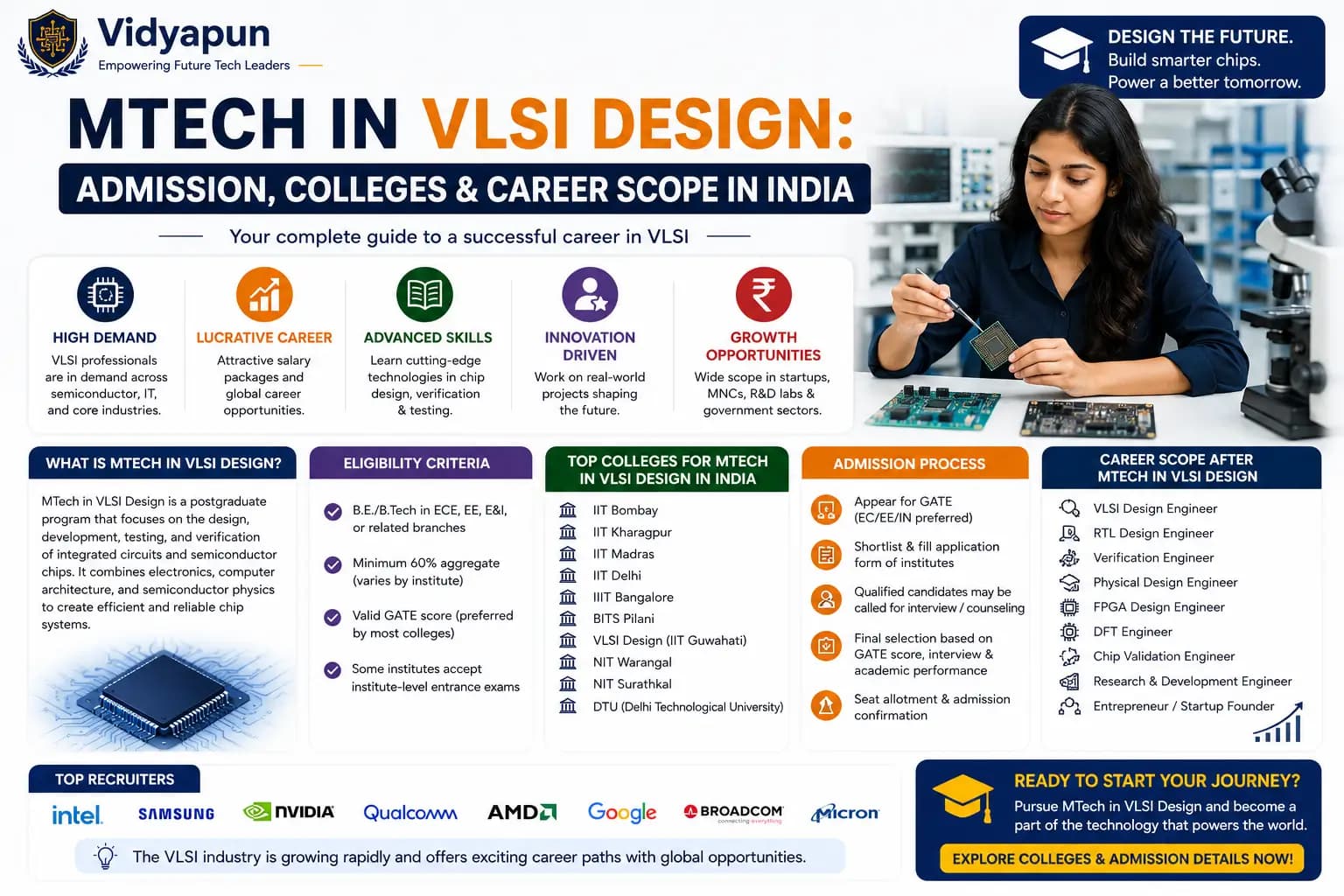
If you have ever wondered what goes inside a chip that powers your smartphone, laptop, or even a satellite — that is the world of VLSI. And if you want to build that world professionally, an MTech in VLSI Design might just be the right path for you.
What Is MTech in VLSI Design?
MTech in VLSI Design is a two-year postgraduate engineering programme focused on the design, fabrication, and testing of integrated circuits (ICs) and semiconductor devices. VLSI stands for Very Large Scale Integration — a technology that allows engineers to pack millions (sometimes billions) of transistors onto a single microchip.
This specialisation sits at the intersection of electronics, computer architecture, and semiconductor physics. Students learn everything from digital circuit design and analog layout to FPGA programming and chip verification — skills that are in serious demand right now, especially after India's big push into semiconductor manufacturing.
Why Choose MTech VLSI Design in 2024?
Here is something most people do not talk about openly: India is currently facing a massive shortage of VLSI engineers. With the Indian government launching the India Semiconductor Mission (ISM) and global giants like Micron, Samsung, and TATA investing in chip fabrication plants in India, the demand for trained VLSI professionals has shot up sharply.
An MTech in VLSI Design gives you:
- Deep technical expertise that a B.Tech alone cannot provide
- Access to research-level lab infrastructure
- Better placement opportunities in core semiconductor companies
- A pathway into PhD programmes or R&D roles
If you are a B.Tech graduate in ECE, EEE, or related fields and you enjoy working with circuits and hardware, this specialisation is worth serious consideration.
MTech VLSI Design Eligibility Criteria
Before you start shortlisting colleges, make sure you meet the basic eligibility requirements:
- A B.Tech or BE degree in Electronics, ECE, EEE, Instrumentation, or Computer Science from a recognised university
- Minimum 55–60% aggregate marks (varies by institution)
- A valid GATE score in EC (Electronics and Communication) or IN (Instrumentation Engineering) for most government colleges
- Some private universities also accept scores from TANCET, PGCET, or their own entrance tests
One important thing to note — GATE is not just an eligibility filter here. For admission to IITs, NITs, and IIITs, a strong GATE score is non-negotiable. The cutoffs for VLSI specialisation at top institutes can be competitive, so start your GATE preparation early.
MTech VLSI Design Admission Process
The general admission process follows these steps:
Step 1 — Appear in GATE Register and appear for GATE in the EC or relevant paper. Results are usually declared in March.
Step 2 — Apply Through COAP or Institute Portals IITs use the COAP (Common Offer Acceptance Portal) for centralised seat allotment. NITs use CCMT (Centralised Counselling for M.Tech). Private colleges have their own portals.
Step 3 — Shortlisting and Interview Some IITs call shortlisted candidates for a written test or personal interview before final admission.
Step 4 — Document Verification and Fee Payment Once selected, complete the formalities and secure your seat before the deadline.
The academic session for most institutes begins in July–August. Keep an eye on official notifications from individual colleges, as deadlines vary.
Top Colleges for MTech VLSI Design in India
Choosing the right college makes a significant difference — not just for the degree, but for the labs, faculty, and placement network you get access to.
Government / Premier Institutes
IIT Bombay — One of the best places in India for VLSI research. The Department of Electrical Engineering offers an excellent MTech programme with strong industry collaboration.
IIT Madras — Known for its VLSI design lab and research work in semiconductor devices. Alumni are placed across global chip design companies.
IIT Kharagpur — Offers MTech in VLSI Design under the Electronics and Electrical Communication Engineering department. Strong research output in embedded systems and chip design.
IIT Delhi — Good faculty strength in analog and mixed-signal VLSI. The institute also has active industry tie-ups with companies like Intel and Qualcomm.
NIT Trichy — Among the top NITs for MTech in VLSI Design. Consistently strong placement record in core electronics companies.
NIT Warangal — Another strong NIT option with a well-structured VLSI curriculum and decent placement support.
BITS Pilani — Offers MTech in Microelectronics (closely related to VLSI) at its Pilani and Hyderabad campuses. Strong alumni network in the semiconductor sector.
Private Colleges Worth Considering
- VIT Vellore — Decent infrastructure, accepts GATE and TANCET scores
- Manipal Institute of Technology — Good for students who want a mix of coursework and industry exposure
- SRM Institute of Science and Technology — Affordable option with reasonable placement assistance
Always check NIRF rankings, NAAC accreditation, and placement data before finalising any private college.
MTech VLSI Design Syllabus: What Will You Study?
The curriculum typically spans four semesters and covers:
Semester 1 & 2 — Core Subjects
- Digital VLSI Design
- Analog and Mixed-Signal Circuits
- CMOS Technology and Fabrication
- HDL Programming (Verilog / VHDL)
- Electronic Design Automation (EDA) Tools
Semester 3 — Electives and Specialisation
- Low Power VLSI Design
- FPGA-Based System Design
- SoC (System on Chip) Design
- RF Circuit Design
- Signal Integrity and Timing Analysis
Semester 4 — Thesis / Dissertation Most programmes dedicate the final semester entirely to a research thesis or industry project. This is where you get hands-on experience with real chip design challenges — and it is also what recruiters look at very closely.
MTech VLSI Design Fees
Fee structures differ a lot depending on the type of institution:
| Institution Type | Approximate Annual Fees |
|---|---|
| IITs | ₹25,000 – ₹1,00,000 |
| NITs | ₹50,000 – ₹1,50,000 |
| BITS Pilani | ₹2,00,000 – ₹3,00,000 |
| Private Universities | ₹1,50,000 – ₹4,00,000 |
Gate-qualified students admitted to IITs and NITs often receive a monthly stipend of ₹12,400 under the MHRD scheme, which effectively offsets a significant portion of the fee and living expenses.
Career Scope After MTech in VLSI Design
This is where things get genuinely exciting. The global semiconductor industry is projected to cross $1 trillion by 2030, and India is positioning itself as a key player in chip design and manufacturing. For MTech VLSI graduates, this means the job market is only going to grow stronger.
Top Job Roles
- VLSI Design Engineer — Works on RTL design, synthesis, and verification of digital circuits
- Physical Design Engineer — Handles the layout, floorplanning, and timing closure of chips
- Verification Engineer — Tests and validates chip designs using simulation tools
- Analog Layout Engineer — Designs analog circuits for mixed-signal chips
- FPGA Engineer — Programs FPGAs for prototyping and embedded applications
- DFT (Design for Testability) Engineer — Ensures chips can be tested efficiently post-fabrication
- Applications Engineer — Works with customers to support chip integration at the system level
Top Recruiters
Companies actively hiring MTech VLSI graduates in India include:
- Qualcomm, Intel, Texas Instruments, Nvidia — Global giants with large R&D centres in Bangalore and Hyderabad
- Cadence Design Systems, Synopsys, Mentor Graphics — EDA tool companies that need VLSI-trained engineers
- Samsung Semiconductor India, MediaTek, Broadcom — Fabless chip design companies
- ISRO, DRDO, C-DAC — Government R&D organisations with niche but prestigious roles
- Tata Elxsi, Wipro VLSI, HCL Technologies — Indian IT companies with growing semiconductor divisions
MTech VLSI Design Salary in India
Fresh MTech VLSI graduates from top institutes can expect:
- Entry-level salary: ₹6 – ₹12 LPA
- Mid-level (3–5 years experience): ₹15 – ₹25 LPA
- Senior roles (7+ years): ₹30 – ₹50+ LPA
Engineers who move into physical design or analog roles at product companies tend to command premium salaries compared to service-side roles.
MTech VLSI vs B.Tech ECE: Should You Pursue It?
If you already have a B.Tech in ECE and are comfortable with digital electronics, then MTech VLSI Design is a natural upgrade. It narrows your focus, deepens your expertise, and makes you far more employable in core hardware roles.
However, if your interest lies in software, IT, or management — MTech VLSI is not the right fit. This is a deeply technical, hardware-intensive programme. You will be spending a lot of time on simulation tools, HDL coding, and circuit analysis. The people who thrive here genuinely enjoy working close to the hardware.
Frequently Asked Questions (FAQs)
Q1. Is GATE compulsory for MTech VLSI Design admission? For IITs and NITs, yes — a valid GATE score is mandatory. Some private universities offer admission without GATE, but those programmes may not carry the same academic or placement value.
Q2. Which GATE paper should I appear for MTech VLSI? Most VLSI-focused programmes prefer GATE EC (Electronics and Communication Engineering). Some institutes also accept GATE IN (Instrumentation) or GATE EE depending on their department.
Q3. What is the scope of MTech VLSI Design in India after 2024? The scope is very strong. With India's semiconductor mission and large-scale fab investments, demand for VLSI engineers is at an all-time high. Both chip design and fabrication sectors are actively hiring.
Q4. Can a computer science graduate do MTech in VLSI Design? Some institutes do accept CS graduates, but most programmes prefer students from ECE, EEE, or Electronics backgrounds due to the hardware-heavy curriculum. Check individual institute eligibility before applying.
Q5. What software tools are used in MTech VLSI programmes? Commonly used EDA tools include Cadence Virtuoso, Synopsys Design Compiler, Mentor ModelSim, Xilinx Vivado, and HSPICE. Familiarity with Verilog or VHDL is expected from the beginning.
Q6. Is MTech VLSI Design good for research and PhD? Absolutely. If you are interested in semiconductor research, VLSI is one of the most active areas for PhD work — both in India (IITs, IISc) and abroad (MIT, Stanford, TU Delft).
Q7. What is the difference between MTech VLSI and MTech Embedded Systems? MTech VLSI focuses on chip design and semiconductor processes, while MTech Embedded Systems is more about programming hardware (microcontrollers, RTOS, firmware). VLSI is closer to the silicon; embedded is closer to the software layer running on it.
Final Thoughts: Is MTech VLSI Design Worth It in 2024?
Honestly — yes, if hardware is your thing.
The semiconductor industry is not going anywhere. In fact, it is becoming more central to everything — from defence and aerospace to consumer electronics and AI hardware. India is investing heavily in building a domestic chip ecosystem, and that means opportunities for trained VLSI engineers are going to multiply over the next decade.
An MTech in VLSI Design from a good college does three things for you: it builds genuine technical depth, it connects you with a strong peer and alumni network, and it opens doors to companies that simply do not hire without that specialised background.
Thinking about applying for MTech VLSI Design but not sure which college suits your GATE score and budget? Or need help comparing programmes across IITs and NITs?
Drop your details below and get a free personalised college shortlist — we will match you with the best MTech VLSI programmes based on your profile, preferences, and career goals. No spam, just straight answers.
Website: www.vidyapun.com
Call / WhatsApp: +91 96438 02216