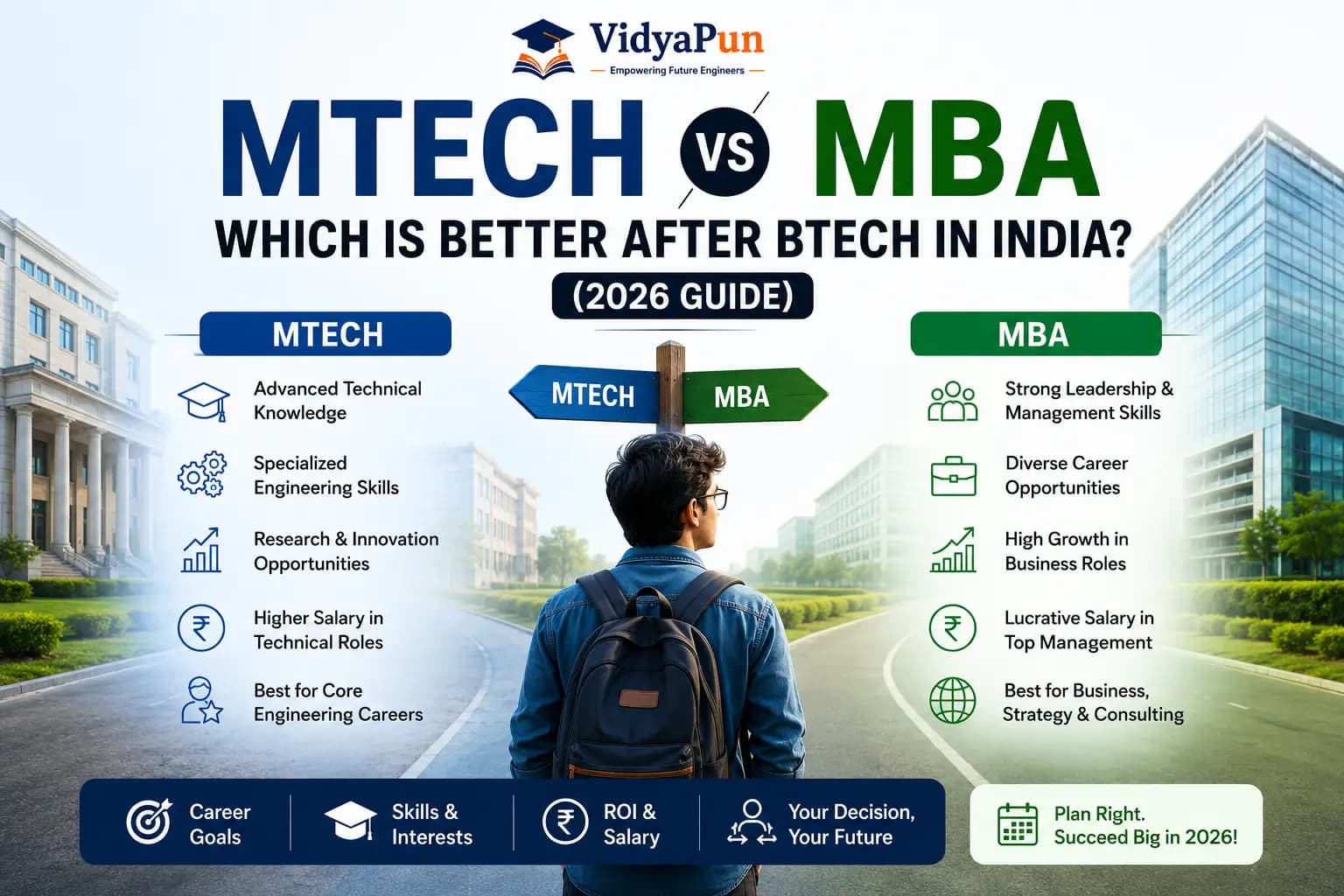
You just finished your BTech. Four years of late nights, lab reports, and coding assignments — and now everyone around you seems to have an opinion on what you should do next.
"Do MTech, you'll get into research." "No, no — MBA is the future. Get into management."
Sound familiar?
Here's the honest truth: there's no single right answer. MTech vs MBA after BTech is one of the most debated career decisions among Indian engineering graduates, and the choice completely depends on where you want to be five years from now. But to make that call confidently, you need clarity — not just opinions.
This 2026 guide breaks down everything: salary expectations, career scope, entrance exams, ROI, and real-world factors that most articles quietly ignore.
MTech vs MBA After BTech — The Core Difference
Before comparing, let's be clear about what each degree actually does for you.
An MTech (Master of Technology) deepens your technical expertise in a specific engineering domain — think VLSI design, machine learning, structural engineering, or thermal systems. It's built for people who genuinely love the technical side and want to go deeper, not broader.
An MBA (Master of Business Administration), on the other hand, shifts your focus entirely. It trains you to think like a manager — understanding markets, leading teams, making financial decisions, and building business strategy. For a BTech graduate, it's essentially a pivot from engineer to business leader.
Both are respected. Both open doors. But they open very different doors.
Who Should Choose MTech After BTech?
MTech makes sense when your ambitions are rooted in technical depth. Here's who typically thrives in this path:
Choose MTech if you:
- Want to work in R&D, product engineering, or core technical roles
- Are considering a PhD or an academic career in the future
- Have a strong GATE score and want to leverage it for PSU recruitment
- Prefer working with systems, algorithms, or hardware over managing people
- Are targeting companies like ISRO, DRDO, Intel, Qualcomm, or BARC
Top institutions for MTech in India (2026): IITs, NITs, IISC Bangalore, and IIITs remain the gold standard. Admission is primarily through GATE, and a high GATE percentile (typically 95+) gets you into the top IITs.
Average MTech salary (2026 placement data):
- IIT MTech graduates: ₹12–28 LPA (core technical roles)
- NIT MTech graduates: ₹7–15 LPA
- Research-focused roles: ₹8–18 LPA
One thing most people overlook — MTech from a top IIT or IISc often carries more weight in specialized technical hiring than an MBA from a mid-tier B-school. Keep that in mind.
Who Should Choose MBA After BTech?
An MBA after BTech is arguably the more popular route in 2026, and for good reason. It unlocks leadership tracks, higher management salaries, and opens doors to consulting, product management, investment banking, and startup ecosystems.
Choose MBA if you:
- Want to transition from technical execution to business leadership
- Are interested in product management, consulting, or entrepreneurship
- Already have 2–3 years of work experience (strongly recommended for top IIMs)
- Want to build a network across industries, not just your engineering domain
- Are targeting roles at McKinsey, Bain, Goldman Sachs, Amazon (PM roles), or building your own startup
Top institutions for MBA in India (2026): IIM Ahmedabad, IIM Bangalore, IIM Calcutta (the holy trinity), followed by IIM Lucknow, IIM Kozhikode, ISB Hyderabad, FMS Delhi, and XLRI Jamshedpur.
Admission is through CAT (for IIMs), XAT (for XLRI), or GMAT (for ISB). CAT 99+ percentile is typically needed for IIM A, B, or C.
Average MBA salary (2026 placement data):
- IIM A/B/C: ₹25–35 LPA (median); top offers go up to ₹70 LPA+
- Tier-2 IIMs: ₹12–20 LPA
- ISB Hyderabad: ₹24–30 LPA (post-experience MBA)
MTech vs MBA: Head-to-Head Comparison
| Factor | MTech | MBA |
|---|---|---|
| Course Duration | 2 years | 2 years (PGP) / 1 year (ISB) |
| Entrance Exam | GATE | CAT / XAT / GMAT |
| Ideal For | Technical depth | Business leadership |
| Work Ex Required? | No | Preferred (2–3 years) |
| Average Fees | ₹50K–3L (IITs/NITs) | ₹10L–25L (top IIMs) |
| ROI Timeline | 3–5 years | 2–4 years |
| Job Profiles | R&D Engineer, Data Scientist, VLSI Designer | Consultant, Product Manager, Finance Analyst |
| PSU Recruitment | Yes (GATE score valid) | No |
| Entrepreneurship Fit | Moderate | High |
Salary Comparison: MTech vs MBA in 2026
Let's talk numbers — because that's what most people actually want to know.
Fresher salaries (immediately after degree):
An IIT MTech graduate in computer science or AI can realistically expect ₹15–28 LPA from top tech companies in 2026. That's genuinely competitive. However, IIM MBA graduates from the top three campuses consistently land median packages of ₹26–35 LPA, with many consulting and finance roles crossing ₹50 LPA.
Mid-career (5–10 years post-degree):
Here's where the MBA starts to really pull ahead — but only if you're targeting management. An MTech professional who stays in core engineering can earn ₹25–40 LPA at senior levels. An MBA from a top school in consulting or investment banking can reach ₹60–1 Cr+ CTC.
But here's the flip side: many BTech + MTech professionals who moved into data science, AI research, or deep tech roles are earning ₹40–80 LPA by 2026, especially with experience at FAANG-level companies.
The salary gap narrows significantly when you factor in the MBA's higher upfront investment (fees of ₹20–25L at IIMs vs almost negligible fees at IITs for MTech).
ROI Analysis: Which Degree Gives Better Returns?
This is the question everyone dances around. Let's be direct.
MTech ROI:
- Fees: ₹50,000 – ₹3 Lakhs (IIT/NIT)
- Stipend during study: ₹12,400–15,000/month (GATE scholarship)
- Break-even: Within 1–2 years of placement
- Long-term ROI: High for core tech, R&D, and PSU roles
MBA ROI:
- Fees: ₹20–25 Lakhs (IIM A/B/C)
- No stipend; opportunity cost of 2 years
- Break-even: 2–4 years post-placement
- Long-term ROI: Very high if you land consulting, finance, or leadership roles
Conclusion: MTech has a lower financial risk. MBA has a higher potential ceiling — but also higher variance. If you're risk-averse or passionate about technical work, MTech wins on ROI. If you're ambitious about leadership and business, MBA's ROI can be extraordinary.
The Work Experience Question
One factor that often goes undiscussed: should you work before doing an MBA?
In 2026, most IIMs and top B-schools strongly prefer candidates with 2–4 years of work experience. Companies like McKinsey and Goldman Sachs actively prefer MBA graduates with prior experience. Fresh BTech graduates going directly into an MBA program (without work experience) sometimes struggle to connect classroom learning with real-world application.
MTech, on the other hand, can be pursued directly after BTech with no work experience required — and in many cases, that's perfectly normal and advisable.
If you're a fresh BTech graduate, here's a practical path many successful professionals take:
Work 2–3 years → Build your CAT/GMAT score → Apply to top IIMs — this combination is increasingly giving candidates a significant edge in MBA admissions.
MTech vs MBA for Specific Career Goals
For Product Management: MBA edges ahead, especially from IIMs or ISB. Many top PMs at Google, Amazon, and Flipkart are IIM graduates.
For Data Science / AI: MTech (especially from IITs in CS or AI) is often more respected and relevant. A BTech + IIT MTech in AI can outshine an MBA for deeply technical roles.
For Entrepreneurship: Honestly, both work. IIM alumni networks are legendary for startup funding access. But many successful founders are IIT MTech graduates who built deep tech products.
For Government / PSU Jobs: MTech wins decisively. GATE scores are valid for PSU recruitment (ONGC, NTPC, BHEL, IOCL), and MTech from a top institute strengthens your profile significantly.
For Investment Banking / Consulting: MBA from IIM A/B/C or ISB is the most direct route. MTech doesn't help much here unless combined with strong finance self-preparation.
Common Mistakes to Avoid
1. Choosing MBA just for the salary. If you don't enjoy business, strategy, or people management, you'll struggle in MBA and post-MBA roles. Passion matters.
2. Doing MTech from a low-ranked institute. An MTech from a third-tier private college rarely adds value over direct work experience. It's IIT/NIT/IISc or strong industry credentials.
3. Ignoring work experience before MBA. Fresh graduates often find it harder to convert top MBA offers into high-paying roles without prior professional context.
4. Not considering the opportunity cost. Two years out of the workforce is significant. Calculate what you'd earn and learn in those two years before committing.
Frequently Asked Questions (FAQs)
Q1. Is MTech worth it after BTech in 2026? Yes, MTech is absolutely worth it — but only from a reputed institute like IITs, NITs, or IISc. An MTech from a top institution offers research opportunities, PSU eligibility, and strong technical roles in leading companies. From a lower-ranked college, the returns may not justify the two years spent.
Q2. Can I do MBA after MTech? Yes, you can. Many professionals pursue MBA after MTech to shift into leadership or management roles. In fact, an MTech + MBA combination from top institutes can be extremely powerful for technical leadership or deep-tech entrepreneurship.
Q3. Which is better for salary: MTech or MBA? In absolute terms, top IIM MBA graduates tend to earn higher starting packages. However, IIT MTech graduates in tech-heavy domains like AI, VLSI, and systems engineering are increasingly competitive. The gap narrows with experience, and both can lead to excellent long-term earnings.
Q4. Is GATE necessary for MTech? GATE is the primary route for MTech admission at IITs and NITs. However, some private universities and IIITs offer MTech through their own entrance tests or GATE scores. For top-tier institutes, GATE is essentially mandatory.
Q5. Which is better for entrepreneurship: MTech or MBA? Both have strong ecosystems. MBA from IIM provides network, business fundamentals, and funding connections. MTech from IIT provides deep technical capability to build product-first companies. It depends on whether your startup will be more technology-driven or business-model-driven.
Q6. How much does MBA from IIM cost in 2026? IIM A, B, and C programs cost approximately ₹22–25 Lakhs for the full two-year PGP program. ISB's one-year MBA is around ₹40 Lakhs. Many students offset this through education loans, scholarships, and pre-placement offers.
Q7. What is the GATE score required for IIT MTech? A GATE score in the 95th–99th percentile is typically required for top IIT branches. The exact cutoff varies by discipline and institute. CSE and ECE are highly competitive; mechanical and civil branches have relatively more seats.
The Final Verdict
Choose MTech if: You love technical work, want to go deeper into your engineering domain, are targeting R&D or PSU roles, or are considering a PhD. It's a low-cost, high-ROI decision when done from a top institute.
Choose MBA if: You want to pivot into business, leadership, or non-core roles, have (or plan to gain) work experience, and are willing to invest significantly in a top B-school. The returns are high — but so is the risk if you choose a mid-tier college.
And if you're genuinely unsure? Work for two years first. Real experience will clarify your direction faster than any ranking article ever will.
Ready to Take the Next Step?
Whether you've decided on MTech, MBA, or are still weighing your options — the most important thing is to start preparing now. GATE and CAT both reward consistent, long-term preparation, not last-minute cramming.
Start with a free mock test, map out your target institutes, and give yourself at least 6–12 months of serious preparation time.
Website: www.vidyapun.com
Call / WhatsApp: +91 96438 02216