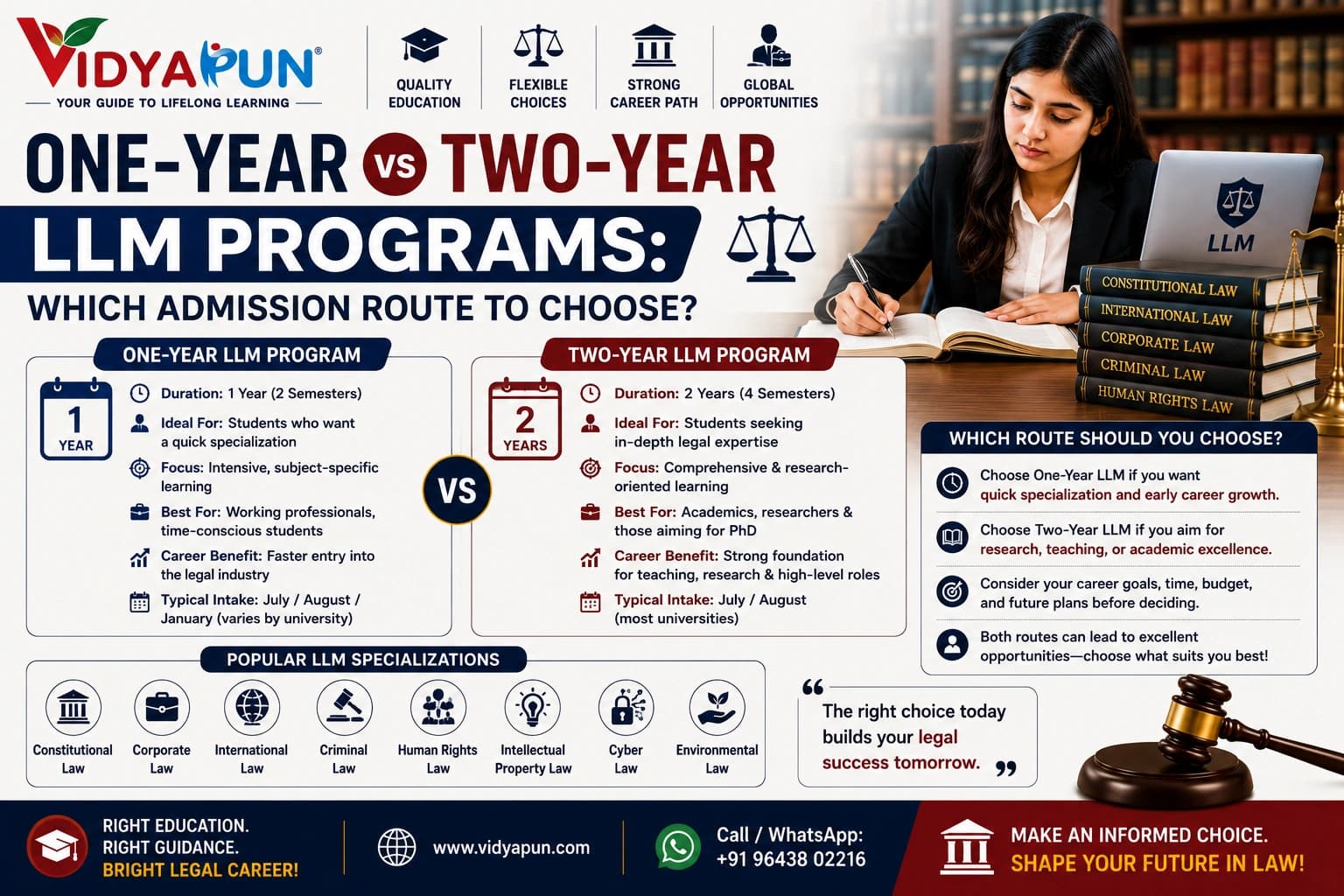
Most LLM programs in India follow the standard two-year format, but a smaller number of institutions offer a compressed one-year option — and choosing between them affects not just how quickly you finish, but your admission route, cost, and depth of specialization along the way.
This guide compares the two formats directly, so you can choose based on your actual situation rather than defaulting to whichever option you happen to come across first.
Do One-Year LLM Programs Exist in India?
Before comparing the two, it's worth confirming the landscape itself.
How Common Are They Compared to Two-Year Programs
One-year LLM programs exist at a select number of institutions in India, though they remain considerably less common than the standard two-year format, which is offered far more widely across government, NLU, and private universities.
Why the Format Matters for Admission Planning
Because one-year programs are less widely available, your choice of format directly narrows or widens your realistic university shortlist — worth deciding early, since it shapes which institutions you should even be researching.
How the Two Formats Differ Structurally
Understanding the practical day-to-day difference helps you judge which pace suits you.
Course Load and Pace
A one-year program compresses the same broad academic expectations into a shorter timeframe, meaning a considerably more intensive pace with less room to breathe between coursework, research, and any practical components.
Specialization Depth
Two-year programs generally allow more time for deeper specialization coursework, a more substantial dissertation or research project, and additional elective breadth, compared to the more condensed one-year format.
Eligibility Differences Between One-Year and Two-Year LLM
Base eligibility is largely similar, though it's worth checking institution-specific nuances.
Do Both Require the Same LLB Eligibility?
Yes, generally — both formats require a completed LLB meeting the university's minimum aggregate requirement. Program duration itself doesn't typically change the fundamental eligibility bar.
Institution-Specific Additional Criteria
Some one-year programs, given their more intensive pace, may set a higher minimum percentage or additional selection criteria compared to the same institution's two-year offering, if both are available. Confirm this directly rather than assuming identical criteria across formats.
Admission Routes for One-Year Programs
Since fewer institutions offer this format, admission mechanics are worth understanding specifically.
Which Universities Offer Them
A limited number of institutions offer a one-year LLM, often as a distinct, sometimes more research-intensive track. Confirm current availability directly with institutions on your shortlist, since this isn't a widespread standard offering.
Entrance Exam vs Merit-Based Admission
Admission routes for one-year programs vary by institution, similar to two-year programs — some may require an entrance exam while others use merit-based selection. There's no universal rule distinguishing the two formats on this point.
Admission Routes for Two-Year Programs
This remains the default, most widely available option.
The More Common, Standard Route
The two-year LLM is the standard offering at the vast majority of Indian universities, including most NLUs and private institutions, making it the default choice for most applicants simply due to availability.
Wider Availability Across Institutions
Because two-year programs are so much more widely available, your specialization and university options are considerably broader if you choose this route, compared to the narrower one-year landscape.
Cost Comparison Between the Two Formats
Why Duration Doesn't Always Mean Proportional Savings
It's tempting to assume a one-year program automatically costs half of a two-year equivalent, but this isn't always the case — some one-year programs charge a comparable or even higher annual rate given their intensive, sometimes more specialized structure. Always compare actual total costs directly rather than assuming a simple proportional relationship based on duration alone.
Which Format Suits Which Type of Applicant
Neither format is universally better — fit depends on your specific circumstances.
Working Professionals and Time-Constrained Applicants
If minimizing time away from work or other commitments is a priority, and you can manage a genuinely intensive pace, a one-year program (where available and appropriately structured) can be appealing, assuming you can access one that fits your circumstances.
Fresh Graduates Wanting Deeper Specialization
If you're a fresh graduate with time to invest in deeper specialization, a stronger dissertation, and broader institutional choice, the standard two-year format generally serves this goal more comprehensively.
Recognition and Career Impact of Program Duration
This is a common underlying concern worth addressing directly.
Is a One-Year LLM Viewed Differently?
Employer perception generally centers more on the specific institution's reputation and your own specialization depth and experience than on program duration alone, though a one-year program does inherently offer less time for building the kind of depth some highly specialized roles may value.
What Actually Matters to Employers
Recruiters generally weigh your specialization expertise, research or practical output, and overall academic performance more heavily than whether your LLM took one or two years, provided the institution itself is well-regarded and properly recognized.
Making Your Decision: A Practical Framework
Questions to Ask Before Choosing
Ask yourself: How much time can I realistically commit, given my other circumstances? Does my target specialization benefit meaningfully from the deeper coursework a two-year program allows? Which specific, well-regarded institutions actually offer the format I'm leaning toward? Answering these honestly points you toward the format that genuinely fits your situation, rather than choosing based on duration alone.
Frequently Asked Questions
1. Do one-year LLM programs exist in India?
Yes, at a limited number of institutions, though they remain considerably less common than the standard two-year format offered across most universities.
2. Is the eligibility criteria different for one-year vs two-year LLM programs?
Generally not in terms of the fundamental requirement (a completed LLB meeting the minimum aggregate), though some one-year programs may set additional or higher criteria given their more intensive pace — confirm this directly with your target institution.
3. Is a one-year LLM cheaper than a two-year LLM?
Not necessarily — some one-year programs charge a comparable or higher rate given their intensive structure. Always compare actual total costs rather than assuming a simple proportional relationship.
4. Which format is better for working professionals?
A one-year program, where available and manageable given the intensive pace, can appeal to those prioritizing minimal time away from other commitments, though availability is more limited than the two-year format.
5. Does program duration affect how employers view an LLM degree?
Employers generally weigh institution reputation, specialization depth, and your academic or practical output more heavily than program duration alone, provided the institution is well-regarded and properly recognized.
6. Which format offers more specialization depth?
Two-year programs generally allow more time for deeper specialization coursework, a more substantial dissertation, and broader elective options compared to the more condensed one-year format.
7. How do I decide between a one-year and two-year LLM?
Weigh your available time and commitments, how much specialization depth your target career genuinely requires, and which well-regarded institutions actually offer the format you're considering, rather than choosing based on duration alone.
Ready to compare your options? Review full details on the Master of Laws (LLM) page, browse our LLM Admission Guide for the complete process, or check Law Admission guidance more broadly. Considering research afterward? Explore PHD Admission.
Check your eligibility for both formats:
🌐 Website: www.vidyapun.com 📞 Call / WhatsApp: +91 96438 02216