Let's be honest — when most people ask "how long does a PhD take in India," they are not just asking about years on a calendar. They are asking about their life. Their savings. Their relationships. Their next career move.
And the frustrating truth is that nobody gives them a straight answer.
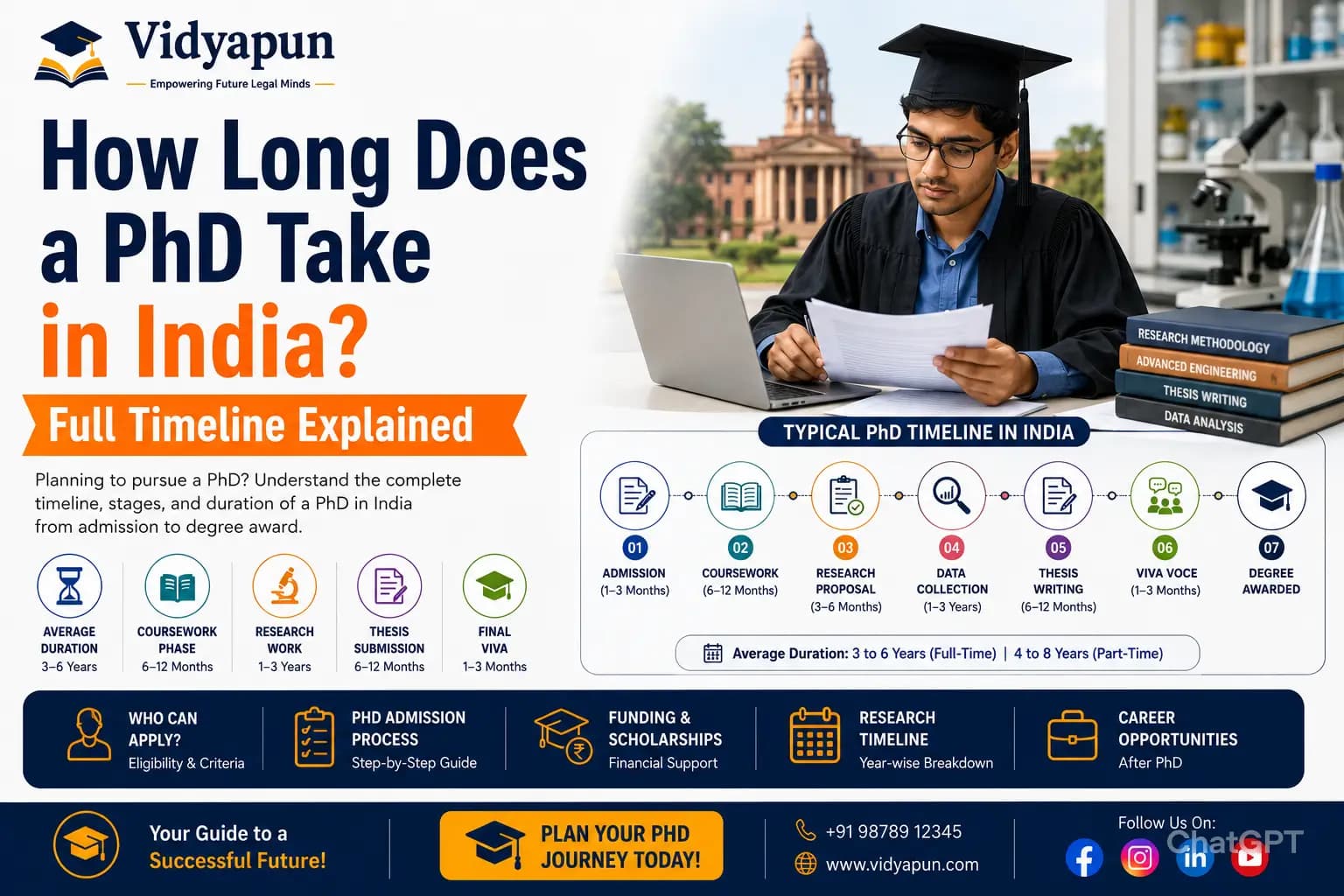
So here it is, plainly: a PhD in India typically takes four to six years for most students. But that number alone tells you almost nothing useful. Because the real question is — what happens inside those years, what can slow you down, what can speed things up, and how do you plan for it?
This guide breaks the entire PhD timeline in India into stages, explains what actually happens at each step, and gives you the realistic picture that university brochures never do.
The Official Minimum and Maximum Duration
Before anything else, let us get the regulatory baseline right.
As per UGC (University Grants Commission) guidelines, the minimum duration of a PhD in India is three years from the date of registration. The maximum is generally five to six years, with provisions for extension in most institutions — subject to valid reasons and supervisor approval.
At IITs, IISc, and NITs, the norm is closer to four to five years for engineering and science disciplines. Humanities and social science PhDs sometimes extend to six or even seven years. Private universities vary significantly — some follow UGC norms strictly, others have their own internal timelines.
One important thing many students do not realise: the clock starts from the date of official PhD registration, not from the date you joined the department or started attending classes. There is sometimes a gap of weeks or months between joining and formal registration — especially if you are waiting for a supervisor confirmation or completing initial coursework.
Stage-by-Stage PhD Timeline in India
Stage 1: Joining and Coursework (Months 1–12)
The first year of a PhD programme in India is rarely pure research. Most institutions — especially IITs and central universities — require PhD scholars to complete a set of coursework credits before they can formally begin their research work.
This coursework typically includes:
- Core subject courses relevant to your research area
- A research methodology course
- Sometimes a seminar or journal club component
At IITs, coursework usually spans one to two semesters and must be completed with a minimum CGPA (often 6.0 or 6.5 on a 10-point scale). Failing to meet this threshold can delay your progression significantly.
During this phase, you are also identifying your research problem, having exploratory conversations with your supervisor, and doing deep literature reading. Do not underestimate this stage — the clarity you build here shapes the next four years.
Typical duration: 6 to 12 months
Stage 2: Comprehensive / Qualifying Examination (Months 10–18)
After coursework, most PhD programmes require students to pass a comprehensive examination — sometimes called a qualifying exam, candidacy exam, or synopsis presentation depending on the institution.
This exam tests whether you have:
- A solid grasp of your research domain
- A clearly defined research problem
- A realistic and well-structured research plan
At IITs, this is usually a two-part process: a written exam followed by an oral defence before a doctoral committee. Some institutions allow a direct synopsis presentation if the student has already made significant research progress.
Failing this exam is not uncommon, and most institutions allow one or two attempts. But failing it does delay your overall PhD timeline by at least six months, sometimes more.
Typical duration: Completed by end of Year 1 or early Year 2
Stage 3: Core Research Phase (Years 2–4)
This is the heart of your PhD — and the phase that is hardest to put a precise timeline on.
During this period, you are running experiments, collecting data, building models, writing code, running simulations, attending conferences, and — critically — publishing papers. Most IITs now require at least one publication in a Scopus or SCI-indexed journal before thesis submission. Some departments expect two.
The pace of this phase depends on several factors that are genuinely outside your control:
- Lab infrastructure and equipment availability — if a critical instrument breaks down, your timeline shifts
- Funding continuity — if your project grant is delayed or not renewed, research slows
- Supervisor availability — a guide who travels frequently or manages too many students can slow your feedback cycles significantly
- Nature of the research problem itself — experimental research often takes longer than computational or theoretical work
Most students hit at least one major roadblock in this phase — a failed experiment, a rejected paper, a pivot in research direction. This is normal. It does not mean something is wrong. But it does mean your original mental timeline will likely need adjustment.
Typical duration: 2 to 3 years
Stage 4: Pre-Submission Requirements and Publications (Years 4–5)
Before you can submit your thesis, most institutions have a checklist of requirements:
- Minimum publication criteria met (varies by department and institution)
- Open seminar / pre-submission seminar conducted
- Doctoral committee approval obtained
- No-dues clearance from the department
- Anti-plagiarism check completed (most IITs use Turnitin or Urkund)
The pre-submission seminar is worth highlighting — this is an open presentation of your research findings before faculty and peers, sometimes followed by a question-and-answer session. It serves as a dry run for your thesis defence and is taken seriously.
If your publication requirement is not met, you simply cannot submit — regardless of how complete your research is. This is one of the most common reasons PhD timelines extend beyond five years in India.
Typical duration: 6 to 12 months
Stage 5: Thesis Writing and Submission (Months 3–6 of Year 5 or 6)
Thesis writing is its own beast. Even students who feel "research complete" often spend four to eight months writing a full doctoral thesis — typically 150 to 300 pages depending on the discipline.
A good thesis is not just a collection of your published papers. It is a coherent, structured document that places your work within the larger body of knowledge, explains your methodology in full detail, and draws clear conclusions and future directions.
After writing, there is an internal review by your supervisor, revisions, formatting as per university guidelines, and final submission. Most universities also require a hard-bound copy along with a digital submission.
Typical duration: 3 to 8 months
Stage 6: Thesis Evaluation and Viva Voce (Months 4–9 after submission)
After submission, your thesis goes to external examiners — usually two or three, at least one of whom is typically from outside your institution, and sometimes from abroad.
The examiner evaluation process in India is notoriously slow. At IITs and central universities, it can take anywhere from three to nine months for examiners to return their reports. If an examiner raises major revisions, you may need to revise and resubmit — adding more months.
Once reports are received and cleared, the viva voce (oral thesis defence) is scheduled. This is your final examination — you defend your research before a panel that includes your supervisor, internal examiners, and at least one external examiner.
After a successful viva, minor corrections (if any) are made, and the final thesis is submitted. The degree is awarded after the university processes everything — which can take one to three more months administratively.
Typical duration: 4 to 12 months
So, How Long Does a PhD Actually Take in India — By Discipline?
Here is a realistic breakdown:
| Discipline | Typical Duration |
|---|---|
| Engineering (IIT/NIT) | 4–5.5 years |
| Sciences (IISc/IIT) | 4–6 years |
| Humanities/Social Sciences | 5–7 years |
| Private Universities | 4–6 years (varies widely) |
| Part-time PhD | 6–8 years |
What Can Delay Your PhD in India?
This deserves its own section because delays are more common than completions on schedule.
1. Supervisor-related issues — Change of supervisor, supervisor going on long leave, or a mismatch in working styles. This alone can add one to two years.
2. Publication rejections — If your paper gets rejected two or three times before acceptance, the timeline stretches. Peer review itself takes three to six months per submission at most journals.
3. Funding gaps — If you are project-funded and the project ends before your research does, you may face a stipend gap. This is more common than institutions admit.
4. Health and personal reasons — Extended leave due to illness or family circumstances. UGC guidelines allow leave provisions, but using them extends the PhD clock.
5. Plagiarism issues in thesis — Institutions like IITs have strict similarity thresholds (often below 10%). A high similarity score in the first anti-plagiarism check means rewriting sections — adding weeks to months.
Can You Finish a PhD in India in 3 Years?
Technically yes — the minimum is three years. Practically, it is extremely rare, especially in experimental sciences and engineering.
Students who finish close to the minimum usually have: a very well-scoped problem, an active and supportive supervisor, a strong publication record built during their master's, and no major experimental failures. If all of those align, a three to three-and-a-half year completion is possible — but it is the exception, not the rule.
Part-Time PhD Duration in India
Some universities, including several private deemed universities and a few central universities, offer part-time PhD programmes for working professionals.
For part-time scholars, the minimum duration is typically four years (per UGC norms), and in practice, six to eight years is common. Balancing a full-time job with research is demanding, and progress naturally slows.
If you are considering a part-time PhD, be honest with yourself about how much dedicated research time you can give each week — and choose a research problem that does not require daily lab presence if you are in a non-experimental field.
Frequently Asked Questions (FAQs)
Q1. What is the minimum duration of a PhD in India? As per UGC regulations, the minimum duration is three years from the date of official PhD registration. Most students, however, take four to five years in practice.
Q2. Can I do a PhD in India in 2 years? No. The UGC mandates a minimum of three years. Any institution offering a PhD in less than three years is not compliant with national regulations — avoid such programmes.
Q3. How long does thesis evaluation take after submission in India? This varies, but four to nine months is typical. External examiners are given a deadline, but delays are common. IITs are working to streamline this process, but it remains one of the slower phases.
Q4. Does a part-time PhD take longer than a full-time PhD in India? Yes, considerably. Part-time PhDs typically take six to eight years, compared to four to five years for full-time programmes.
Q5. What happens if I exceed the maximum PhD duration? Most institutions allow extensions beyond the standard maximum (usually five to six years) with valid reasons — supervisor approval, pending publications, health reasons. You typically need to apply for an extension formally every six months or one year. Indefinite extensions are not guaranteed.
Q6. Do IIT PhDs take longer than private university PhDs? Not necessarily longer — but IIT PhDs tend to have stricter publication requirements that can extend timelines. The rigour is higher, but so is the credential value at the end.
Q7. When does the PhD clock start — from joining date or registration date? The official PhD duration is counted from the date of formal registration, which may be weeks or months after you join the department. Always confirm your exact registration date with your institution.
Plan Your PhD Timeline Realistically
The biggest mistake PhD aspirants make is building their life plans around a four-year finish — and then experiencing a mental and financial crisis when year five arrives and the thesis is still in progress.
Plan for five years. Hope for four. Build a financial buffer. Choose your supervisor as carefully as you choose your research topic. And build your publication pipeline early — do not wait until year three to start writing your first paper.
A PhD in India, done right, is one of the most rewarding intellectual experiences available. The timeline is long, yes — but it is manageable when you know what is coming.
Ready to map out your PhD journey?
Whether you are still shortlisting universities, preparing your research proposal, or trying to figure out which specialisation fits your goals — start with a clear plan. Browse our detailed guides on PhD admission processes, fellowship applications, supervisor selection tips, and research proposal writing. Subscribe to our newsletter for PhD admission notifications from IITs, NITs, and top research institutions — delivered straight to your inbox, on time.
Your PhD timeline begins the moment you decide to take it seriously. Start today.
Website: www.vidyapun.com
Call / WhatsApp: +91 96438 02216