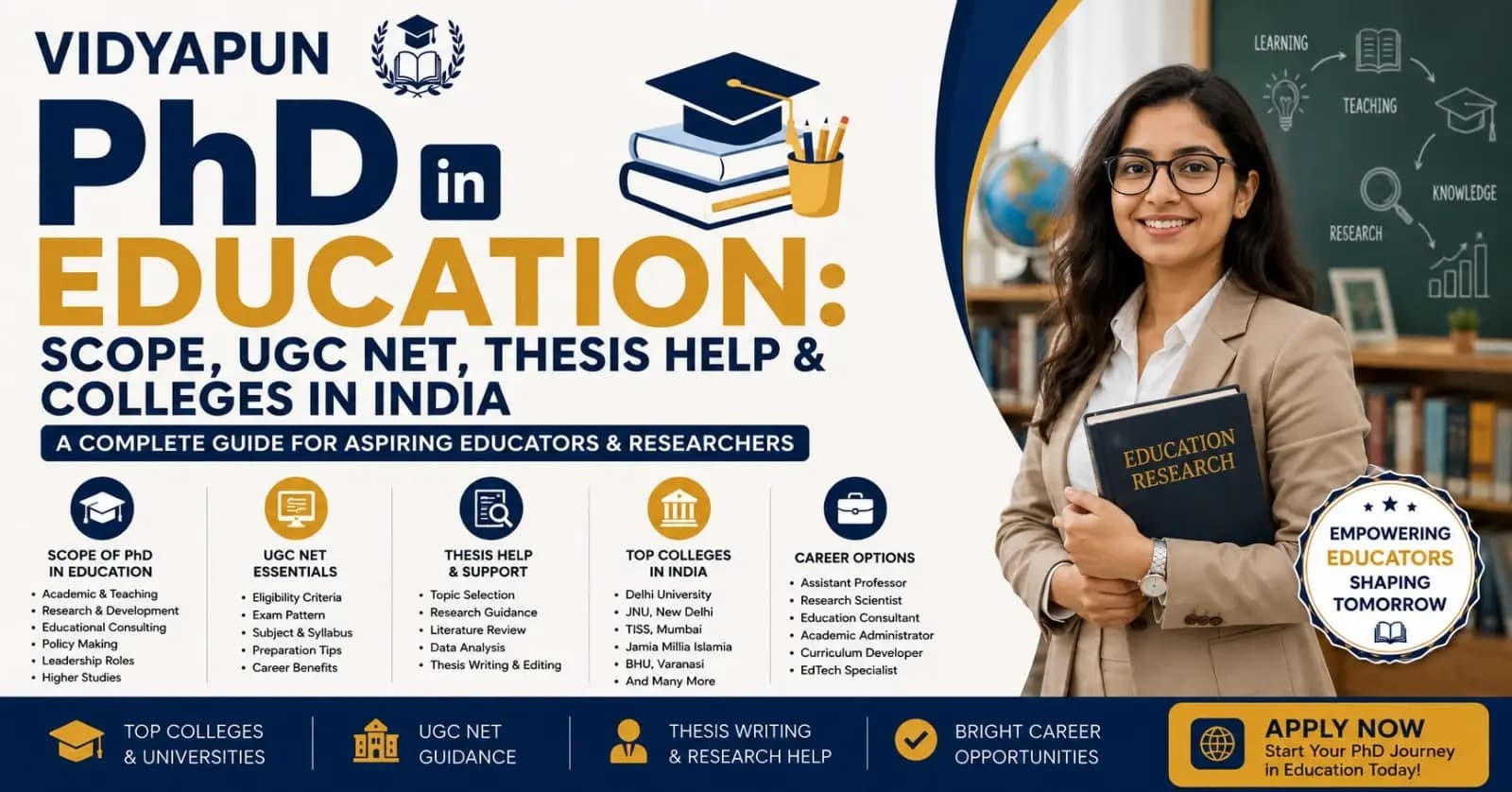
Education is one of the most powerful tools for transforming society. While teaching remains a respected profession, many educators today want to contribute beyond classrooms through research, policy-making, curriculum development, and higher education leadership. This is where a PhD in Education in India becomes valuable.
Whether you are a teacher, assistant professor, education consultant, researcher, or NET-qualified candidate, pursuing a doctoral degree in education can open new academic and professional opportunities.
In this guide, we will discuss the scope of a PhD in Education, eligibility criteria, UGC NET requirements, thesis writing support, career opportunities, and some of the best colleges offering PhD programs in India.
What Is a PhD in Education?
A PhD in Education is the highest academic qualification in the field of education. It focuses on advanced research related to teaching methodologies, educational psychology, curriculum design, educational technology, policy development, teacher training, and learning outcomes.
Unlike regular postgraduate programs, a PhD emphasizes original research that contributes new knowledge to the education sector.
Students spend several years conducting research, collecting data, analyzing findings, and writing a doctoral thesis under the guidance of a research supervisor.
Why Pursue a PhD in Education in India?
Many professionals choose a doctoral degree because it helps them build expertise in a specific area of education while improving their career prospects.
Some major benefits include:
- Opportunities to become an Assistant Professor or Professor
- Better chances of promotion in academic institutions
- Research and policy-making careers
- Leadership roles in educational organizations
- Higher salary potential
- Contribution to educational reforms and innovation
- Eligibility for funded research projects
With increasing focus on educational quality and policy reforms in India, demand for qualified educational researchers continues to grow.
Eligibility for PhD in Education in India
The eligibility criteria may vary slightly between universities, but most institutions require:
Educational Qualification
Candidates generally need:
- Master's degree in Education (M.Ed.)
- Master's degree in a related discipline
- Minimum 55% marks or equivalent CGPA
- Relaxation for reserved categories as per UGC guidelines
Entrance Examination
Most universities conduct:
- PhD entrance test
- Research aptitude assessment
- Personal interview or viva voce
Some universities exempt candidates who have qualified:
- UGC NET
- JRF
- SET
- GATE (where applicable)
Always check the latest admission guidelines of the university before applying.
Is UGC NET Required for PhD in Education?
This is one of the most common questions among aspiring researchers.
The answer is: Not always.
Many universities conduct their own PhD entrance examinations. However, qualifying UGC NET can offer significant advantages.
Benefits of UGC NET for PhD Admission
- Direct interview eligibility in some universities
- Exemption from entrance tests
- Improved chances of selection
- Better academic profile
- Eligibility for Junior Research Fellowship (JRF)
Candidates with JRF often receive financial assistance during their doctoral studies, making research more manageable.
Therefore, while UGC NET is not mandatory everywhere, it remains highly beneficial for students planning a PhD in Education.
Scope of PhD in Education in India
One of the biggest reasons students pursue a doctorate is the growing career scope after completion.
Academic Careers
A PhD can help candidates pursue positions such as:
- Assistant Professor
- Associate Professor
- Professor
- Academic Coordinator
- Dean of Education
Universities and colleges increasingly prefer candidates with doctoral qualifications for senior teaching positions.
Educational Research
Research organizations frequently hire education specialists for:
- Policy evaluation
- Educational surveys
- Curriculum research
- Learning assessment studies
Government Opportunities
Several government bodies recruit educational researchers and consultants.
Examples include:
- NCERT
- SCERT
- NIOS
- Educational departments
- Policy think tanks
EdTech Industry
The rapid growth of educational technology has created demand for experts in:
- Learning design
- Online education
- Educational content development
- Learning analytics
- Assessment systems
International Opportunities
A PhD in Education can also support careers in:
- International educational organizations
- NGOs
- Research institutes
- Global education projects
Best Research Areas for PhD in Education
Choosing the right research topic is crucial for doctoral success.
Some popular and emerging research areas include:
Educational Technology
Research topics may include:
- Artificial intelligence in education
- Digital classrooms
- Online learning effectiveness
- Educational software adoption
Teacher Education
Focus areas include:
- Teacher training models
- Professional development
- Classroom effectiveness
Educational Psychology
Researchers explore:
- Student motivation
- Learning behavior
- Cognitive development
- Emotional intelligence
Curriculum Studies
Research can examine:
- Curriculum reforms
- Competency-based education
- Assessment strategies
Inclusive Education
This area addresses:
- Special education
- Accessibility
- Equity in learning
- Inclusive classroom practices
Selecting a research topic aligned with future career goals often improves both academic outcomes and employability.
Challenges Faced During a PhD in Education
Although rewarding, doctoral research can be demanding.
Common challenges include:
Topic Selection
Many students struggle to identify a research gap and develop a unique proposal.
Literature Review
Finding relevant and credible scholarly sources requires time and expertise.
Research Methodology
Choosing appropriate research methods, tools, and statistical techniques can be challenging.
Data Collection
Obtaining reliable data from schools, institutions, or participants often takes longer than expected.
Thesis Writing
Structuring a doctoral thesis according to university guidelines requires careful planning and academic writing skills.
These challenges explain why many researchers seek professional thesis guidance during their PhD journey.
Importance of Thesis Writing Support for PhD Scholars
A doctoral thesis is the foundation of a PhD degree.
Even talented researchers often need guidance in areas such as:
- Research proposal development
- Literature review writing
- Research methodology design
- Data analysis
- Statistical interpretation
- Referencing and citations
- Plagiarism reduction
- Thesis formatting
Professional thesis support helps researchers maintain academic quality while following university standards.
However, scholars should always ensure that their work remains original and ethically conducted.
How to Write a Successful PhD Thesis in Education
A strong doctoral thesis generally follows these steps:
1. Define a Research Problem
Choose a topic that addresses a genuine educational issue or research gap.
2. Conduct Literature Review
Analyze previous studies to understand existing knowledge and identify gaps.
3. Develop Research Objectives
Create clear and measurable objectives that guide the study.
4. Select Research Methodology
Choose qualitative, quantitative, or mixed-method approaches based on research goals.
5. Collect Data
Gather reliable information using surveys, interviews, observations, or experiments.
6. Analyze Findings
Interpret data carefully using appropriate analytical techniques.
7. Present Conclusions
Discuss findings, implications, recommendations, and future research directions.
Consistency, clarity, and academic rigor are essential throughout the thesis.
Top Colleges for PhD in Education in India
Several reputed universities offer doctoral programs in education.
Banaras Hindu University (BHU)
Known for strong research infrastructure and experienced faculty.
University of Delhi
Offers excellent opportunities for educational research and interdisciplinary studies.
Jamia Millia Islamia
Recognized for quality education research programs and academic excellence.
Aligarh Muslim University
Provides research opportunities across multiple educational domains.
Tata Institute of Social Sciences (TISS)
Popular among students interested in educational policy and social research.
Jawaharlal Nehru University (JNU)
Offers a strong research environment and interdisciplinary collaborations.
University of Calcutta
One of India's oldest universities with established doctoral programs.
Before applying, review faculty expertise, research facilities, admission criteria, and supervisor availability.
Career Opportunities After PhD in Education
Graduates can pursue diverse career paths.
Higher Education
- Professor
- Research Supervisor
- Academic Administrator
Educational Consulting
- Curriculum Consultant
- Education Advisor
- Academic Planner
Government Sector
- Policy Analyst
- Research Officer
- Education Specialist
Research Organizations
- Principal Investigator
- Research Associate
- Project Director
Corporate and EdTech Sector
- Learning Experience Designer
- Training Manager
- Educational Product Specialist
The demand for education professionals continues to increase as institutions adopt modern teaching and assessment practices.
Salary After PhD in Education
Salary varies based on experience, institution, and role.
Typical positions may offer:
- Assistant Professor: ₹6–12 LPA
- Research Associate: ₹5–10 LPA
- Educational Consultant: ₹8–15 LPA
- Academic Manager: ₹10–20 LPA
Professionals with strong research publications and teaching experience often command higher compensation.
Conclusion
A PhD in Education in India is more than just an academic qualification. It is an opportunity to contribute to educational development, influence policy, improve learning systems, and build a meaningful career in research and higher education.
Whether your goal is becoming a professor, researcher, consultant, or educational leader, a doctoral degree can provide the expertise and credibility needed to achieve long-term professional growth.
Careful planning, the right research topic, strong methodology, and proper thesis guidance can significantly improve your chances of completing a successful PhD journey.
Frequently Asked Questions (FAQs)
How many years does a PhD in Education take in India?
Most PhD programs take between 3 and 6 years depending on research progress and university regulations.
Can I pursue a PhD in Education without UGC NET?
Yes. Many universities conduct their own entrance examinations for PhD admissions.
Is a PhD in Education worth it?
Yes. It offers career advancement, research opportunities, academic leadership roles, and higher earning potential.
Which is the best research topic for a PhD in Education?
Popular areas include educational technology, teacher education, curriculum development, educational psychology, and inclusive education.
Can working professionals pursue a PhD in Education?
Many universities offer flexible research options that allow working professionals to pursue doctoral studies.
Need Expert PhD Thesis Guidance?
Planning to pursue a PhD in Education or struggling with your research proposal, literature review, synopsis, data analysis, or thesis writing?
Vidyapun provides expert research guidance for PhD scholars across India. From topic selection and proposal development to thesis structuring, plagiarism checking, and publication support, our experienced academic mentors help researchers move forward with confidence.
Contact Vidyapun today and take the next step toward completing your PhD successfully and publishing high-quality research with confidence.
Website: www.vidyapun.com
Call / WhatsApp: +91 96438 02216