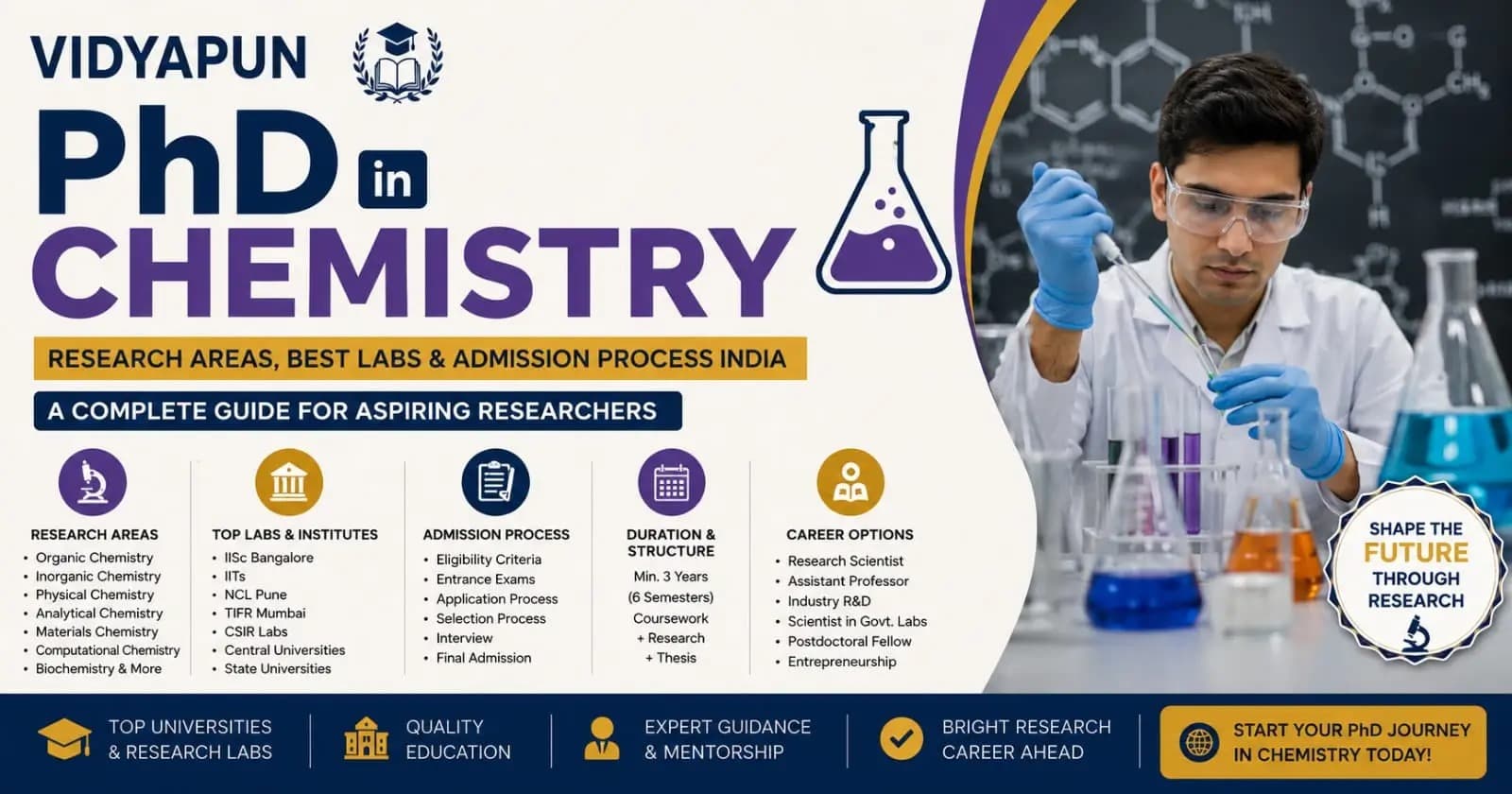
You just finished your M.Sc. in Chemistry. Maybe you spent the last two years running reactions, staring at NMR spectra, or troubleshooting column chromatography at midnight. And somewhere between all of that, you realized — you actually want to go deeper. Not into a job yet. Into research.
That feeling is exactly what a PhD in Chemistry is built for.
India right now is going through a quiet but significant shift in its scientific research landscape. Funding from DST, DBT, and SERB has increased. New national research infrastructure is being built under Anusandhan National Research Foundation (ANRF). IICs and IISERs are producing world-class research. If there was ever a time to pursue a doctorate in chemistry in India, this decade is it.
This guide covers everything you need to make a smart decision — what research areas are hot right now, which labs are genuinely doing cutting-edge work, and how the PhD in Chemistry admission process in India actually works, step by step.
Why PhD in Chemistry in India Makes Sense Right Now
Before we get into research areas and labs, it is worth understanding the larger picture.
India ranks among the top 10 globally in chemistry research output, according to recent Scopus citation analysis. Indian chemists publish extensively in journals like AngewandteChemie, JACS, Green Chemistry, and ACS Nano. The CSIR network alone — 37 national laboratories — employs thousands of PhD-level scientists.
Beyond academia, chemistry doctorates in India are finding opportunities in:
- Pharmaceutical and drug discovery — India's generic pharma sector needs deep chemical expertise
- Agrochemicals — pest resistance research and green pesticide development
- Material science and semiconductors — driven by India's electronics manufacturing push
- Specialty chemicals — a ₹4 lakh crore industry that is actively growing
- Defence research (DRDO) — energetic materials, polymers, and chemical sensors
A PhD in Chemistry in India is not just an academic exercise. It is an entry point into one of the country's most strategically important scientific sectors.
Hot Research Areas in PhD Chemistry India 2026
Choosing a research area is the most important decision in your doctoral journey. Pick something too niche and you may struggle to find a supervisor. Pick something too broad and your thesis will lack focus.
Here are the research areas that are active, funded, and producing strong publications in Indian chemistry labs right now:
1. Green Chemistry and Sustainable Synthesis
One of the fastest-growing areas globally. In India, research focuses on solvent-free reactions, bio-catalysis, atom-economical synthesis routes, and replacing hazardous reagents in industrial processes. Labs at IIT Bombay, IIT Madras, and NCL Pune are particularly active here.
Key problems being studied: microwave-assisted synthesis, ionic liquid-based reactions, photocatalytic organic transformations, and CO₂ utilization chemistry.
2. Medicinal Chemistry and Drug Discovery
Given India's dominance in generic pharmaceuticals, medicinal chemistry is one of the most career-relevant PhD research areas. Research covers synthesis of bioactive molecules, anti-cancer drug candidates, anti-tubercular agents, and kinase inhibitor design.
CSIR-CDRI (Lucknow), CSIR-IICT (Hyderabad), and several IIT chemistry departments run active medicinal chemistry programs with industry partnerships.
3. Nanochemistry and Nanomaterials
From quantum dots to graphene derivatives to metal-organic frameworks (MOFs), nanochemistry sits at the intersection of chemistry, physics, and materials science. Indian research in this space is internationally competitive.
IIT Delhi, JNCASR Bangalore, and INST Mohali are producing globally cited work in nanomaterial synthesis, self-assembly, and functional coatings.
4. Computational and Theoretical Chemistry
As computing power grows, so does the role of computational approaches in chemistry. Density Functional Theory (DFT) calculations, molecular dynamics simulations, and machine learning-assisted molecular design are active research directions.
IIT Kanpur, IISc Bangalore, and IISER Pune have strong theoretical chemistry groups doing research that directly informs experimental work.
5. Electrochemistry and Energy Materials
Battery technology, fuel cells, supercapacitors, and electrocatalysis for hydrogen production are among the most intensely funded research areas in India right now — driven by the National Hydrogen Mission and EV transition goals.
CECRI (CSIR's Central Electrochemical Research Institute, Karaikudi), IIT Kharagpur, and IIT Bombay are centers of gravity for this research.
6. Supramolecular and Polymer Chemistry
Host-guest chemistry, self-assembling systems, stimuli-responsive polymers, and biopolymer design are rich areas with applications in drug delivery, soft robotics, and smart coatings.
TIFR Mumbai, JNCASR, and IIT Madras have groups working on supramolecular architectures that are internationally recognized.
7. Environmental and Analytical Chemistry
Water purification, heavy metal detection, air quality monitoring, and remediation of industrial waste sites are pressing national problems creating strong research funding and social relevance.
NIT Trichy, NEERI (Nagpur), and several state university labs focus on analytical and environmental chemistry relevant to Indian ecological challenges.
Best Labs for PhD in Chemistry in India
A PhD is not just about the institution — it is about the supervisor and the lab. A strong lab has active funding, regular publications in good journals, functional instruments, and a supervisor who is present and engaged.
Here is an honest look at the best ecosystems for chemistry doctoral research in India:
Indian Institute of Science (IISc), Bangalore
The Department of Inorganic and Physical Chemistry, Organic Chemistry, and Materials Research Centre at IISc are among the finest in Asia. IISc offers both direct PhD admission (post-BSc, 5 years) and post-MSc admission (4 years). Faculty here have international collaborations, active SERB and DST grants, and publish regularly in top-tier journals. The campus infrastructure — including a 950 MHz NMR, cryo-EM, and advanced mass spectrometry — is world-class.
IITs (Indian Institutes of Technology)
IIT Bombay: Particularly strong in organic chemistry, polymer chemistry, and materials. The Chemistry department has several DST-SERB funded groups.
IIT Madras: Known for computational chemistry, green synthesis, and analytical chemistry. Strong industry connect through its research park.
IIT Kanpur: One of India's oldest and most respected chemistry departments. Strong theoretical chemistry, organic synthesis, and chemical biology groups.
IIT Delhi: Active in nanochemistry, photochemistry, and medicinal chemistry. Good infrastructure and proximity to Delhi's pharma research ecosystem.
IIT Kharagpur: Strong electrochemistry and materials chemistry. Benefits from CSIR-NML proximity and metallurgical research collaborations.
IISERs (Indian Institutes of Science Education and Research)
IISERs were specifically designed for science research. The chemistry departments at IISER Pune, IISER Kolkata, IISER Bhopal, and IISER Mohali are producing excellent doctoral researchers in organic, inorganic, physical, and biological chemistry.
IISER Pune in particular has faculty trained at top global institutions and publishes regularly in ACS and RSC journals.
CSIR Laboratories
CSIR (Council of Scientific and Industrial Research) runs India's largest network of chemistry-focused national labs:
- CSIR-NCL, Pune — Polymer chemistry, catalysis, chemical engineering
- CSIR-CDRI, Lucknow — Drug discovery, medicinal chemistry, natural products
- CSIR-IICT, Hyderabad — Synthetic chemistry, process chemistry, fluorine chemistry
- CSIR-CECRI, Karaikudi — Electrochemistry, corrosion science, battery materials
- CSIR-CSMCRI, Bhavnagar — Salt and marine chemical research, desalination chemistry
CSIR offers the JRF-NET (CSIR-UGC NET Chemical Sciences) as the primary entrance pathway, with selected candidates receiving direct lab placement and fellowship.
TIFR (Tata Institute of Fundamental Research), Mumbai
TIFR's Department of Chemical Sciences is elite — small intake, outstanding supervision, and a research culture that is genuinely international. TIFR PhD students receive generous fellowships and have access to exceptional instrumentation. Admission is through the TIFR GS (Graduate School) Exam.
JNCASR (Jawaharlal Nehru Centre for Advanced Scientific Research), Bangalore
JNCASR is a deemed university focused entirely on advanced research. Its chemistry and materials science programs are among the best in India. Faculty include some of India's most highly cited chemists.
PhD in Chemistry Admission Process India 2026: Step by Step
Here is how the admission process works, realistically, for the major pathways:
Step 1: Qualify the Right Entrance Exam
CSIR-UGC NET in Chemical Sciences (Paper-1 + Chemical Sciences Paper) This is the most important exam for chemistry PhD admission in India. It is conducted twice a year (June and December). Qualifying with JRF gives you both admission eligibility and ₹37,000/month fellowship. Qualifying without JRF (Lectureship band) still helps in many university admissions.
GATE (Chemistry — CY) GATE Chemistry score is accepted by IITs, NITs, and several central universities for PhD admission. A GATE score above 600 is generally competitive for IIT PhD programs.
JEST (Joint Entrance Screening Test) Conducted by IISc, IISERs, and TIFR for admission to their PhD and integrated PhD programs. Strong theoretical chemistry aptitude is needed.
TIFR GS Separate exam conducted by TIFR. Covers all areas of chemistry with a strong analytical and problem-solving focus.
University-level PETs Most state and central universities conduct their own PhD Entrance Tests (PETs) for students who have not qualified CSIR-NET or GATE.
Step 2: Shortlisting Research Areas and Potential Supervisors
This step is skipped by most applicants — and it is a mistake. Before you apply anywhere, read faculty pages, look up recent publications on Google Scholar, and identify 3–5 potential supervisors whose current research aligns with your interests.
Send a brief, professional email expressing your interest. Keep it specific: mention one or two of their recent papers and how your MSc work connects. A positive response from a faculty member significantly improves your chances of selection.
Step 3: Application and Interview
Most IIT and IISc chemistry PhD admissions happen twice a year — January and July cycles. Applications are submitted online through the institute portal.
The selection process includes:
- Shortlisting based on entrance score (GATE/CSIR-NET/JEST)
- Written test (in some institutes)
- Research interview — expect questions on your MSc coursework, research interests, and how you would approach a given chemical problem
For CSIR labs, there is often a direct interview process after CSIR-JRF qualification — labs post positions and shortlisted JRF holders interview for available projects.
Step 4: Registration and Coursework
Once admitted, PhD in Chemistry students typically complete 1–2 semesters of coursework (advanced spectroscopy, chemical literature, research methodology) before transitioning full-time to research.
Most programs have annual or biannual progress reviews (Research Advisory Committee — RAC meetings) where students present their work to a panel.
Step 5: Thesis Submission and Defence
The typical PhD in Chemistry duration in India is 4 to 6 years. After thesis submission, an external examiner (often from abroad in top institutions) evaluates the thesis. A satisfactory evaluation is followed by a viva voce (open defence).
PhD in Chemistry Fellowship and Funding
| Fellowship | Amount (2026) | Source |
|---|---|---|
| CSIR-JRF | ₹37,000/month (JRF), ₹42,000/month (SRF) | CSIR-UGC NET |
| DST-INSPIRE Fellowship | ₹80,000/month | DST (for top ranked candidates) |
| GATE-based fellowship (IIT/NIT) | ₹37,000/month | MHRD/Govt of India |
| TIFR Fellowship | ₹37,000–₹42,000/month | TIFR internal |
| IISER Fellowship | ₹37,000/month | DBT/SERB |
| PM Research Fellowship (PMRF) | ₹70,000–₹80,000/month | Govt of India |
Frequently Asked Questions (FAQs)
Q1. What is the minimum eligibility for PhD in Chemistry in India? An M.Sc. in Chemistry or a closely related subject with a minimum of 55% marks (50% for SC/ST/PwD). Some institutes like IISc and TIFR offer integrated PhD programs that accept BSc graduates directly.
Q2. Is CSIR-NET compulsory for PhD in Chemistry admission? Not universally. IITs accept GATE Chemistry scores. TIFR and IISERs conduct their own entrance exams. However, CSIR-JRF is the most widely accepted qualification and is required for admission to most university and CSIR lab PhD programs.
Q3. How long does a PhD in Chemistry take in India? Most candidates complete in 4 to 6 years. IIT and IISc programs formally expect completion within 5 years. Extensions are granted with supervisor approval and with justification to the doctoral committee.
Q4. Can I pursue PhD in Chemistry through distance or part-time mode? Unlike social science doctorates, chemistry PhD programs require hands-on laboratory work. Distance or online modes are not available. Part-time programs exist at some institutions for candidates employed in research organizations, but residential requirements apply.
Q5. What is the scope of PhD in Chemistry in India for non-academic careers? Very strong. Pharmaceutical companies (Sun Pharma, Dr. Reddy's, Cipla research divisions), specialty chemical firms, FMCG R&D labs, environmental consultancies, and government bodies like DRDO, BARC, and CSIR labs all actively recruit PhD chemists.
Q6. Which IIT is best for PhD in Chemistry in India? IIT Bombay, IIT Kanpur, and IIT Madras are consistently ranked highest. The "best" IIT for you depends on your specific research area and which faculty member's work aligns most closely with your interests.
Q7. What documents are typically required for PhD in Chemistry application? Mark sheets (BSc and MSc), GATE/CSIR-NET scorecard, research proposal or statement of purpose, CV, category certificate (if applicable), and passport-size photographs. Some institutes require a no-objection certificate if you are currently employed.
Quick Application Checklist
- [ ] M.Sc. in Chemistry with 55%+ marks
- [ ] CSIR-NET (JRF preferred) / GATE CY / JEST score ready
- [ ] 3–5 target labs identified with supervisor profiles reviewed
- [ ] Cold email to potential supervisor drafted and sent
- [ ] Research statement / SOP written (minimum 600–800 words)
- [ ] Academic CV updated with publications, projects, and skills
- [ ] Aware of application windows (January and July for most IITs)
- [ ] Fellowship type identified based on qualifying exam
Final Thoughts
A PhD in Chemistry is not the easiest path. There will be reactions that do not work for weeks, instruments that break at inconvenient times, and days when the research feels completely stuck. Every chemistry PhD scholar in the country has been through that — and most of them will also tell you it was worth every single difficult day.
The key is choosing the right research area, finding a supervisor whose vision aligns with yours, and applying strategically rather than blindly submitting to ten places without preparation.
India's chemistry research ecosystem is genuinely growing. The labs are better equipped than they were a decade ago. The fellowships are higher. The international collaborations are more accessible. If research excites you, now is exactly the right time to start.
Ready to begin your chemistry doctoral journey?
Start with what you know best from your M.Sc. work. Narrow it to one research area. Find three faculty members in India whose recent papers genuinely excite you. Then write to them — not a generic email, but a specific, thoughtful one.
That one email could be the first step of a career that puts your name on discoveries that matter. Explore our other guides on CSIR-NET Chemical Sciences preparation, how to write a chemistry research proposal, and IIT PhD interview questions to complete your preparation. Your bench is waiting.
Website: www.vidyapun.com
Call / WhatsApp: +91 96438 02216