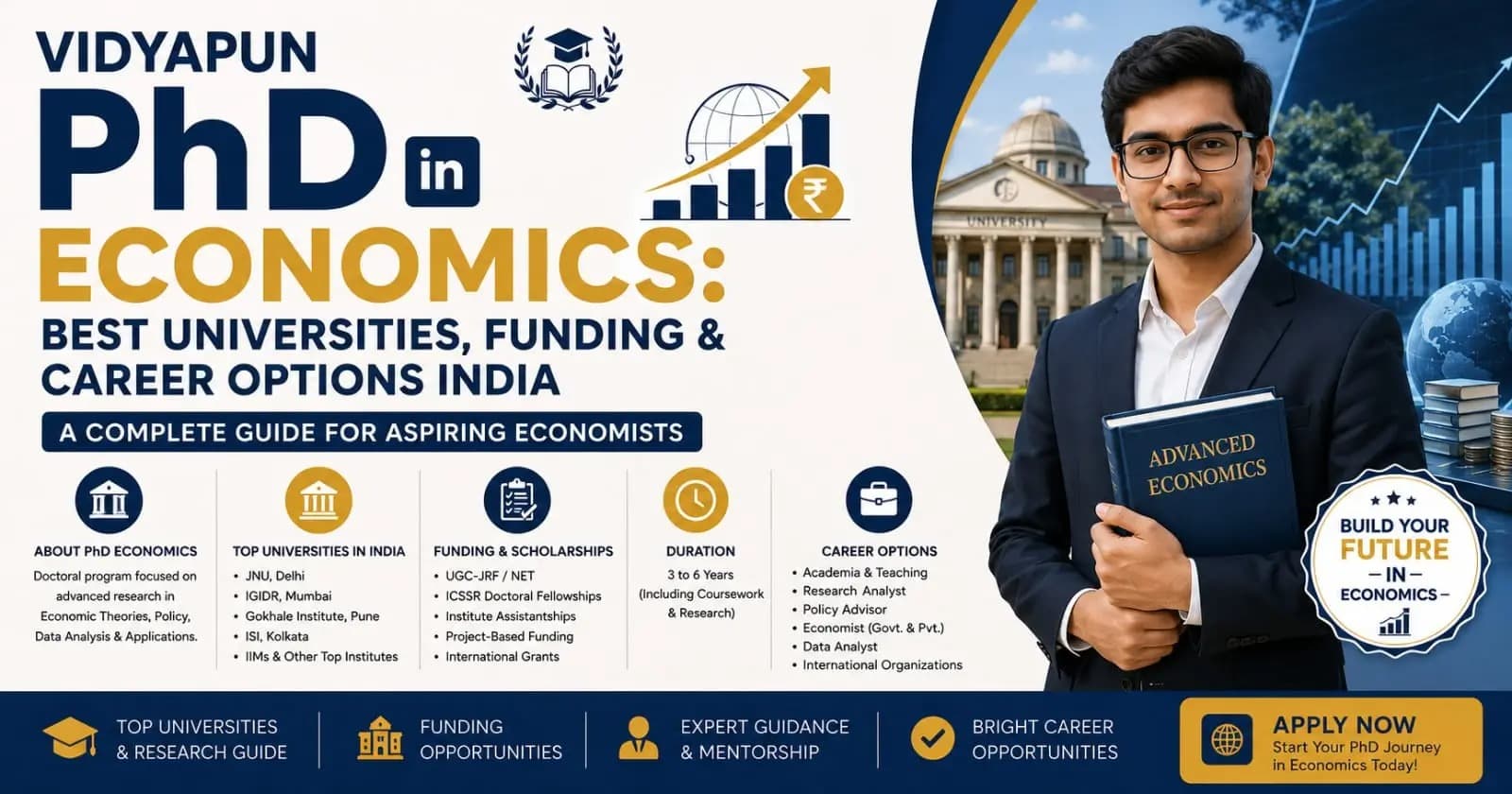
Thinking About a PhD in Economics? Here's What You Should Know
Many students complete their Master's degree in Economics and then find themselves asking an important question:
"Should I pursue a PhD in Economics?"
It is a fair question.
A PhD is not just another academic qualification. It is a long-term commitment that can open doors to research, teaching, policy-making, consulting, data analytics, and leadership roles in government and private organizations.
If you are passionate about understanding how economies work, solving real-world problems through research, and building expertise in economic theory or applied economics, a PhD can be a rewarding career path.
In this guide, we will cover the best universities for a PhD in Economics in India, available funding opportunities, admission requirements, career options, salary expectations, and frequently asked questions.
What Is a PhD in Economics?
A PhD in Economics is a doctoral-level research degree that focuses on advanced economic theories, quantitative methods, public policy analysis, development economics, financial economics, behavioral economics, and other specialized areas.
Unlike regular coursework-based programs, a PhD primarily revolves around original research and the creation of new knowledge.
Most PhD programs in Economics in India take between 3 and 6 years to complete depending on research progress and institutional requirements.
Why Choose a PhD in Economics?
There are several reasons students decide to pursue a doctorate in Economics:
- Opportunity to become a researcher or professor
- Better career prospects in policy organizations
- Access to government and international research positions
- Higher earning potential in consulting and analytics
- Ability to influence economic policy and development planning
- Expertise in a specialized area of economics
For students interested in academics, research, or public policy, a PhD often becomes a valuable long-term investment.
Eligibility for PhD in Economics in India
The eligibility criteria may vary across institutions, but most universities require:
Educational Qualification
- Master's Degree in Economics
- MA Economics
- MSc Economics
- MPhil Economics (if applicable)
- Master's in related disciplines such as Statistics, Econometrics, Public Policy, Development Studies, or Applied Economics
Minimum Marks
Most universities require:
- 55% to 60% marks in postgraduate studies
- Relaxation for reserved categories as per government norms
Entrance Exams
Many institutions accept:
- UGC NET
- JRF
- CSIR NET (selected interdisciplinary areas)
- University-specific entrance examinations
Some universities provide direct admission to candidates who qualify for Junior Research Fellowship (JRF).
Best Universities for PhD in Economics in India
Choosing the right university plays a major role in your research experience and career growth.
1. Indian Statistical Institute (ISI)
ISI is one of India's most respected institutions for economics, statistics, and quantitative research.
Highlights:
- Strong research environment
- Excellent faculty
- Generous fellowships
- International collaborations
Popular research areas include econometrics, development economics, and mathematical economics.
2. Delhi School of Economics (DSE)
Delhi School of Economics has produced some of India's leading economists and policymakers.
Key advantages:
- Strong academic reputation
- Access to leading economists
- Extensive research resources
- Competitive doctoral funding
3. Jawaharlal Nehru University (JNU)
JNU remains a preferred destination for doctoral studies due to its strong research culture and affordable education.
Research areas include:
- International economics
- Development economics
- Public finance
- Political economy
4. Indira Gandhi Institute of Development Research (IGIDR)
IGIDR specializes in advanced research related to development economics and policy studies.
Benefits include:
- Fully research-focused environment
- Competitive fellowships
- Strong publication support
5. Indian Institutes of Technology (IITs)
Several IITs now offer highly respected PhD programs in Economics.
Popular options include:
- IIT Delhi
- IIT Kanpur
- IIT Bombay
- IIT Madras
- IIT Kharagpur
These institutions are particularly attractive for students interested in quantitative economics and interdisciplinary research.
6. Ashoka University
Ashoka University has quickly developed a strong reputation in economics research.
Advantages include:
- International faculty
- Modern research infrastructure
- Interdisciplinary opportunities
Funding Opportunities for PhD in Economics in India
One of the biggest concerns among students is funding.
The good news is that many PhD scholars receive financial support throughout their research journey.
UGC Junior Research Fellowship (JRF)
JRF remains one of the most popular funding options.
Benefits include:
- Monthly fellowship
- Contingency grants
- Academic recognition
University Fellowships
Many universities provide:
- Institutional scholarships
- Teaching assistantships
- Research assistantships
ICSSR Fellowships
The Indian Council of Social Science Research supports doctoral scholars working on significant social science research topics.
RBI and Government Research Grants
Students researching topics related to:
- Monetary policy
- Banking
- Financial inclusion
- Economic development
may receive project-based funding support.
Popular PhD Research Areas in Economics
Students can choose from several specialized fields.
Development Economics
Focuses on poverty, inequality, employment, and economic growth.
Econometrics
Combines economics with advanced statistical methods.
Behavioral Economics
Studies how human behavior influences economic decisions.
Financial Economics
Examines financial markets, investments, and banking systems.
Public Economics
Focuses on taxation, government expenditure, and public policy.
International Economics
Studies global trade, international finance, and globalization.
Career Options After a PhD in Economics
A PhD in Economics can lead to diverse career opportunities.
University Professor
Many scholars choose careers in teaching and academic research.
Responsibilities include:
- Teaching students
- Conducting research
- Publishing papers
- Supervising doctoral candidates
Economic Researcher
Research positions are available in:
- Think tanks
- Government institutions
- Research organizations
- International agencies
Policy Analyst
Policy analysts contribute to public decision-making by evaluating economic issues and proposing solutions.
Economist
Economists work across:
- Government departments
- Financial institutions
- International organizations
- Consulting firms
Data Analyst and Quantitative Researcher
The growing importance of data-driven decision-making has increased demand for economists with quantitative skills.
International Organizations
PhD graduates can pursue opportunities with organizations such as:
- World Bank
- International Monetary Fund
- United Nations agencies
- Asian Development Bank
Salary After a PhD in Economics
Salary depends on experience, specialization, and employer.
Typical ranges include:
| Career Role | Average Annual Salary |
|---|---|
| Assistant Professor | ₹8–15 LPA |
| Economist | ₹10–25 LPA |
| Policy Analyst | ₹8–20 LPA |
| Research Fellow | ₹6–15 LPA |
| Quantitative Researcher | ₹12–35 LPA |
Candidates with strong analytical and econometric skills often command higher salaries.
Is a PhD in Economics Worth It?
A PhD in Economics is worth pursuing if:
- You enjoy research and critical thinking.
- You want an academic career.
- You are interested in economic policy.
- You want to work in research-intensive organizations.
- You are passionate about solving real-world economic problems.
However, it requires patience, discipline, and a genuine interest in research.
FAQs About PhD in Economics in India
How many years does a PhD in Economics take?
Most programs take between 3 and 6 years depending on research progress and university regulations.
Can I pursue a PhD in Economics after MA Economics?
Yes. MA Economics is one of the most common qualifications accepted for PhD admissions.
Do PhD students get a stipend?
Yes. Many universities and government agencies provide fellowships, scholarships, and research assistantships.
Which entrance exam is best for PhD Economics?
UGC NET JRF is among the most recognized pathways for funded doctoral admissions.
What are the best research areas in Economics?
Development Economics, Econometrics, Financial Economics, Behavioral Economics, and Public Policy are currently among the most sought-after fields.
Can I get a government job after a PhD in Economics?
Yes. PhD holders are eligible for research, policy, academic, and advisory positions in various government institutions.
Final Thoughts
A PhD in Economics is more than a degree—it is an opportunity to contribute meaningful research, influence policy decisions, and build expertise in a field that directly impacts society and economic development.
Whether your goal is becoming a professor, economist, policy analyst, or researcher, choosing the right university and funding opportunity can significantly shape your academic and professional future.
Need Expert Guidance for PhD Admissions, Research Proposal Writing, SOPs, University Shortlisting, or Fellowship Applications?
Vidyapun helps aspiring PhD scholars with end-to-end academic support, from selecting the right university to preparing strong research proposals and admission documents. Connect with our experts today and take the next step toward your PhD journey with confidence.
Website: www.vidyapun.com
Call / WhatsApp: +91 96438 02216