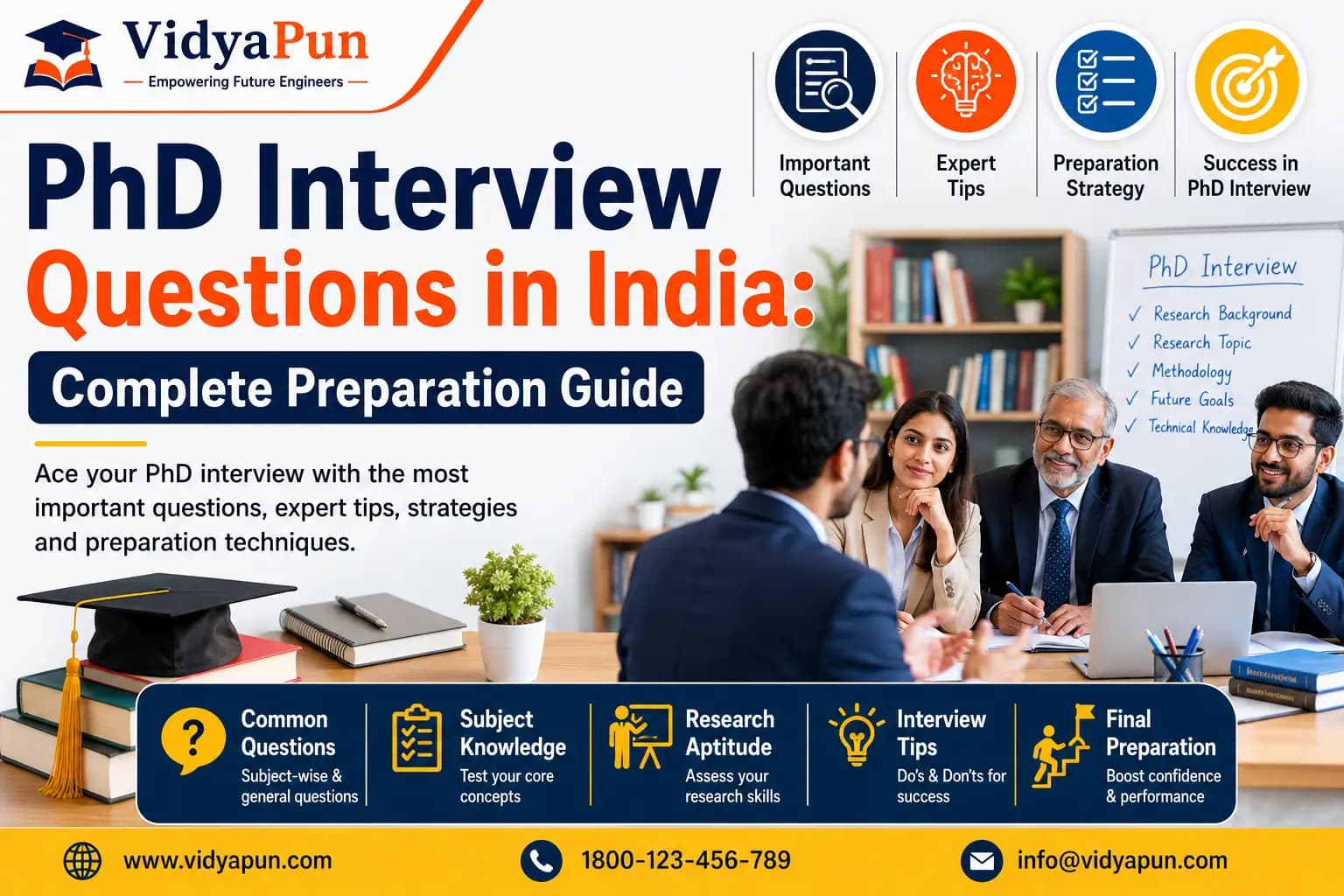
If you have ever sat outside an interview room with sweaty palms, clutching a printed copy of your research proposal, you already know that a PhD interview is nothing like a regular job interview. It is part academic interrogation, part personality test, and part "let's see if you actually understand your own topic" exercise. And in India, where PhD admissions across universities like JNU, Delhi University, IITs, and various state universities follow fairly similar patterns, knowing what to expect can be the difference between a confident performance and a forgettable one.
This guide breaks down everything you need to know about PhD interview questions in India, from the most commonly asked questions to subject-specific queries, plus practical tips that actual scholars wish someone had told them before their own interview.
Why PhD Interviews in India Feel So Different
Most Indian universities treat the PhD interview as the final filter after written exams like UGC NET, CSIR NET, or university-level entrance tests. Once you clear the cutoff, the interview (often called a viva-voce or research aptitude test) decides whether you actually get admission and, in many cases, which supervisor you get assigned to.
Unlike a corporate interview where soft skills often carry the day, a PhD interview panel wants to know one thing above everything else: do you have the research temperament to survive three to five years of independent academic work? That's it. Everything they ask circles back to this single question.
There's also a structural reason these interviews feel intense. A panel usually consists of three to five faculty members, sometimes including the Head of Department, a subject expert from outside the university, and the supervisor you've shortlisted. Each person on that panel brings a different lens. One might focus purely on your conceptual clarity, another might dig into the feasibility of your timeline, and a third might simply want to see how you handle being challenged. Walking in expecting a single conversational thread, when in reality you're facing three or four different evaluation styles at once, is where many candidates lose their footing early on.
Common PhD Interview Questions in India (And What Panels Are Really Asking)
Let's get into the heart of it. These are the questions that show up again and again across disciplines and universities.
1. Why do you want to pursue a PhD?
This sounds simple, but it trips up more candidates than any other question. Panels are tired of hearing "I am passionate about research" without any substance behind it. They want a genuine reason tied to your academic journey, a specific problem you want to solve, or a gap you noticed during your master's degree.
A weak answer: "I love research and want to contribute to knowledge."
A stronger answer connects your past coursework or project work to a specific curiosity that a PhD would let you pursue properly.
2. Explain your research proposal in simple terms.
Almost every Indian university interview panel will ask you to explain your synopsis or research proposal as if talking to someone outside your field. This tests two things: whether you actually understand your own proposal, and whether you can communicate complex ideas clearly. If you can't explain your topic to a layperson, the panel will doubt whether you wrote the proposal yourself.
3. What is the research gap you have identified?
This is a favourite among PhD viva questions in India because it separates candidates who copied a proposal template from those who did genuine literature review work. Be ready to name two or three existing studies and explain, in your own words, what they missed or didn't address.
4. Who will be your potential supervisor, and why?
Many universities expect you to have already approached a faculty member before the interview. If you haven't done this homework, it shows immediately. Mention the professor's recent publications or research interests and explain the overlap with your own area.
5. What is your research methodology?
You don't need a complete chapter-by-chapter breakdown, but you should be able to discuss whether your study will be qualitative, quantitative, or mixed-method, and roughly how you plan to collect and analyse data. PhD entrance interview questions in India almost always touch on methodology because supervisors want to gauge whether your plan is realistic for the time frame.
It also helps to think through the practical side before walking in. If your study involves surveys, how many respondents are you targeting, and how will you reach them? If it's archival or text-based research, where exactly will you source your material from, and is that access already confirmed? Panels have heard countless proposals that sound impressive on paper but fall apart the moment someone asks "and how exactly will you get this data within three years?" Having even a rough, honest answer to that question puts you ahead of most candidates in the room.
6. How is your proposed research different from existing literature?
Similar to the research gap question but with a sharper focus on originality. The panel wants reassurance that you're not simply repeating someone else's thesis with minor tweaks.
7. What challenges do you anticipate during your PhD?
Here, honesty works in your favour. Talk about realistic concerns such as access to data, fieldwork logistics, or balancing coursework with research, and follow up with how you plan to manage them.
8. Where do you see yourself after completing your PhD?
This is less about having your entire career mapped out and more about showing that you see the PhD as a meaningful step rather than just another degree to collect.
9. What have you read recently in your field?
A surprising number of candidates stumble here because they prepared their proposal months ago and haven't kept up with recent papers. Mentioning one or two recent journal articles, even briefly, shows ongoing engagement with the subject.
10. Why this university and not another?
Generic answers about "reputation" rarely land well. Specific reasons, like access to a particular lab, a faculty member's expertise, or a unique resource the university offers, work much better.
Subject-Specific PhD Interview Questions
While the questions above apply broadly, certain disciplines bring their own flavour of questioning.
For Science and Engineering candidates: Expect deeper probing into your undergraduate or master's thesis, basic conceptual questions from your core subject, and sometimes a quick problem to solve on the spot to test analytical thinking under pressure.
For Humanities and Social Sciences candidates: Panels often dig into theoretical frameworks, ask you to defend your choice of theory over alternatives, and question the practical relevance of your research to current social or policy issues.
For Management and Commerce candidates: Be ready for questions tying your proposal to industry trends, along with basic statistics or data analysis questions if your methodology involves quantitative work.
How to Prepare for a PhD Viva in India: A Practical Approach
Preparation for PhD viva voce in India isn't about memorising answers. It's about building genuine familiarity with your own proposal and the surrounding academic conversation. Here's a sequence that tends to work well for most candidates.
Start by rereading your own proposal as if you're seeing it for the first time. Many candidates write their synopsis weeks or months before the interview and forget the finer details. Read it slowly, underline anything vague, and rewrite those sections in plain language.
Next, pull up five to seven recent research papers closely related to your topic. You don't need to read each one cover to cover, but understand the core argument, methodology, and findings well enough to discuss them if asked.
After that, practice explaining your topic out loud to someone outside your field, maybe a friend or family member who has no academic background in the subject. If they can follow your explanation, you're in good shape. If they look confused, that's exactly the gap the interview panel will spot too.
Finally, prepare two or three thoughtful questions to ask the panel at the end. It signals genuine interest rather than just trying to get through the interview.
Common Mistakes Candidates Make in PhD Interviews
A lot of preparation guides focus only on what to say. Equally important is knowing what not to do.
Overloading answers with jargon to sound impressive often backfires, since panels can tell when someone is hiding a shaky understanding behind complicated terms. Another common slip is criticising existing research too harshly without acknowledging its contributions, which can come across as disrespectful rather than analytical. Many candidates also forget to connect their proposed research to real-world or societal relevance, leaving the panel wondering why the study matters beyond academic curiosity. And perhaps the most damaging mistake is bluffing when you don't know an answer. Saying "I'm not entirely sure, but here's how I would approach finding out" is almost always received better than confidently stating something incorrect.
What Panels Actually Look For Beyond Knowledge
Subject knowledge matters, but it's rarely the only deciding factor. Most experienced panel members are also evaluating how a candidate handles pressure, whether they can think on their feet when asked an unexpected question, and how coherently they structure their thoughts under stress. A candidate who pauses, thinks, and gives a measured answer often leaves a better impression than one who rushes through a rehearsed response without truly engaging with the question being asked.
Frequently Asked Questions
How long does a typical PhD interview last in India?
Most PhD interviews in Indian universities last between fifteen and thirty minutes, though some research-intensive institutes may extend this if multiple panel members want to probe different aspects of your proposal.
Is it compulsory to have a research proposal before the PhD interview?
Yes, at most Indian universities, you're required to submit a research proposal or synopsis along with your application, and the interview largely revolves around discussing it.
Can I change my research topic after the PhD interview?
In many cases, yes, especially during the initial coursework phase, but this usually requires approval from your supervisor and the doctoral committee, so it's not something to plan around casually.
What should I wear for a PhD interview in India?
Formal or semi-formal attire is generally expected, similar to what you'd wear for any academic or professional interview. Comfort matters too, since you'll want to focus on answering questions rather than adjusting an uncomfortable outfit.
Do PhD interview panels ask about publications?
If you already have publications from your master's research, expect at least one question about them, including your specific contribution if the work was co-authored.
What happens if I don't know the answer to a question?
It's far better to admit you're unsure and explain how you'd find the answer than to guess incorrectly. Panels generally respect intellectual honesty over false confidence.
Final Thoughts
Preparing for PhD interview questions in India ultimately comes down to knowing your own research inside out, staying current with your field, and being able to communicate complex ideas in a grounded, honest way. There's no universal script that guarantees success, because every panel, every department, and every research area brings its own set of expectations. What stays consistent is the value of genuine preparation over last-minute memorisation.
If you're currently working on your research proposal or preparing for an upcoming PhD interview and want a second pair of eyes on your synopsis, methodology, or interview answers, reach out for a one-on-one consultation. Sometimes all it takes is a focused conversation with someone who has sat on the other side of that table to turn a shaky proposal into one you can defend with confidence.
Website: www.vidyapun.com
Call / WhatsApp: +91 96438 02216