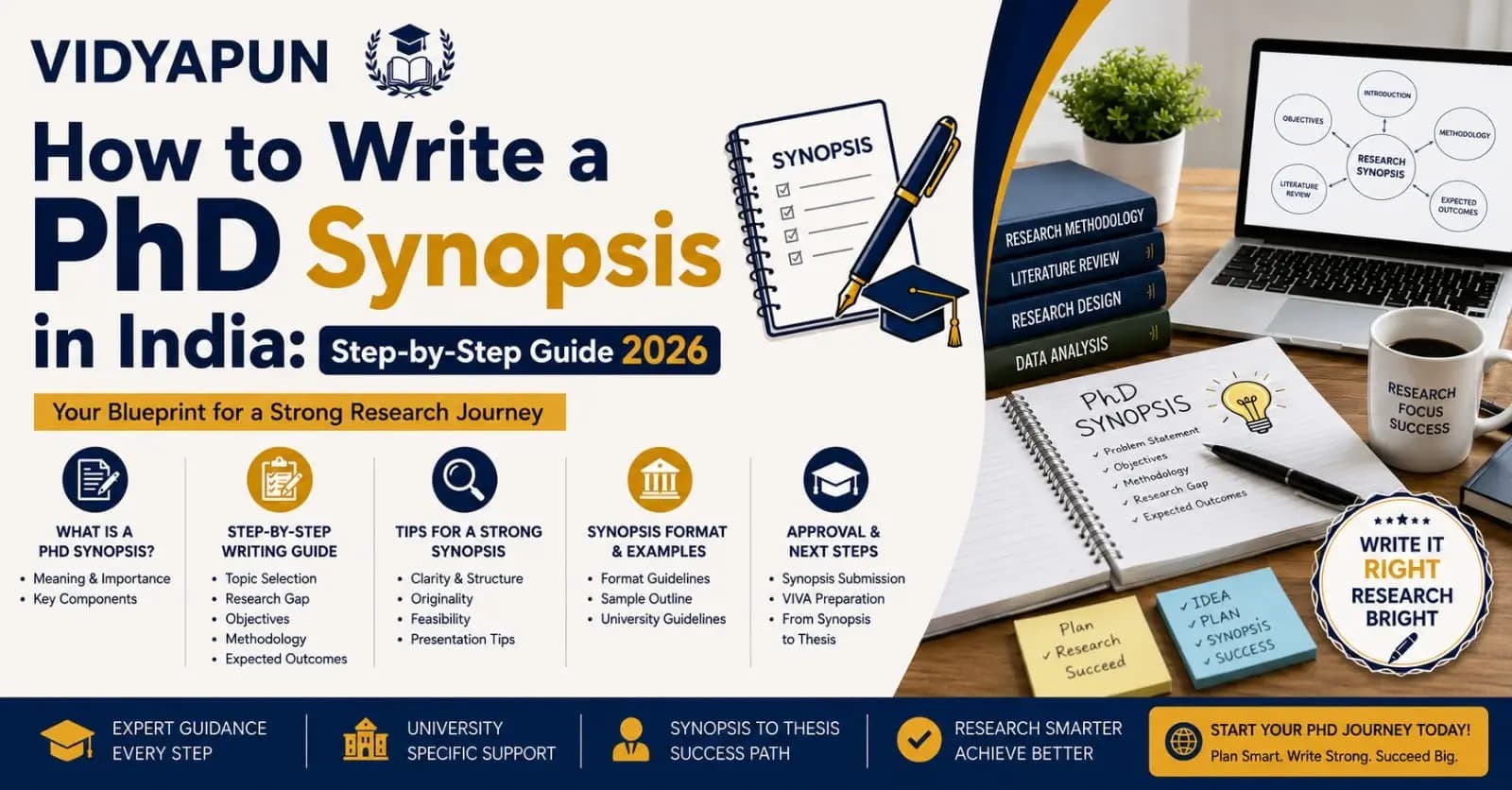
Starting a PhD is exciting, but before your research journey officially begins, there is one document that can determine whether your proposal gets approved or not—the PhD synopsis.
Many research scholars spend months selecting a topic, reviewing literature, and discussing ideas with supervisors. Yet when it comes to writing the synopsis, confusion often takes over. What should be included? How long should it be? What do universities expect? And how can you make your synopsis stand out?
If you are planning to pursue a doctoral degree in India in 2026, this guide will help you understand exactly how to write a PhD synopsis step by step.
Whether you are applying in education, management, commerce, engineering, social sciences, humanities, law, or healthcare, the basic structure remains similar.
Let's understand everything in simple language.
What Is a PhD Synopsis?
A PhD synopsis is a brief but detailed summary of your proposed research work. It explains what you plan to study, why the research is important, how you will conduct the study, and what outcomes you expect.
Think of it as a blueprint for your doctoral research.
Before granting approval, universities and research committees review your synopsis to evaluate:
- Research relevance
- Originality of topic
- Research objectives
- Methodology
- Feasibility of study
- Expected contribution
A well-written synopsis increases your chances of getting research approval faster.
Why Is a PhD Synopsis Important?
Many scholars focus heavily on thesis writing and underestimate the importance of the synopsis.
In reality, your synopsis creates the first impression of your research.
A strong synopsis helps:
- Demonstrate research clarity
- Show academic preparedness
- Define research direction
- Gain supervisor confidence
- Secure university approval
- Avoid future research complications
A weak synopsis often leads to revisions, delays, and confusion later during the PhD journey.
PhD Synopsis Format in India
Most Indian universities follow a similar format, although specific guidelines may vary.
A standard PhD synopsis generally includes:
- Title of the Research
- Introduction
- Background of the Study
- Statement of the Problem
- Research Gap
- Research Objectives
- Research Questions
- Hypotheses (if applicable)
- Literature Review
- Research Methodology
- Scope of the Study
- Significance of the Study
- Expected Outcomes
- Chapterization
- References
Following a structured format makes your proposal easier to evaluate.
Step 1: Choose a Clear Research Topic
Everything starts with selecting the right topic.
Many scholars choose broad topics that become difficult to manage later.
For example:
Instead of:
"Impact of Digital Technology on Education"
Choose:
"Impact of Artificial Intelligence-Based Learning Platforms on Student Engagement in Higher Education Institutions in India"
A focused topic makes research easier and improves originality.
Tips for Topic Selection
- Select a topic related to your specialization
- Choose an area with sufficient literature
- Ensure practical relevance
- Identify a clear research gap
- Avoid overly broad subjects
Remember, a good research topic solves a specific problem.
Step 2: Write a Strong Introduction
The introduction explains the context of your research.
This section should help readers understand:
- The subject area
- Current situation
- Existing challenges
- Importance of the topic
Avoid lengthy explanations.
Instead, present the issue logically and gradually move toward your research focus.
A good introduction creates curiosity and establishes the foundation of your study.
Step 3: Define the Research Problem
This is one of the most critical sections of a PhD synopsis.
The research problem explains exactly what issue your study intends to investigate.
Ask yourself:
- What problem exists?
- Why does it matter?
- Who is affected?
- Why is further research needed?
A clearly defined problem statement shows that your research has purpose and direction.
Step 4: Identify the Research Gap
One common reason synopsis proposals get rejected is the absence of a research gap.
A research gap refers to something previous studies have not fully explored.
You can identify gaps by reviewing:
- Journal articles
- Research papers
- Conference publications
- Government reports
- Books
Examples of research gaps include:
- Limited geographical coverage
- Outdated studies
- Contradictory findings
- Emerging technologies
- New policy changes
Your study should aim to fill one of these gaps.
Step 5: Develop Research Objectives
Research objectives explain what you want to achieve.
Good objectives are:
- Specific
- Measurable
- Achievable
- Relevant
- Research-focused
Examples:
- To analyze factors influencing online learning adoption.
- To evaluate the effectiveness of AI-based educational tools.
- To examine consumer behavior toward digital banking services.
Most PhD synopsis formats include three to five objectives.
Avoid writing too many objectives.
Step 6: Formulate Research Questions
Research questions guide the entire study.
These questions should directly align with your objectives.
Examples:
- What factors influence technology adoption among students?
- How effective are AI-powered learning platforms?
- What challenges do institutions face during implementation?
Well-defined research questions improve research consistency.
Step 7: Write the Literature Review
The literature review demonstrates your understanding of existing research.
This section summarizes previous studies relevant to your topic.
While writing:
- Use recent studies whenever possible
- Compare findings
- Identify patterns
- Highlight limitations
- Explain research gaps
Avoid simply listing authors and studies.
Instead, critically analyze existing literature and show how your research contributes something new.
Step 8: Explain Research Methodology
Research methodology tells evaluators how you plan to conduct your study.
This section should include:
Research Design
Will the study be:
- Qualitative
- Quantitative
- Mixed Methods
Data Collection Methods
Examples include:
- Surveys
- Interviews
- Questionnaires
- Observations
- Focus Groups
Sampling Technique
Mention:
- Target population
- Sample size
- Sampling method
Data Analysis
Specify how data will be analyzed.
Examples:
- SPSS
- Regression analysis
- Thematic analysis
- Structural Equation Modeling
A clear methodology strengthens the credibility of your research proposal.
Step 9: Define Scope of the Study
The scope explains what your research will cover.
This includes:
- Geographic boundaries
- Time period
- Industry or sector
- Target population
Defining scope prevents unrealistic expectations and keeps the study manageable.
Step 10: Explain the Significance of the Study
This section answers an important question:
Why does your research matter?
You should explain how the study will benefit:
- Researchers
- Policymakers
- Educational institutions
- Businesses
- Society
A strong significance section demonstrates practical and academic value.
Step 11: Describe Expected Outcomes
Although research findings are not yet available, you can discuss expected contributions.
Examples include:
- New theoretical insights
- Improved policy recommendations
- Practical frameworks
- Better understanding of emerging trends
Expected outcomes help reviewers understand the potential impact of the study.
Step 12: Prepare Tentative Chapterization
Most universities require a proposed chapter structure.
A common format includes:
Chapter 1
Introduction
Chapter 2
Review of Literature
Chapter 3
Research Methodology
Chapter 4
Data Analysis and Interpretation
Chapter 5
Findings, Conclusions, and Recommendations
This structure may vary depending on the discipline.
Step 13: Add References Properly
Never overlook references.
A synopsis without proper citations appears incomplete.
Use standard referencing styles such as:
- APA
- MLA
- Harvard
- Chicago
Follow your university guidelines carefully.
Ensure all cited sources are authentic and relevant.
Common Mistakes to Avoid While Writing a PhD Synopsis
Many scholars repeat the same errors.
Avoid:
Choosing an Overly Broad Topic
Broad topics become difficult to research effectively.
Weak Research Gap
Without a gap, your study lacks originality.
Unclear Objectives
Objectives should directly connect to the research problem.
Poor Literature Review
Do not summarize studies without analysis.
Methodology Confusion
Your methods must align with research objectives.
Plagiarism
Always write in your own words and cite sources properly.
Ignoring University Guidelines
Every university may have specific formatting requirements.
Following instructions carefully can save weeks of revisions.
Tips for Getting PhD Synopsis Approval Faster
If you want quicker approval:
- Choose a practical topic
- Conduct a detailed literature review
- Define a clear research gap
- Align objectives with methodology
- Maintain academic writing quality
- Follow university formatting rules
- Seek supervisor feedback before submission
Small improvements often make a significant difference during evaluation.
Final Thoughts
Writing a PhD synopsis may feel overwhelming initially, but it becomes manageable when approached systematically.
A strong synopsis is not about using complicated language or writing lengthy paragraphs. It is about presenting a clear, logical, and research-worthy idea that convinces reviewers of its value.
Spend adequate time refining your topic, identifying a research gap, developing meaningful objectives, and selecting the right methodology. The effort you invest at the synopsis stage can save months of corrections during your PhD journey.
Remember, a well-prepared synopsis is the first step toward a successful doctoral thesis.
Frequently Asked Questions (FAQs)
What is the ideal length of a PhD synopsis in India?
Most universities require a synopsis between 10 and 25 pages, depending on their guidelines.
Can I write a PhD synopsis without a supervisor?
You can prepare an initial draft, but supervisor guidance is highly recommended before submission.
How long does synopsis approval take?
Approval timelines vary by university but generally range from a few weeks to several months.
Is a literature review mandatory in a PhD synopsis?
Yes. A literature review is an essential component because it helps establish the research gap.
What is the difference between a research proposal and a PhD synopsis?
In many Indian universities, the terms are used interchangeably. However, a research proposal may contain more detailed planning than a synopsis.
Can a PhD synopsis be rejected?
Yes. Common reasons include unclear objectives, weak methodology, lack of originality, and inadequate literature review.
Need Expert Help With Your PhD Synopsis?
Writing a PhD synopsis requires more than academic knowledge—it requires proper research planning, gap identification, methodology selection, and university-compliant formatting.
Our experienced research mentors provide personalized support for PhD scholars across Education, Management, Commerce, Engineering, Social Sciences, Law, Healthcare, and other disciplines.
Contact vidyapun today and get expert guidance to prepare a professional PhD synopsis that strengthens your research proposal and moves you one step closer to doctoral success.
Website: www.vidyapun.com
Call / WhatsApp: +91 96438 02216