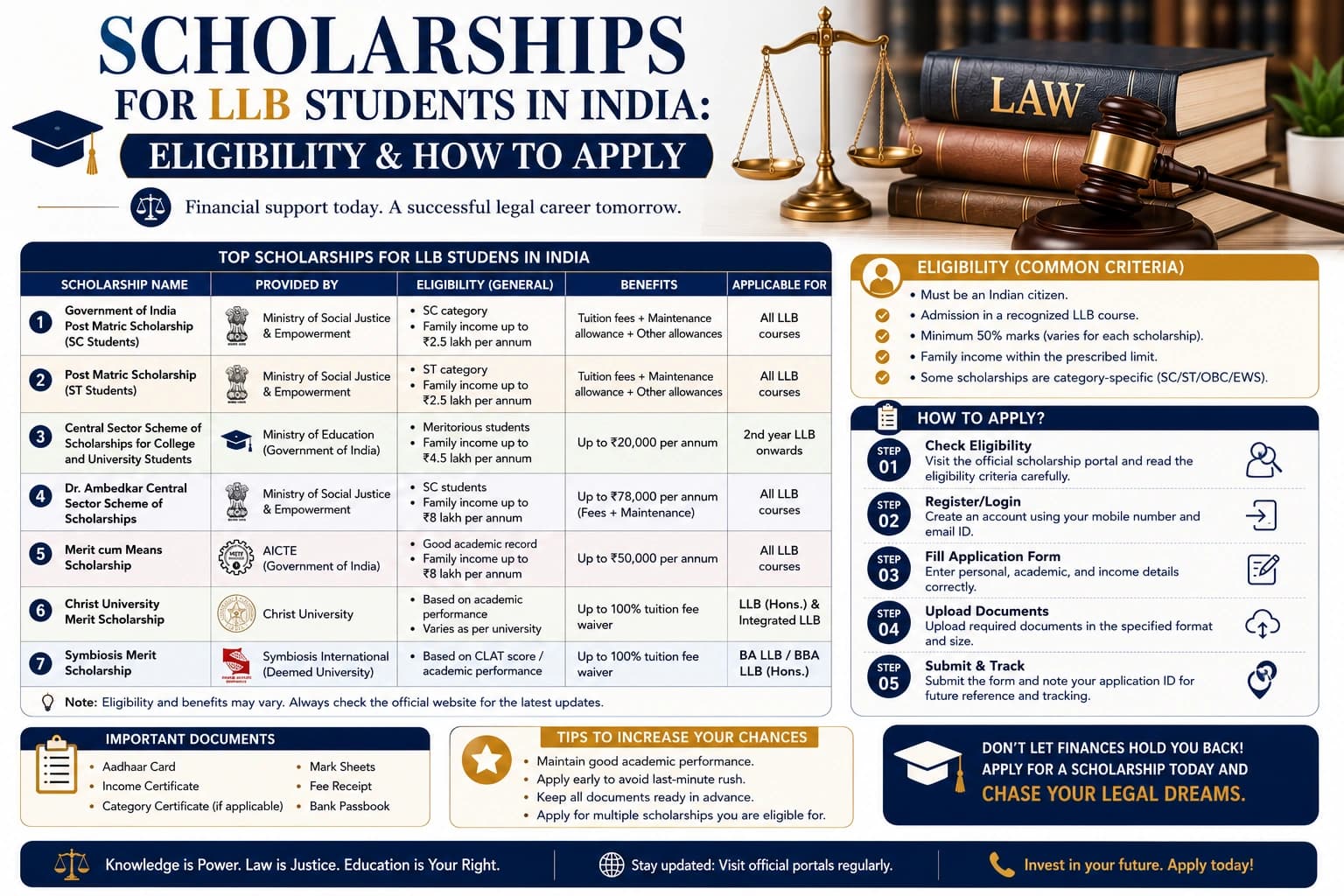
Law school fees, even at government colleges, add up — and for many families, a scholarship isn't a bonus, it's what makes an LLB possible in the first place. This guide covers the main categories of scholarships available to LLB students in India: what they cover, who qualifies, and how the application process actually works.
Government Scholarships for LLB Students
Central Sector Scheme of Scholarships
Administered through the National Scholarship Portal (NSP), this is one of the most widely applicable schemes for undergraduate students, including LLB students, based on a combination of merit and family income criteria. Renewal each year typically depends on maintaining a minimum academic performance.
Post-Matric Scholarships for SC/ST/OBC and Minority Students
Central and state governments jointly fund post-matric scholarship schemes specifically for SC, ST, OBC, and minority community students pursuing undergraduate courses, including LLB. These usually cover tuition fees (fully or partially) and sometimes a maintenance allowance, and are also applied for through the NSP or your respective state's scholarship portal.
EWS and Economically Weaker Section Scholarships
Several states run their own scholarship or fee-reimbursement schemes for economically weaker section students that overlap with, but are distinct from, the EWS reservation category used for admission — check your specific state education department's portal, since eligibility criteria and coverage differ from state to state.
State Government Scholarships for LLB
Most state governments run their own scholarship portals in addition to the National Scholarship Portal, often with schemes specific to that state's residents. Coverage, income thresholds, and application windows vary significantly by state, so check your state education department's scholarship portal directly rather than relying on a general national figure.
Minority Scholarships for Law Students
The central government and several state governments run dedicated minority scholarship schemes (pre-matric, post-matric, and merit-cum-means based) available to students from notified minority communities pursuing undergraduate degrees, including LLB. These are also applied for centrally through the NSP in most states.
Merit-Based Scholarships from Law Colleges and Universities
Many National Law Universities and private law colleges run their own internal scholarship or fee-waiver schemes for top-ranking students — based on your entrance exam rank (CLAT, AILET, or state CET) or your academic performance during the course. These are separate from government schemes and applied for directly through the college's admission or scholarship office, not the NSP.
Private and Corporate Scholarships for LLB Students
Several private trusts, foundations, and corporate CSR programs fund scholarships for law students, often targeting specific groups — first-generation learners, girl students, students from a particular region, or those pursuing public interest law. These vary year to year in availability and criteria, so it's worth checking directly with law schools' financial aid offices and specific trust websites rather than assuming a fixed annual scheme exists.
Documents You'll Typically Need
- Income certificate (for means-based and EWS-linked scholarships)
- Category certificate (SC/ST/OBC/minority, where applicable)
- Previous academic mark sheets
- Bank account details linked to Aadhaar (most disbursements are now via direct benefit transfer)
- Admission or fee receipt from your college
- Bonafide student certificate from your institution
How to Apply: Step by Step
- Register on the National Scholarship Portal (or your state's portal, if the scheme is state-specific)
- Fill in your personal, academic, and bank details
- Upload the required documents (income certificate, category certificate, mark sheets)
- Get your application verified by your institution — this step is often the one applicants forget, and an unverified application won't be processed
- Track your application status through the portal and respond promptly to any query raised during verification
- For college-specific merit scholarships, apply separately and directly through your college's financial aid or scholarship office
Common Mistakes That Delay or Reject Applications
- Missing the institutional verification step after online submission
- Submitting an expired category or income certificate
- Bank account not linked to Aadhaar, causing disbursement failures
- Applying after the scheme's deadline (most portals close applications strictly on the notified date)
- Assuming a central scheme automatically covers a state-specific scholarship — they usually require separate applications
Frequently Asked Questions
1. Can LLB students apply for the National Scholarship Portal scheme? Yes, undergraduate LLB students are generally eligible for schemes listed on the NSP, subject to each scheme's specific income and category criteria.
2. Are there scholarships specifically for LLB students, or only general undergraduate ones? Most government scholarships are general undergraduate schemes that LLB students qualify for; some law colleges and NLUs additionally run law-specific merit scholarships.
3. Do private LLB colleges offer scholarships? Many do, particularly merit-based fee waivers for top-ranking students, but these are set independently by each college — check directly with the institution's admission or financial aid office.
4. How do I check my scholarship application status? Through the National Scholarship Portal's applicant login, or your state portal if you applied through a state-specific scheme.
5. Is there a scholarship specifically for girl students pursuing LLB? Some states and private trusts run girl-child education schemes that extend to undergraduate courses including LLB — availability and criteria vary by state, so check your state's scholarship portal.
6. Do scholarships need to be renewed every year? Most means-based and merit-based government scholarships require annual renewal, contingent on maintaining minimum attendance and academic performance — check the specific renewal conditions for your scheme.
7. What is the income limit for EWS-based scholarships? This is set by government notification and can be revised, so confirm the current threshold on the NSP or your state portal rather than relying on an older figure.
8. What if my scholarship application is rejected during verification? Most portals and institutions allow a correction or re-submission window before final rejection — check your application status regularly and respond to any discrepancy notice promptly.
Related Reading
For the full admission document checklist, see Documents Required for LLB Admission. For how reservation interacts with scholarship eligibility, see LLB Reservation Policy Explained. Explore the full LLB Course page for admission details.
🌐 Website: www.vidyapun.com 📞 Call / WhatsApp: +91 96438 02216