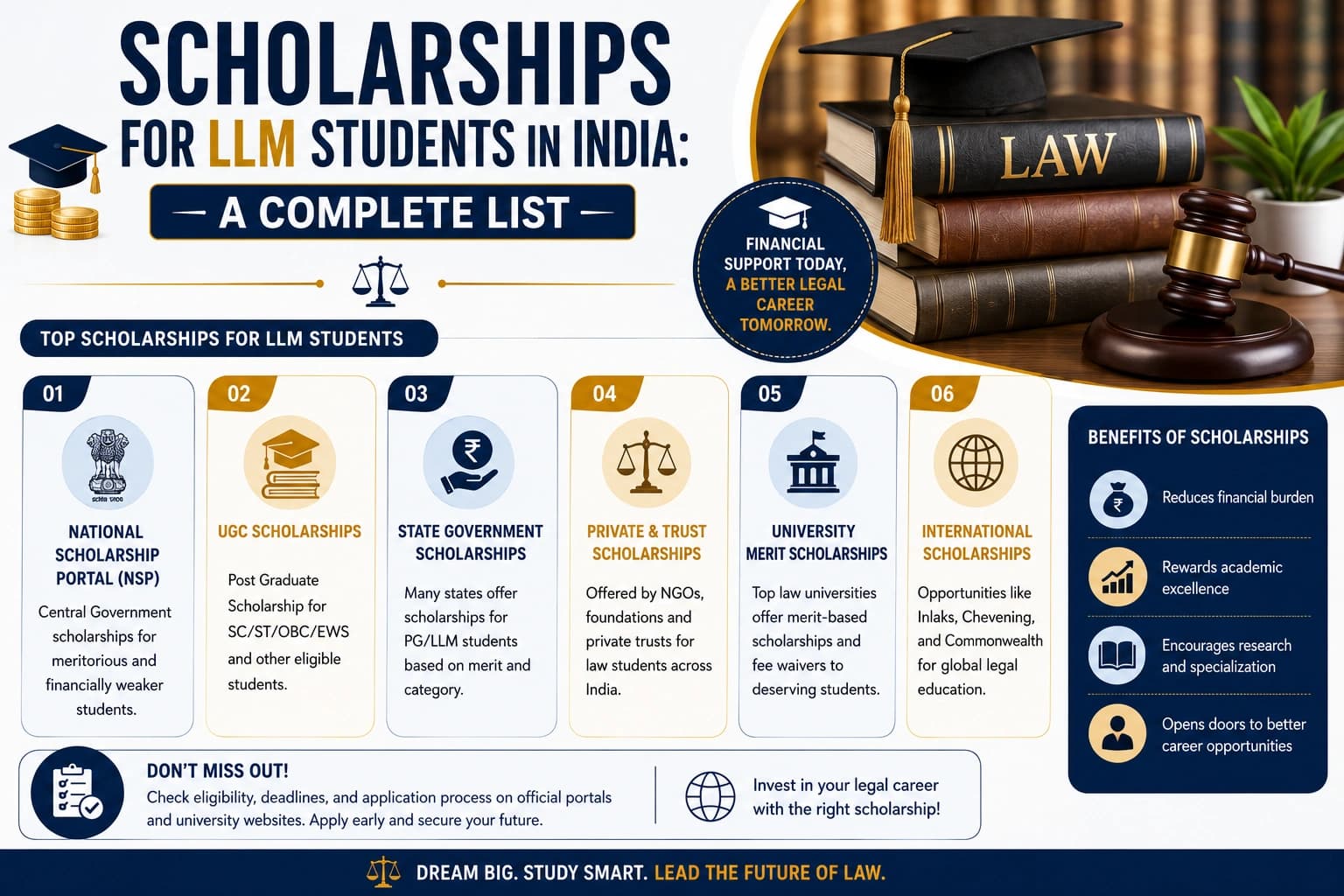
LLM fees can vary widely depending on the institution, and for many students, scholarships make the difference between choosing a program based on genuine fit versus choosing based purely on what's affordable. Yet scholarship information is often scattered — some schemes are run by the central government, others by individual states, and still others directly by universities, each with its own eligibility criteria and deadline.
This guide brings together the main categories of LLM scholarships available in India, what each typically requires, and how to actually go about applying.
Why Researching Scholarships Early Matters
Scholarship deadlines don't always align with admission deadlines, which catches many students off guard.
Scholarships vs Fee Waivers vs Assistantships
A scholarship typically provides a fixed or percentage-based reduction in fees or a stipend, a fee waiver reduces or removes tuition cost directly (often merit or need-based), and an assistantship (more common at the PhD level, though some LLM programs offer research or teaching assistantships) provides a stipend in exchange for research or teaching support. Understanding which type you're eligible for shapes how and when you apply.
How Scholarship Timelines Differ from Admission Timelines
Some scholarships require you to have a confirmed admission offer first, while others (particularly government schemes) have independent application windows that can open before or after your university admission process concludes. Track scholarship deadlines separately from your LLM admission timeline rather than assuming they align.
Government Scholarships for LLM Students
Central and state governments run several scholarship schemes relevant to postgraduate law students.
Central Government Schemes
Central schemes such as the National Fellowship for students from reserved categories, and broader central sector scholarship schemes for professional and postgraduate courses, are commonly available to eligible LLM students. Eligibility typically depends on category, family income, and academic merit — check the National Scholarship Portal for the current list of active schemes each year, since offerings and criteria can change.
State Government Schemes
Many state governments run their own postgraduate scholarship schemes, often specifically for students domiciled in that state, with income and merit criteria similar to central schemes but with state-specific application portals and deadlines. If you're studying in or are domiciled in a particular state, check that state's higher education or social welfare department portal directly.
Merit-Based Scholarships from Universities
Many universities offer their own scholarships independent of government schemes, based purely on academic performance.
Entrance Exam Rank-Based Scholarships
Some universities offer partial or full fee waivers to top-ranking candidates in exams like CLAT PG, scaled down for lower ranks within a defined band. Check whether your target university publishes a rank-to-scholarship scale in its admission brochure.
Academic Merit Scholarships
Separate from entrance rank, many universities also offer scholarships based on your LLB percentage or overall academic record, sometimes combined with performance during your LLM itself (continuing eligibility tied to maintaining a minimum grade each semester). Confirm whether a university's merit scholarship is a one-time award or something you need to requalify for annually.
Need-Based and Income-Linked Scholarships
These scholarships specifically target students who may otherwise be unable to afford the program.
Income Certificate-Based Aid
Many government and some private scholarships require an income certificate below a specified threshold, providing partial or full fee support based on documented financial need rather than academic rank alone.
University-Specific Financial Aid Programs
Beyond government-linked schemes, some universities maintain their own internal financial aid funds for students who can demonstrate need, often assessed through a separate application and sometimes an interview. These aren't as widely publicized as merit scholarships, so it's worth asking your target university's admission or student welfare office directly about internal aid options.
Category-Specific Scholarships (SC/ST/OBC/EWS/PwD)
Reserved category students have access to a wider set of scholarship options tied specifically to their category status.
Central and State Category Schemes
Post-matric and postgraduate scholarship schemes for SC, ST, and OBC students are available at both central and state levels, generally requiring a valid category certificate and often an income certificate as well. EWS-specific scholarship schemes have also expanded in recent years at some institutions.
PwD-Specific Scholarships
Scholarships specifically for Persons with Disabilities are available through central schemes and at many universities, sometimes with additional support like assistive technology funding alongside fee concessions. Check both government portals and your specific university's disability support office for the full range of options.
Scholarships for Women in Law
Several scholarships specifically target women pursuing legal education, aimed at improving representation in the legal profession.
Government and NGO-Run Programs
Various government schemes and legal education-focused NGOs and foundations run scholarships specifically for women in law, often at the postgraduate level given the aim of increasing female representation in senior legal roles. These are less universally known than general merit scholarships, so dedicated research into legal education foundations and bar association initiatives can surface options not listed on mainstream scholarship portals.
University-Specific Women's Scholarships
Some universities maintain internal scholarships specifically for women in their LLM programs, sometimes tied to specific specializations like human rights or family law where representation gaps are more pronounced. Ask your target university's admission office directly, since these aren't always prominently advertised.
International and Study-Abroad Scholarships
If you're considering an LLM abroad, a different set of scholarship options opens up.
Government-Sponsored International Scholarships
Schemes like the Commonwealth Scholarship and various country-specific government scholarships (Chevening, Fulbright, and others depending on your target country) fund postgraduate law study abroad for eligible Indian students, typically covering tuition and a living stipend. Application processes and deadlines are usually well in advance of the academic year, so research these early if studying abroad is part of your plan.
University-Specific International Scholarships
Many foreign universities also offer their own merit or need-based scholarships specifically for international students, sometimes with dedicated funding for students from India or South Asia. Check each university's international admissions office directly, since these vary significantly by institution.
How to Find and Apply for LLM Scholarships
With so many scattered sources, having a systematic search approach saves considerable time.
Where to Search Systematically
Start with the National Scholarship Portal for central and state government schemes, then check your shortlisted universities' official scholarship or financial aid pages directly, and finally search category-specific or women-in-law foundations relevant to your profile. Building this list before you apply for admission means you're not scrambling to find funding after a seat is already confirmed.
Application Documents Typically Required
Most scholarship applications require your LLB mark sheets and degree certificate, income certificate (for need-based schemes), category certificate (for reserved category schemes), bank account details for direct benefit transfer, and sometimes a statement of purpose or recommendation letter. Keep these ready alongside your admission documents, since the two processes often overlap in timing.
Common Mistakes Students Make When Applying for Scholarships
A few recurring issues cause otherwise eligible students to miss out on funding they qualify for.
Missing Independent Scholarship Deadlines
The most common mistake is assuming scholarship deadlines align with admission deadlines. Many government scholarship portals operate on entirely separate academic-year cycles, so track these independently rather than assuming your university will remind you.
Not Renewing Multi-Year Scholarships
For scholarships that continue across your full LLM (particularly merit-based ones tied to maintaining a minimum grade), some students forget that many require annual renewal documentation. Missing a renewal deadline can mean losing the scholarship mid-program, so calendar these renewal dates as carefully as the original application deadline.
Frequently Asked Questions
1. What government scholarships are available for LLM students in India? Central schemes for reserved categories and general postgraduate students, plus state-specific schemes for domiciled students, are commonly available. Check the National Scholarship Portal and your state's education department for the current year's active schemes.
2. Do universities offer merit scholarships for LLM based on CLAT PG rank? Many do, typically offering partial or full fee waivers on a sliding scale tied to your entrance rank. Check your target university's admission brochure for its specific rank-to-scholarship structure.
3. Are there scholarships specifically for women pursuing LLM? Yes, both government/NGO-run programs and some university-specific scholarships target women in law, aimed at improving representation in senior legal roles. These aren't always widely advertised, so direct research is often needed.
4. Can SC/ST/OBC students get additional scholarships for LLM? Yes, category-specific postgraduate scholarship schemes are available at central and state levels, generally requiring a valid category certificate and, for some schemes, an income certificate as well.
5. What documents are needed to apply for an LLM scholarship? Typically LLB mark sheets and degree certificate, income certificate (for need-based aid), category certificate (if applicable), bank details, and sometimes a statement of purpose or recommendation letter.
6. Are there scholarships for LLM abroad for Indian students? Yes, government-sponsored international scholarships (such as Commonwealth Scholarships and various country-specific schemes) and university-specific international scholarships are both available, usually with early application deadlines well ahead of the academic year.
7. Do LLM scholarships need to be renewed every year? Many merit-based scholarships that span your full LLM require annual renewal, often tied to maintaining a minimum grade each semester. Check the specific renewal requirements for any multi-year scholarship you receive.
8. Where can I find a complete, updated list of LLM scholarships? Start with the National Scholarship Portal for government schemes, then check your shortlisted universities' financial aid pages directly, and search category-specific or women-in-law foundations relevant to your profile, since no single portal lists every available option.
Ready to explore your LLM options alongside scholarship planning? Review full details on the Master of Laws (LLM) page and your BA LLB Course foundation. If you're still preparing for an entrance exam, see our LLM Entrance Exam Guide, narrow down your focus with our Best LLM Specializations guide, or check our LLM Abroad Guide if studying overseas is part of your plan.
Talk to our Admission Expert about scholarship options for your specific profile:
🌐 Website: www.vidyapun.com 📞 Call / WhatsApp: +91 96438 02216