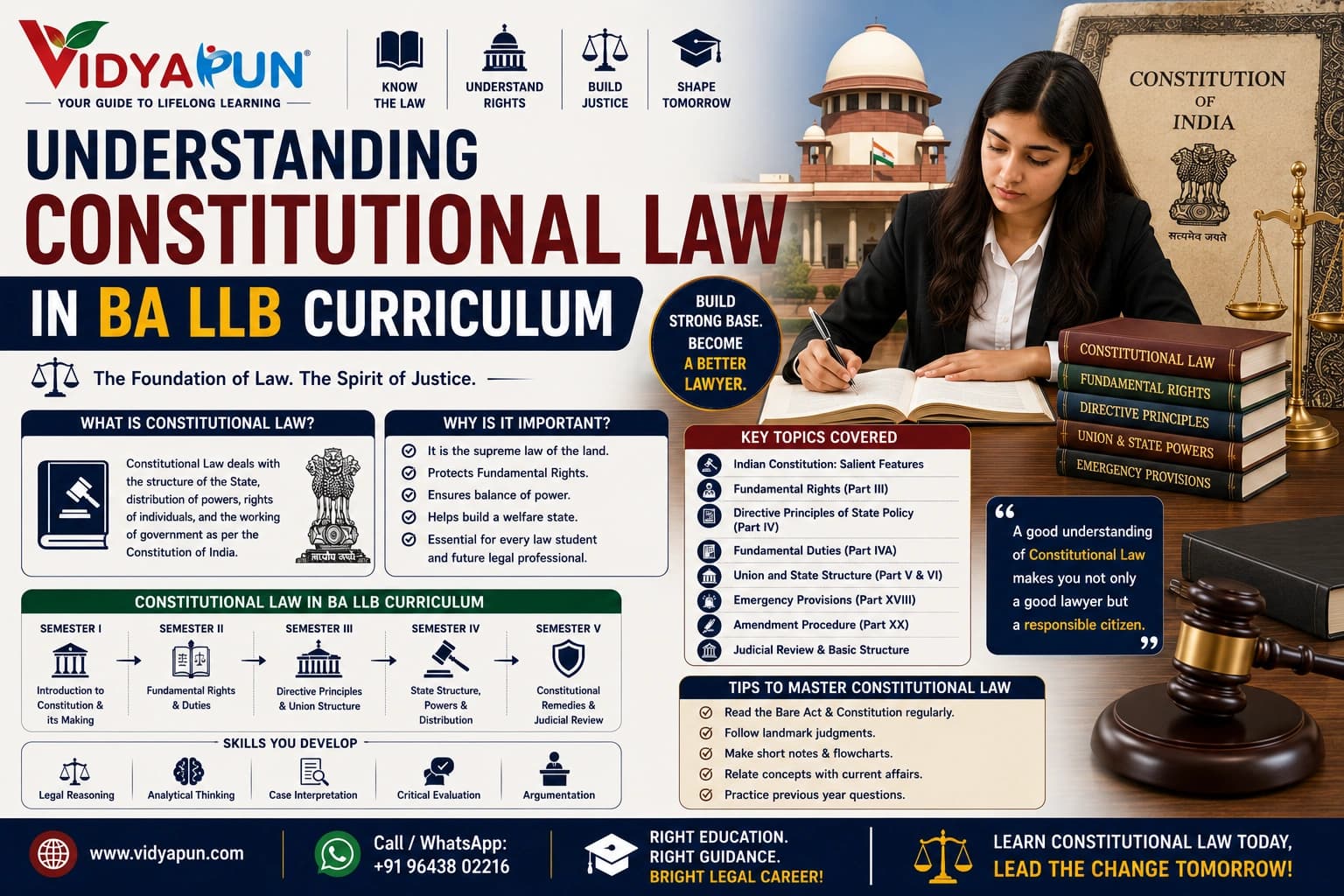
If there's one subject in BA LLB that quietly underlies almost everything else you study, it's Constitutional Law. Every other area of law — criminal, civil, administrative, even corporate — ultimately operates within the framework the Constitution establishes, which is exactly why this subject gets so much curricular weight from your first year onward.
This guide introduces the core structure of Constitutional Law as taught in BA LLB, the concepts you'll need to genuinely understand rather than memorize, and how to study the subject effectively.
Why Constitutional Law Is Central to Legal Education
Understanding why this subject carries so much weight shapes how seriously you should engage with it from day one.
The Constitution as the Foundation of Indian Law
The Constitution of India is the supreme legal document in the country — every statute, government action, and judicial decision must ultimately be consistent with it. Understanding constitutional principles gives you the framework within which every other area of law operates.
How This Subject Shapes Everything Else You Study
Concepts you learn in Constitutional Law — like fundamental rights, judicial review, and the separation of powers — reappear constantly across Criminal Law, Administrative Law, and even Corporate Law, particularly whenever a case touches on individual rights or the limits of government or regulatory power.
Structure and Basic Framework of the Indian Constitution
Before diving into specific doctrines, it helps to understand the Constitution's overall architecture.
Preamble, Parts, and Schedules
The Constitution is organized into a Preamble (setting out its foundational values), numbered Parts covering different subject areas (fundamental rights, directive principles, the structure of government, and more), and Schedules containing detailed lists and technical provisions. Familiarity with this overall structure makes navigating specific provisions significantly easier.
Federal Structure and Distribution of Powers
India's Constitution establishes a federal structure with a distribution of legislative powers between the central government and states, organized through defined lists of subjects each level can legislate on. Understanding this distribution is essential background for later subjects like Administrative Law and any specialization touching on regulatory power.
Fundamental Rights: What Every Law Student Must Know
This is typically the most heavily emphasized portion of introductory Constitutional Law coursework.
Key Rights Under Part III
Part III of the Constitution guarantees fundamental rights including equality before law, protection of various freedoms (like speech and expression), protection of life and personal liberty, and the right to constitutional remedies allowing citizens to approach courts directly when these rights are violated.
Reasonable Restrictions and Limitations
Fundamental rights aren't absolute — the Constitution permits reasonable restrictions on most rights in the interest of things like public order, morality, or national security. Understanding how courts have interpreted "reasonable restriction" over time is a recurring theme throughout constitutional law study.
Directive Principles and the Basic Structure Doctrine
Beyond enforceable rights, the Constitution also sets out broader governance goals and has developed important judicially-created doctrines.
Directive Principles of State Policy
These are guiding principles for governance — covering areas like social welfare, economic policy, and equitable distribution of resources — that aren't directly enforceable in court but are meant to inform how the state governs and legislates.
The Basic Structure Doctrine Explained
Developed through landmark judicial interpretation (most notably in the Kesavananda Bharati case), the basic structure doctrine holds that certain fundamental features of the Constitution cannot be altered even through a constitutional amendment. This doctrine is one of the most significant judicial contributions to Indian constitutional law and a near-certain exam topic.
Judicial Review and the Role of Constitutional Courts
Understanding how courts actually enforce constitutional principles ties the whole subject together.
How Judicial Review Works
Judicial review is the power of courts to examine whether laws and government actions comply with the Constitution, and to strike down those that don't. This power is central to how constitutional rights are actually enforced in practice, rather than existing only on paper.
Landmark Cases Every Student Should Know
Beyond Kesavananda Bharati, cases like Maneka Gandhi v. Union of India (which significantly expanded the interpretation of the right to life and personal liberty) are foundational to understanding how constitutional interpretation has evolved. Building familiarity with these landmark cases — not just their outcome but their reasoning — is essential preparation for exams, moot court, and later legal practice.
How to Study Constitutional Law Effectively
A few specific study habits make this subject considerably more manageable.
Reading the Bare Text Alongside Commentary
Read the actual constitutional text for provisions you're studying, not just textbook summaries — commentary is useful for interpretation and context, but genuine familiarity with the actual language builds a stronger foundation than relying on secondary sources alone.
Following Current Constitutional Developments
Constitutional law is not static — new judgments continue to interpret and sometimes reshape existing doctrine. Following current constitutional cases and developments, even informally through legal news, builds a more dynamic understanding than treating the subject as a fixed body of historical material.
Frequently Asked Questions
1. Why is Constitutional Law considered so important in BA LLB?
Because it establishes the framework within which every other area of law operates — concepts like fundamental rights and judicial review recur constantly across Criminal, Administrative, and other legal subjects.
2. What are fundamental rights in the Indian Constitution?
Rights guaranteed under Part III of the Constitution, including equality before law, protected freedoms like speech and expression, protection of life and personal liberty, and the right to approach courts directly for enforcement.
3. What is the basic structure doctrine?
A judicially developed doctrine, most notably from the Kesavananda Bharati case, holding that certain fundamental features of the Constitution cannot be altered even through a constitutional amendment.
4. What is judicial review in constitutional law?
The power of courts to examine whether laws and government actions comply with the Constitution, and to strike down those that don't — the primary mechanism through which constitutional rights are enforced.
5. Are fundamental rights absolute?
No, most fundamental rights are subject to reasonable restrictions the Constitution permits in the interest of considerations like public order, morality, or national security.
6. How should I study Constitutional Law effectively?
Read the actual constitutional text alongside commentary rather than relying only on textbook summaries, and follow current constitutional developments to build a dynamic rather than purely historical understanding.
Ready to build a strong foundation from day one? Explore full details on the BA LLB course page, or use Vidyapun's Admission Chances Predictor if you're still finalizing your college choice.
Still have questions about your BA LLB coursework? Reach out to our counsellors directly.
🌐 Website: www.vidyapun.com 📞 Call / WhatsApp: +91 96438 02216