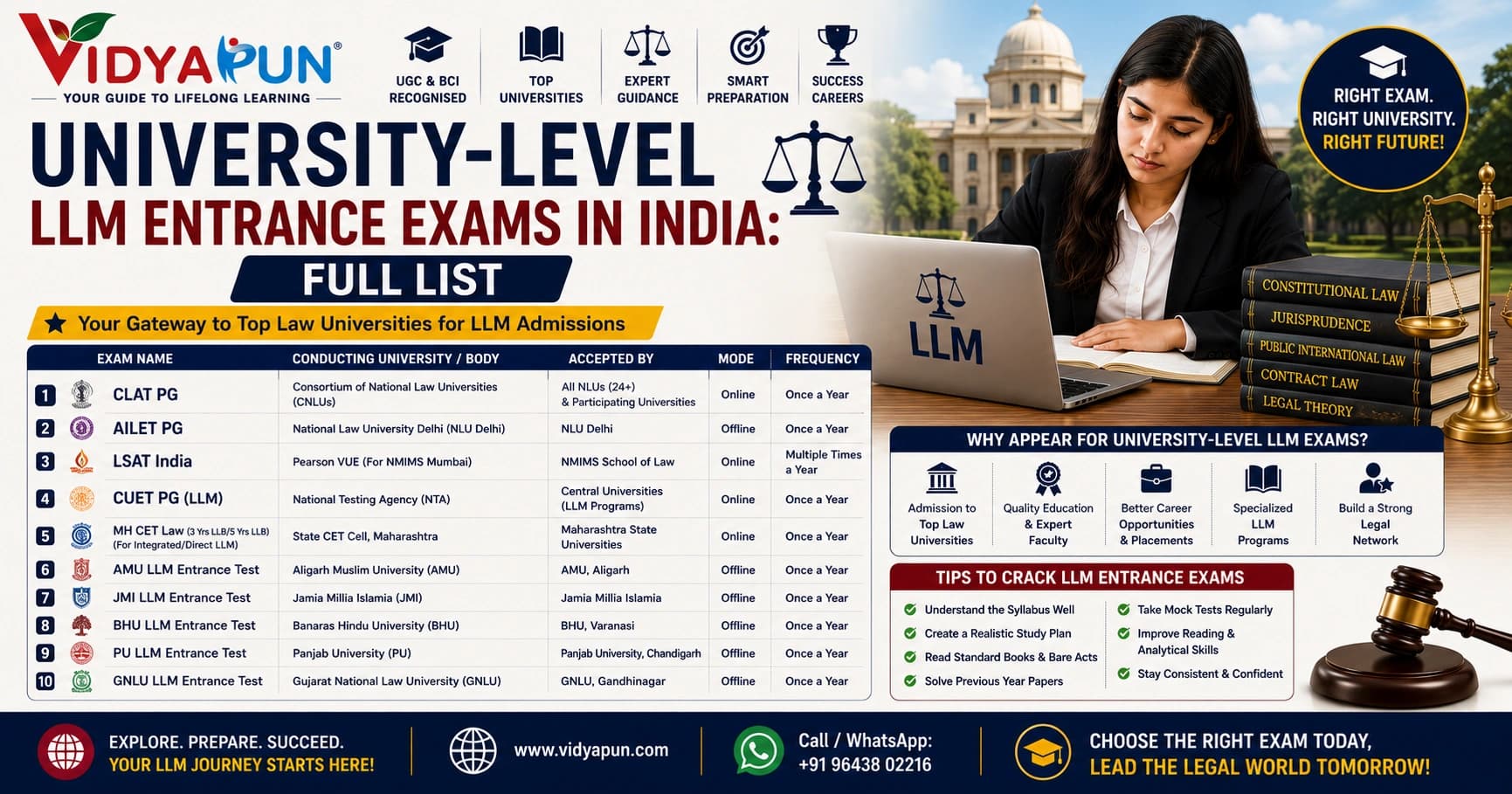
A lot of guidance online still describes universities like Delhi University as having "their own" separate LLM entrance exam — that's outdated for several major institutions now. Here's the current, accurate landscape: which exams are genuinely university-specific, which universities have folded into CUET PG, and which admit without any entrance exam at all.
The Three Categories of LLM Admission Routes in India
Before going university by university, it helps to understand the three broad buckets every institution falls into.
National Consortium Exams
CLAT PG and AILET PG serve the wider NLU network and NLU Delhi respectively — see our dedicated guides on AILET PG for the NLU Delhi route specifically.
CUET PG (A Growing, Shared Route)
An increasing number of central universities have moved their LLM admission onto the NTA-conducted CUET PG exam, rather than running an independent university-specific test.
Genuinely Independent University Exams
A smaller, shrinking group of universities still conduct their own distinct LLM entrance test, separate from both the Consortium exams and CUET PG.
Universities That Have Moved to CUET PG
This is the biggest, most commonly misunderstood category — treat any claim of a separate "university exam" for these institutions with caution.
Delhi University
Contrary to older guidance still circulating online, Delhi University's LLM admission (both the 2-year and 3-year programmes) is now based on CUET PG (Law) scores, conducted by the NTA, with seat allotment through DU's own Common Seat Allocation System (CSAS-PG) portal. There is no longer a separate, independently-set DU LLM entrance paper.
Banaras Hindu University (BHU)
BHU's LLM admission also runs through CUET PG scores, similar to DU — see our state-wise universities guide for more on BHU's broader admission structure.
Other Central Universities
Several other central universities across India have similarly adopted CUET PG as their admission route for postgraduate law programmes — the trend has been consistently toward consolidation onto this shared national exam rather than maintaining independent tests.
Universities That Still Run Their Own Independent LLM Entrance Exam
This smaller group is where "university-level entrance exam" genuinely still applies in the traditional sense.
Aligarh Muslim University (AMU)
AMU continues to conduct its own entrance test for LLM admission, distinct from both CUET PG and the Consortium exams — consistent with its approach at the undergraduate level, where it also runs a separate BA LLB entrance test rather than using CUET or CLAT.
O.P. Jindal Global Law School
Following the discontinuation of LSAT India, Jindal Global runs its own JSAT Law exam for its 3-year LLB, LLM, and BA in Law programmes — a genuinely independent, institution-specific test.
Select State and Deemed Universities
A number of state and deemed universities continue to run their own LLM entrance processes rather than adopting CUET PG, particularly where the university hasn't opted into the CUET framework for postgraduate admission. Always check the specific university's current-year admission bulletin, since this landscape shifts as more institutions adopt CUET PG each cycle.
Universities That Admit to LLM on Merit, Without Any Entrance Exam
Not every LLM route requires clearing a competitive test at all.
Merit-Based Admission Using LLB Marks
Some universities, particularly certain state universities, admit LLM candidates directly based on their LLB qualifying marks, without a separate entrance exam layer — worth checking specifically if you'd rather avoid another competitive test altogether.
Why This Route Is Often Overlooked
Because CLAT PG, AILET PG, and CUET PG dominate LLM admission conversations online, merit-based state university routes get relatively little coverage — despite being a genuinely simpler path for candidates whose primary goal is completing the LLM itself rather than targeting a specific top-ranked institution.
How Eligibility Differs Across These Routes
Eligibility criteria follow a broadly similar shape, but small differences matter.
The Common Baseline
Most routes require a completed LLB (3-year or 5-year) from a Bar Council of India-recognised institution, with a minimum aggregate percentage — commonly in the 50-55% range for general category candidates, with relaxation for reserved categories.
Where Institutions Diverge
Some universities set a higher minimum percentage for their own independent exam route compared to CUET PG-based admission at a comparable institution — always verify against the specific university's current notification rather than assuming a uniform standard across all routes.
Choosing Which Route to Prepare For
With this many options, deciding where to focus matters as much as knowing the list exists.
If You Want Maximum Institutional Reach
CUET PG is increasingly the broadest single exam to prepare for, given how many central universities (including DU and BHU) now use it — one exam, multiple institutional options.
If a Specific Institution Is Your Priority
For AMU, Jindal Global, or a specific state university with its own process, prepare specifically for that institution's exam pattern rather than assuming your CUET PG or CLAT PG preparation transfers directly — question style and subject weightage can differ meaningfully.
If You Simply Want to Complete an LLM Without Chasing a Specific Brand-Name Institution
A merit-based state university route, or a well-regarded university within CUET PG's network at a less competitive cutoff, can be a perfectly sound choice — institution prestige matters more for certain career paths (academia, top-tier corporate recruitment) than others.
A Quick Reference Table
| Route | Examples | Conducted By |
| National Consortium | NLU network (via CLAT PG), NLU Delhi (via AILET PG) | Consortium of NLUs / NLU Delhi |
| CUET PG | Delhi University, BHU, several other central universities | NTA |
| Independent University Exam | AMU, Jindal Global (JSAT Law) | Respective university |
| Merit-Based, No Exam | Select state universities | Respective university |
Note: this landscape shifts as more universities adopt CUET PG each admission cycle — always confirm current-year status directly with your target institution before assuming which category it falls into.
Frequently Asked Questions
1. Does Delhi University still conduct its own separate LLM entrance exam?
No. DU's LLM admission is now based on CUET PG scores, conducted by the NTA, not an independently-set DU exam — a common outdated claim still found in older guidance online.
2. Which universities still run a genuinely independent LLM entrance exam?
Aligarh Muslim University and O.P. Jindal Global Law School (via its JSAT Law exam) are notable examples that continue to conduct their own tests rather than using CUET PG or the Consortium exams.
3. Can I get an LLM without taking any entrance exam?
Yes, some state universities admit LLM candidates based on LLB qualifying marks alone, without a separate entrance test — check specific state university admission processes.
4. Is CUET PG the same exam for both DU and BHU?
Yes, both use the shared, NTA-conducted CUET PG (Law) paper, though each university applies its own cutoff and counselling process based on the same scores.
5. Should I prepare differently for AMU's LLM exam compared to CUET PG?
Yes — AMU's exam is set independently by the university and may differ in structure and emphasis from the CUET PG Law paper, so prepare specifically for AMU's own pattern if that's your target.
6. Is a merit-based LLM (without an entrance exam) less valuable than one requiring an exam?
Not inherently — value depends more on the specific institution's reputation and your own specialization and output than on whether admission required an entrance exam.
7. How do I find out if a university still has its own entrance exam or has moved to CUET PG?
Check the specific university's current-year admission notification directly, since more institutions continue to adopt CUET PG each cycle and outdated information circulates widely online.
8. Which route offers the widest range of institutional choices?
CUET PG currently offers the broadest reach, given the number of central universities, including DU and BHU, that now use it for LLM admission.
Related Reading
For NLU Delhi's exam specifically, see our AILET PG Complete Exam Guide. For general LLM admission planning, see the LLM Admission Guide and explore Best LLM Specializations. Review the Master of Laws (LLM) and LLB Course pages, or check Law Admission guidance more broadly.
🌐 Website: www.vidyapun.com 📞 Call / WhatsApp: +91 96438 02216