
If you've just started your BA LLB and keep hearing seniors talk about "mooting," you're not alone in wondering exactly what it means and why everyone seems to take it so seriously. Moot court is one of the most talked-about — and most valuable — parts of a five-year law degree, and understanding it early can shape how you approach the rest of your law school journey.
What Is Moot Court? A Beginner's Explanation
At its core, moot court is a simulated court proceeding where law students argue a hypothetical legal case in front of judges, exactly as practising advocates would in a real courtroom.
Simulated Court Proceedings Explained
You're assigned a fictional case (called a "moot problem"), split into teams representing opposing sides, and asked to research, draft, and argue the matter as if it were a real dispute before a court — right down to courtroom etiquette and procedure.
Key Terms Every Beginner Should Know
A few terms will come up constantly: "memorial" (your written submission), "mooter" (a student arguing the case), "researcher" (a team member who supports research but doesn't argue), and "bench" (the panel of judges evaluating your performance).
Why Moot Court Matters During Your BA LLB
Moot court isn't just an extracurricular activity — for many recruiters and law schools, it's a genuine signal of practical ability.
Bridging Theory and Practice
Your classroom subjects teach you what the law says. Moot court is where you learn how to actually use it — applying legal principles to a specific, contested set of facts under pressure, the way real practice demands.
Boosting Your Resume and Career Prospects
Strong moot court performance, especially at national or international competitions, is one of the most recognisable achievements on a law student's resume, and it's frequently discussed directly in law firm and judicial clerkship interviews.
How Moot Court Competitions Work
Most moot court competitions follow a broadly similar structure, even though the specific case and rules change each time.
Memorial Drafting and Written Rounds
Before the oral rounds begin, teams submit written memorials — structured legal arguments supporting their assigned side — which are evaluated separately and often carry significant weight in the overall competition score.
Oral Rounds and Judging Criteria
In the oral rounds, mooters argue their case in front of a judging panel, who evaluate legal knowledge, clarity of argument, response to questions, and courtroom presentation — not just who "wins" the hypothetical case.
Skills You Build Through Moot Court
The reason moot court gets so much attention isn't the competition itself — it's the skill-building that comes with it.
Legal Research and Argumentation
You'll develop the ability to research case law and statutes efficiently, build a coherent legal argument from scratch, and anticipate counter-arguments — skills that translate directly into real legal practice.
Public Speaking and Courtroom Confidence
Standing in front of judges and responding to unexpected questions on the spot builds a kind of composure and quick thinking that's difficult to develop any other way during law school.
How to Prepare for Your First Moot Court
Getting started can feel intimidating, but a structured approach makes the first competition far more manageable.
Choosing Your First Moot Court Competition
Look for intra-college or beginner-friendly external moots first, rather than jumping straight into a highly competitive national event — this lets you learn the format without the pressure of facing seasoned mooters.
Building a Practice Routine With Your Team
Start early: divide research work clearly among your team, schedule regular practice rounds well before the actual competition, and get feedback from seniors or faculty on your arguments before the final round.
Common Mistakes First-Time Mooters Make
A few recurring mistakes account for most of the difference between a strong first moot and a forgettable one.
Weak Research and Poor Time Management
Starting research too late, relying on secondary sources instead of primary case law, and not leaving enough time to revise your memorial are the most common reasons first-time teams underperform.
Ignoring Court Etiquette and Presentation
Judges notice more than just your legal argument — how you address the bench, how you handle being interrupted with questions, and general courtroom decorum all factor into your score, and they're easy to overlook when you're focused purely on content.
Final Thoughts
Moot court can feel intimidating the first time you hear about it, but it's really just structured, guided practice at the core skill your entire law degree is building toward: constructing and arguing a legal case. Start early, pick a beginner-friendly competition for your first attempt, and treat every round — win or lose — as practice for the practising lawyer you're becoming.
Curious how strong your BA LLB profile is shaping up so far? Check Your Admission Chances with Vidyapun's free assessment tool.
Frequently Asked Questions
1. What exactly is moot court in law school?
Moot court is a simulated courtroom exercise where law students research, draft, and orally argue a hypothetical legal case in front of judges, mirroring real courtroom procedure.
2. Is moot court compulsory during BA LLB?
It depends on the college — some make at least one moot court a mandatory part of the curriculum, while others treat it as an optional but highly encouraged extracurricular activity.
3. What is a "memorial" in moot court?
A memorial is the written legal submission each team prepares in support of their assigned side, typically evaluated separately from (and often alongside) the oral argument rounds.
4. When should I start participating in moot court during BA LLB?
Most students start with intra-college or beginner-friendly moots in their first or second year, before moving on to more competitive national and international moots later in the programme.
5. How does moot court help with a legal career?
Strong moot court performance is a well-recognised signal of practical legal skill and is frequently discussed in law firm and judicial clerkship interviews, alongside academic performance.
6. Do I need to be a confident public speaker to do well in moot court?
Not initially — public speaking confidence is something moot court itself helps you build. Most first-time mooters improve significantly after just one or two competitions.
🌐 Website: www.vidyapun.com 📞 Call / WhatsApp: +91 96438 02216
Free admission guidance
Tell us what you are looking for. A counsellor will call you.
Read next

BA LLB Campus Placements: What to Expect
A realistic guide to BA LLB campus placements — how the process works, what placement statistics actually mean, typical recruiters, and how to prepare.
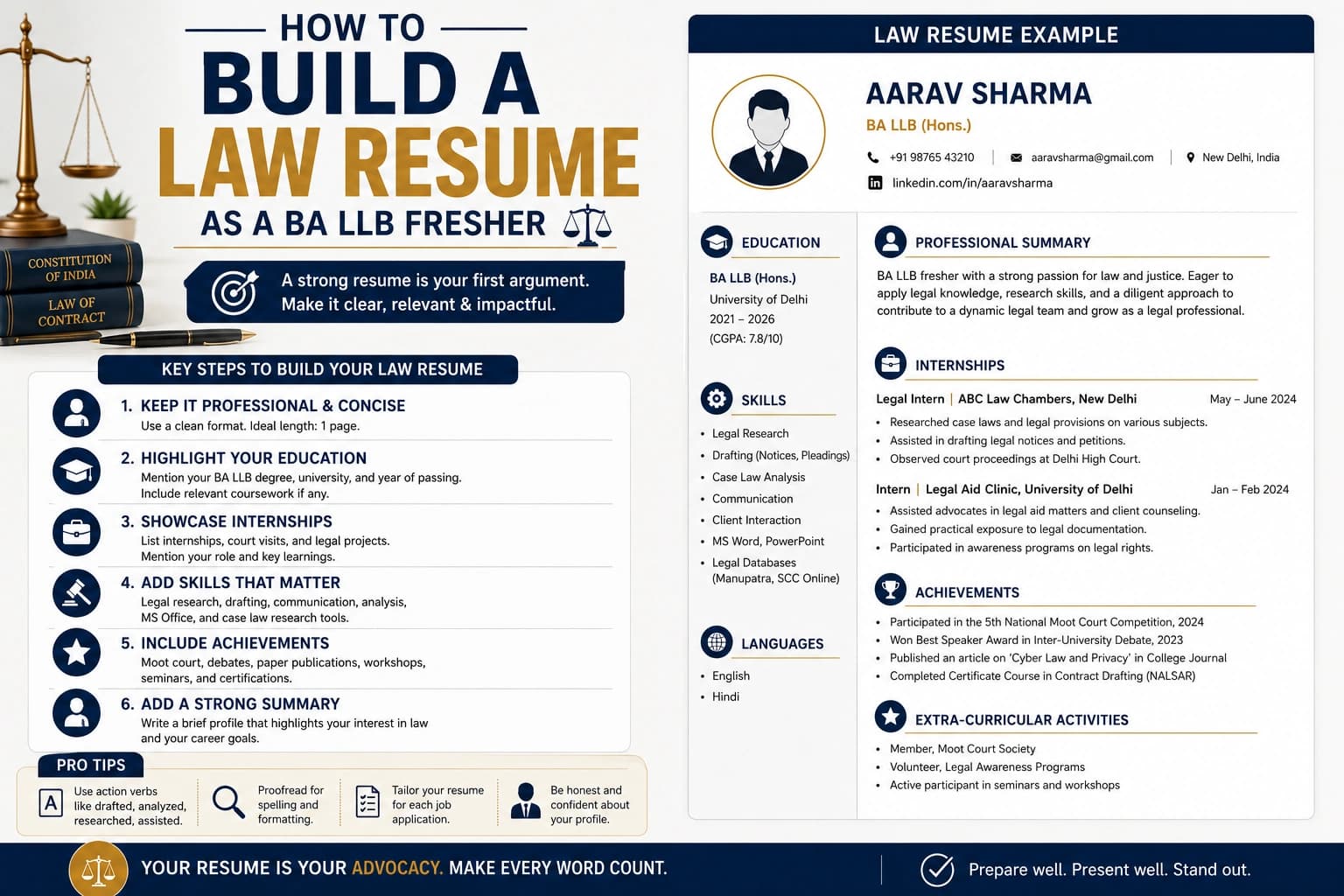
How to Build a Law Resume as a BA LLB Fresher
A practical, section-by-section guide to building a strong law resume as a BA LLB fresher — structure, internships, moot court, formatting, and mistakes to avoid.

How to Crack Law Firm Interviews After BA LLB
A practical, step-by-step guide to preparing for and cracking law firm interviews after BA LLB — common questions, technical rounds, and mistakes to avoid.
Most read on Vidyapun
Comments
0No comments yet
Be the first to share your thoughts!