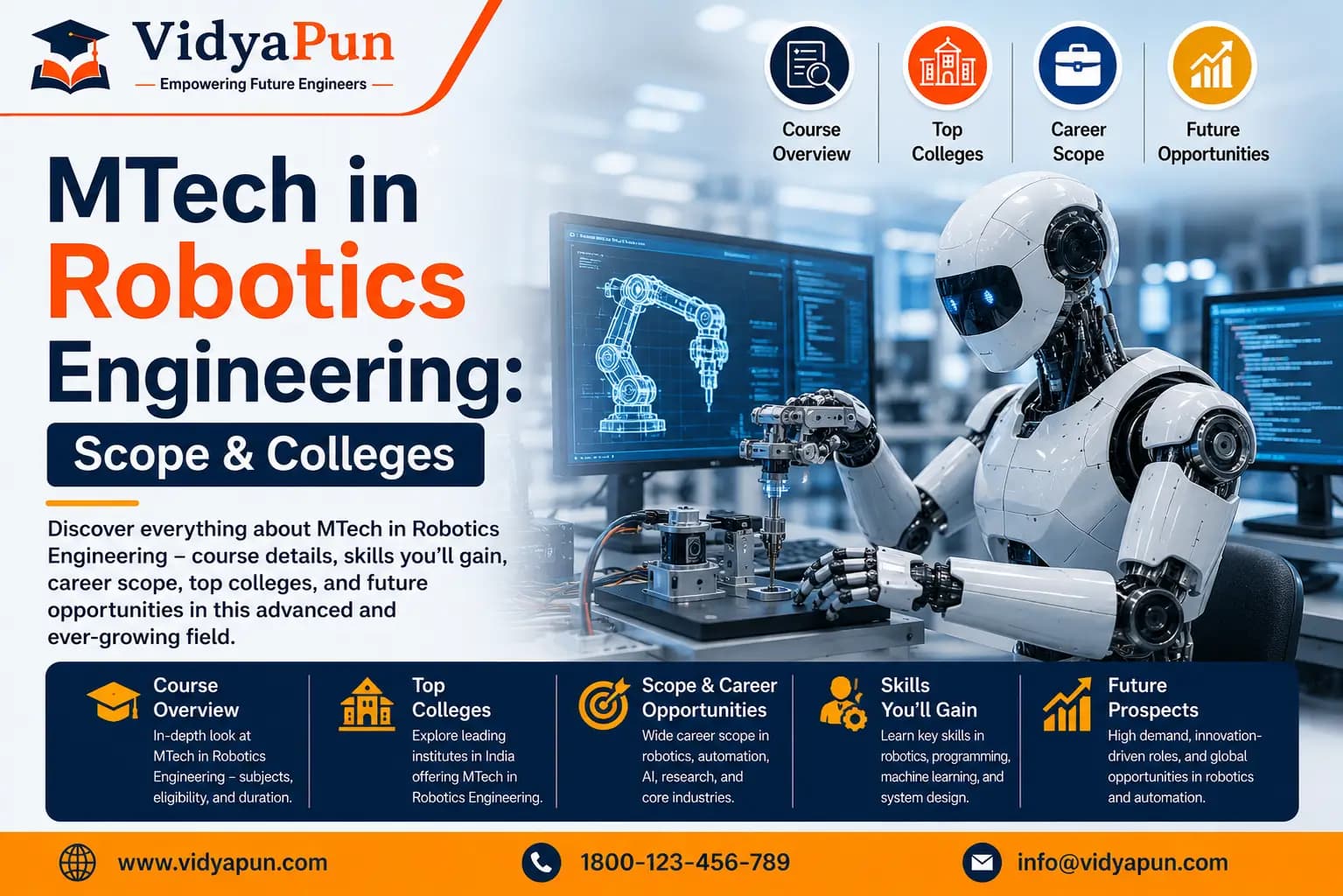
There is a reason robotics engineering keeps coming up in every conversation about the future of work in India — and it is not hype.
Manufacturing plants are deploying robotic arms. Hospitals are experimenting with surgical robots. Defence organizations are investing in autonomous systems. Warehouses run by e-commerce giants are increasingly staffed by machines, not people. And someone has to design, build, program, and maintain all of it.
That someone could be you — if you make the right postgraduate decision now.
An MTech in Robotics Engineering is one of the most forward-looking technical postgraduate programs available in India today. It is still relatively niche, which means competition for seats is lower than mainstream engineering branches, job opportunities are genuinely growing, and the salary premium for specialized robotics engineers is real and rising.
This guide covers everything you need to know — top colleges, career scope, eligibility, salary expectations, and whether this degree is the right fit for your goals.
What Is MTech in Robotics Engineering?
MTech in Robotics Engineering is a two-year postgraduate program that trains engineers in the design, development, and application of robotic systems. It sits at the intersection of multiple engineering disciplines — mechanical engineering, electronics, computer science, and artificial intelligence — making it genuinely interdisciplinary in nature.
The curriculum typically covers:
- Robot kinematics and dynamics
- Control systems and automation
- Embedded systems and microcontrollers
- Artificial intelligence and machine learning for robotics
- Computer vision and image processing
- Sensors, actuators, and mechatronics
- Industrial automation and programmable logic controllers (PLCs)
- Human-robot interaction
- Autonomous vehicles and drone systems
- VLSI design (in some programs)
What makes this program particularly valuable is that it prepares graduates not just for academic careers but for direct industry application — in manufacturing, defence, healthcare, agriculture, and space technology.
Why MTech in Robotics Engineering Makes Sense Right Now
Let us be direct about the timing here, because it matters.
India's manufacturing sector is undergoing rapid automation. The government's Production Linked Incentive (PLI) scheme is driving investment in electronics, semiconductors, and advanced manufacturing — all of which require robotics expertise. The defence sector is pushing toward indigenization of autonomous systems under the Make in India initiative. ISRO regularly recruits engineers with robotics and control systems backgrounds. And the startup ecosystem around robotics, drones, and industrial automation is genuinely expanding.
Globally, the robotics market is projected to grow at a compound annual rate that makes this one of the highest-demand engineering specializations through 2030. Indian engineers with an MTech in Robotics Engineering are well-positioned to tap both domestic and international opportunities.
The niche nature of the program also works in your favor. Unlike MTech in Computer Science or Electronics, where hundreds of thousands of graduates compete for positions, MTech in Robotics produces a far smaller talent pool — which means employers compete for you, rather than the reverse.
Top Colleges for MTech in Robotics Engineering in India
1. Indian Institute of Technology (IIT) Kanpur
IIT Kanpur offers an MTech program in Mechatronics and Robotics under its Department of Mechanical Engineering. The research environment here is among the best in the country, with strong industry collaborations and state-of-the-art robotics laboratories.
Key strengths: GATE-based admission, excellent placement record, active research in autonomous systems and industrial robotics. Approximate fees: ₹1–2 lakhs per year (with GATE scholarship, most students receive a monthly stipend of ₹12,400–14,400)
2. Indian Institute of Technology (IIT) Delhi
IIT Delhi offers relevant postgraduate programs through its Electrical Engineering and Mechanical Engineering departments, with significant research focus on robotics, automation, and control systems. Students here benefit from proximity to Delhi's industrial and research ecosystem.
Key strengths: Strong placement in core engineering, defence PSUs, and global robotics firms. Active robotics research lab. Approximate fees: Similar to other IITs, with GATE stipend available
3. Indian Institute of Technology (IIT) Bombay
IIT Bombay's Systems and Control Engineering group is among the most respected in the country for control theory and robotics research. Its proximity to Mumbai's industrial base and startup ecosystem adds significant practical value.
Key strengths: Strong research output, excellent alumni network, industry connections with automation and manufacturing companies.
4. Indian Institute of Science (IISc) Bangalore
IISc offers postgraduate and research programs with a strong robotics component through its Department of Mechanical Engineering and Centre for Product Design and Manufacturing. For students interested in research-oriented careers, IISc is arguably the strongest institution in India.
Key strengths: World-class research facilities, DRDO and ISRO collaborations, strong focus on autonomous systems and AI-driven robotics. Admission: Through GATE + interview
5. National Institute of Technology (NIT) Trichy
NIT Trichy offers an MTech in Mechatronics Engineering, which has a strong robotics and automation component. It is one of the most competitive NITs for this specialization and offers quality education at a fraction of the cost of private institutions.
Key strengths: Excellent faculty, strong GATE-based admission, good placement in core engineering and automation sectors.
6. Manipal Institute of Technology (MIT), Manipal
For students who do not qualify through GATE or prefer a private institution with strong infrastructure, MIT Manipal offers an MTech in Robotics and Automation. The program has industry tie-ups and a practical, application-focused curriculum.
Approximate fees: ₹3–5 lakhs per year Key strengths: Good lab facilities, internship opportunities, strong alumni presence in robotics and automation companies
7. Amrita Vishwa Vidyapeetham
Amrita's School of Engineering offers an MTech in Robotics and Automation with strong research components and collaborations with international universities. The Coimbatore and Bangalore campuses both have active robotics labs.
Key strengths: International research collaborations, focus on medical robotics and industrial automation, NIRF-ranked institution.
8. VIT University (Vellore)
VIT Vellore offers an MTech in Robotics and Automation that is well-regarded for its industry-integrated curriculum. Strong placement cell and connections with manufacturing and automotive companies make it a practical choice.
Approximate fees: ₹2.5–4 lakhs per year Key strengths: Industry-aligned curriculum, strong placement support, flexible specialization tracks
Eligibility for MTech in Robotics Engineering
The basic eligibility requirements are largely consistent across institutions:
- BTech/BE in Mechanical Engineering, Electronics Engineering, Electrical Engineering, Mechatronics, Computer Science, or a closely related discipline
- Minimum aggregate: 55–60% (varies by institution; SC/ST candidates typically require 50%)
- GATE score: Required for admission to IITs, NITs, and most government-funded institutions. GATE papers accepted are typically ME (Mechanical), EC (Electronics), EE (Electrical), or CS (Computer Science) depending on the program's home department
- For private institutions: Some accept direct admission through their own entrance tests or on the basis of BTech marks, without GATE
For IIT and IISc admissions, a strong GATE score is essential — aim for a percentile above 90 for competitive programs. For NITs, the GATE cutoff varies by category and year.
MTech in Robotics Engineering: Career Scope in India and Abroad
This is where the picture gets genuinely exciting.
Core Engineering and Manufacturing
Automotive companies, aerospace manufacturers, electronics firms, and heavy industry players all use robotic systems extensively. Companies like Tata Motors, Mahindra, Bosch India, ABB, Fanuc, and Siemens actively recruit robotics engineers for roles in automation design, systems integration, and process optimization.
Defence and Space
DRDO, ISRO, BEL, HAL, and BHEL regularly recruit MTech graduates in robotics and mechatronics for roles involving autonomous systems, unmanned vehicles, satellite components, and advanced manufacturing. These are highly stable, technically rich careers with significant long-term growth.
Healthcare and Medical Robotics
Surgical robotics, rehabilitation devices, prosthetics, and hospital automation are growing rapidly. Research institutions and medical device companies need engineers who understand both the mechanical and software sides of robotic systems.
Agriculture Technology
Precision agriculture using robotic systems — automated harvesters, drone-based crop monitoring, soil analysis robots — is an emerging sector in India with significant government backing under digital agriculture initiatives.
Startups and Product Companies
India's robotics startup ecosystem is growing — companies building warehouse automation, drone delivery, agricultural robots, and service robots are actively hiring MTech graduates. These roles often come with competitive salaries, equity, and the excitement of building something genuinely new.
Academia and Research
For students inclined toward research, an MTech in Robotics Engineering can lead into a PhD — either in India (IITs, IISc) or abroad (CMU, MIT, ETH Zurich, TU Delft). Faculty positions at engineering colleges, research fellowships at national labs, and postdoctoral opportunities at international universities are all realistic post-PhD outcomes.
MTech in Robotics Engineering Salary in India
Let us talk real numbers.
Fresh MTech graduate (0–2 years):
- Core engineering firms and PSUs: ₹6–10 lakhs per annum
- Automation and robotics product companies: ₹8–14 lakhs per annum
- R&D and defence organizations: ₹7–12 lakhs per annum (with stability and benefits)
- Robotics startups: ₹8–15 lakhs per annum (+ equity in some cases)
Mid-level (3–6 years experience):
- Robotics system engineers and automation specialists: ₹15–25 lakhs per annum
- Senior roles at MNCs (ABB, Fanuc, Siemens, Bosch): ₹20–35 lakhs per annum
Senior level (7+ years):
- Lead engineers, project managers, and R&D heads: ₹30–60 lakhs per annum
- Niche robotics specialists in international companies or global roles: ₹60 lakhs to ₹1 crore+
For IIT or IISc graduates with strong research profiles, international offers — particularly from robotics companies in the USA, Germany, Japan, and South Korea — are realistic and often substantially higher.
MTech in Robotics vs MTech in Mechatronics vs MTech in Automation
These three programs overlap significantly, and students often wonder which to choose.
MTech in Robotics Engineering is the broadest, covering AI-driven systems, autonomous machines, and both hardware and software integration.
MTech in Mechatronics focuses more on the mechanical-electronics integration — motors, sensors, actuators, and control systems. It has a stronger mechanical engineering foundation.
MTech in Automation and Control emphasizes industrial process control, PLCs, SCADA systems, and manufacturing automation. More directly aligned with factory and process industry roles.
If your interest is in intelligent, autonomous systems — robots that perceive, decide, and act — MTech in Robotics is the right fit. If you want to work in manufacturing automation or industrial control systems specifically, Mechatronics or Automation and Control may serve you better.
FAQs: MTech in Robotics Engineering
Q1. Is MTech in Robotics Engineering a good career choice in India? Yes — it is one of the stronger MTech specializations for long-term career prospects. The combination of AI, mechanical design, and control systems makes robotics graduates versatile and increasingly in demand across defence, manufacturing, healthcare, and technology sectors.
Q2. What GATE score is needed for MTech in Robotics at IITs? Cutoffs vary by year and category, but for general category candidates, a GATE score above 650–700 in ME, EC, or EE is typically competitive for IIT programs. For IISc, the cutoff is generally higher. Check each institution's official admissions notification for the current year.
Q3. Can a computer science engineer do MTech in Robotics? Yes. Many robotics programs accept BTech in Computer Science, especially those with a focus on AI, computer vision, and software aspects of robotics. GATE CS score is often accepted. Check individual institution eligibility requirements.
Q4. What is the scope of MTech in Robotics Engineering abroad? Excellent. Countries like Germany, Japan, South Korea, the USA, and the Netherlands have strong robotics industries and actively recruit Indian engineers. An MTech from a reputed IIT or IISc, combined with relevant research publications, significantly improves international placement prospects.
Q5. Is MTech in Robotics Engineering available without GATE? Yes — several private universities like VIT, Amrita, and Manipal offer MTech in Robotics without a GATE requirement, based on merit or their own entrance exams. However, GATE-qualified students at government institutions also receive a monthly stipend, making the financial case for GATE preparation strong.
Q6. What is the difference between MTech in Robotics and MTech in Artificial Intelligence? MTech in Robotics covers physical robotic systems — hardware, control, mechanics, and AI applied to robotics. MTech in AI focuses more broadly on machine learning, deep learning, data systems, and software intelligence. Robotics is more interdisciplinary; AI is more software and data intensive.
Website: www.vidyapun.com
Call / WhatsApp: +91 96438 02216