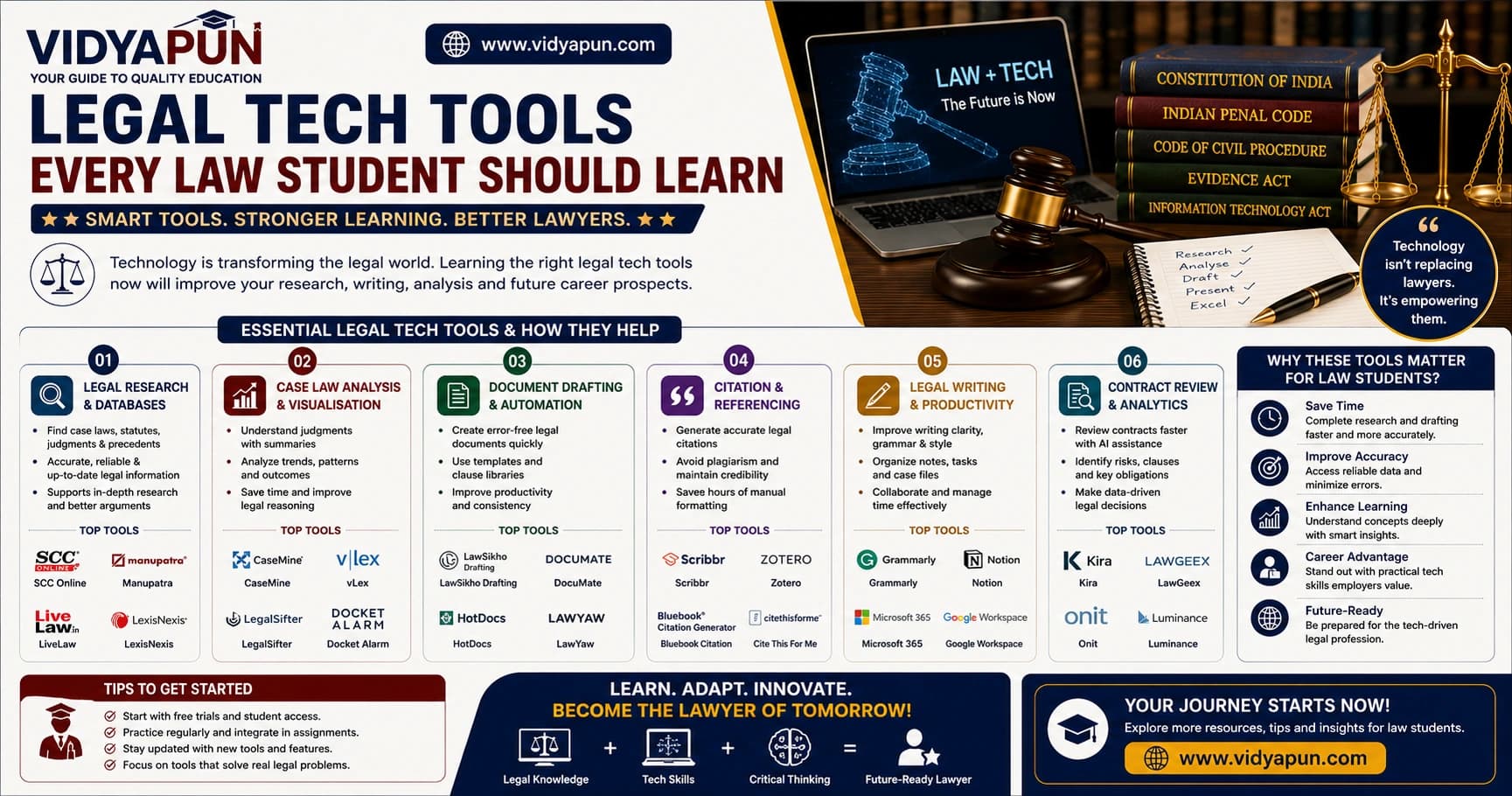
Most BA LLB students only get hands-on with legal research software during internships — often fumbling through their first login to a database everyone assumes they already know. Getting familiar with the major legal tech tools before you graduate isn't just about convenience; recruiters increasingly expect baseline fluency, and knowing which tool actually fits which task will save you real time once you're working on live matters.
This guide covers the legal tech tools worth learning during your BA LLB, organized by what they're actually used for.
Why Legal Tech Fluency Matters Earlier Than You Think
Legal research and practice in India now run on a mix of established databases and newer AI-powered platforms, and the expectation to know your way around them starts as early as your first internship:
- Internships assume baseline familiarity – supervisors rarely have time to teach you how a research platform works from scratch
- Recruiters increasingly screen for it – comfort with legal-tech tools is becoming a genuine differentiator, not just a nice-to-have
- The tools themselves are evolving fast – AI-powered legal research has moved well past experimental status, and students who learn only keyword-based search are behind before they start
Our broader guide on digital skills for LLB students covers this shift at a higher level; this guide gets specific about which tools to actually learn.
Legal Research Databases: The Foundation
These are the core databases nearly every Indian legal career runs through at some point:
- SCC Online – one of the most trusted case law databases in India, offering authoritative citations, tribunal orders, and commentary; widely used across courts and academia
- Manupatra – a long-established legal research platform with an extensive historical case law database, statutory updates, and academic articles, now expanded with AI-powered analytics and workflow features
- CaseMine – increasingly regarded as a leading India-first AI-powered research platform, combining case law coverage with citation analysis and precedent visualization tools
Most serious practitioners in India don't rely on just one of these — they build a working combination depending on the task, starting with citation-first research on one platform before layering in AI-assisted analysis from another. Getting comfortable navigating at least two of these during your BA LLB will put you well ahead during internships.
AI-Powered Legal Research and Drafting Tools
Beyond the traditional databases, a newer generation of AI-native tools is becoming part of standard practice:
- AI features within SCC Online and Manupatra – both platforms have added AI-driven analytics, predictive tools, and drafting assistance to their existing databases
- General-purpose AI tools (like ChatGPT or Claude) – increasingly used for quick drafts, summaries, and template work, though always with a "lawyer-in-the-loop" verifying citations and accuracy
- Domain-specific drafting tools – newer Indian legal-tech platforms are emerging specifically for tax, regulatory, and corporate drafting workflows
The consistent theme across every serious guide to these tools: AI is meant to assist legal reasoning, not replace it — verifying citations and outputs remains a non-negotiable step regardless of which tool you use. For a deeper look at how this shift is reshaping the profession more broadly, see our guide on how AI is changing the legal profession.
Case Management and Court Tracking Tools
Beyond research, legal tech also covers the operational side of practice — increasingly relevant even for students heading into litigation-heavy internships:
- Court and cause-list tracking platforms – newer Indian legal-tech tools now offer tracking across thousands of Indian courts, including cause-list matching, CNR lookup, and limitation risk alerts
- Case workspace tools – shared digital hubs where research, documents, tasks, and case communication live in one place, replacing the fragmented email-and-folder approach many chambers still use
- Document intelligence tools – built for high-volume document review, useful for arbitration and litigation matters involving large case bundles
Even if you're not headed toward litigation specifically, understanding how these tools work will make you noticeably more useful during any internship involving active case files.
Building Your Legal Tech Skill Set During BA LLB
A few practical ways to build this fluency before you graduate:
- Get access to at least one major database through your college library – most law schools provide institutional access; use it well before your first internship, not during it
- Practice with free trials or student versions of AI-powered legal research tools where available
- Ask supervisors during internships to walk you through their preferred tool stack – this is one of the fastest ways to learn what's actually used in practice
- Follow legal-tech developments – the tools and features change often enough that staying current matters, especially as AI capabilities expand quickly
- Pair tech fluency with strong underlying research skills – tools are only as useful as your ability to evaluate their output critically; our guide on legal research skills every BA LLB student needs is a good foundation to build alongside tool familiarity
If you're also building your broader professional skill set, our guides on modern legal skills for BA LLB students, practical legal skills for BA LLB students, and communication skills for LLB students cover related ground worth developing in parallel. For students interested in legal-tech as a career direction itself, our guide on top job roles for BA LLB graduates touches on where this specialization can lead.
Curious how your profile stacks up for programs that build this kind of practical readiness? Explore verified BA LLB programs on the Vidyapun BA LLB course page.
Frequently Asked Questions
Which legal research tool should BA LLB students learn first?
SCC Online and Manupatra are the most widely used and recognized databases across Indian courts, law firms, and academia, making them the most practical starting point. Adding familiarity with an AI-powered platform like CaseMine is a strong next step.
Are legal tech skills actually important for law students, or just for practicing lawyers?
Increasingly important for students too. Internship supervisors and recruiters expect baseline familiarity with major research platforms, and comfort with AI-assisted research tools is becoming a genuine differentiator even before graduation.
Do I need to pay for legal research databases as a student?
Usually not — most law schools provide institutional access to platforms like SCC Online or Manupatra through their libraries. Check with your college library before assuming you need a personal subscription.
Can AI tools replace traditional legal research databases?
No. AI-powered tools are best used alongside traditional databases like SCC Online and Manupatra, not as a replacement — verifying AI-generated research and citations against authoritative sources remains essential.
Is legal tech a viable career path after BA LLB?
Yes, it's a growing field, particularly given the rapid expansion of India's legal-tech sector. Students interested in this direction often combine legal training with an interest in technology, data, or product-related roles within legal-tech companies or law firm innovation teams.
Final Thoughts
Legal tech fluency isn't a niche add-on to your BA LLB anymore — it's close to a baseline expectation, and getting comfortable with the major research databases and AI-assisted tools before your first internship will save you real friction later. Start with SCC Online or Manupatra through your college library, layer in an AI-powered platform once you're comfortable, and keep verifying everything you find against authoritative sources.
Wondering which BA LLB program will best prepare you for a tech-forward legal career? Check Your Admission Chances for personalized guidance.
🌐 Website: www.vidyapun.com 📞 Call / WhatsApp: +91 96438 02216