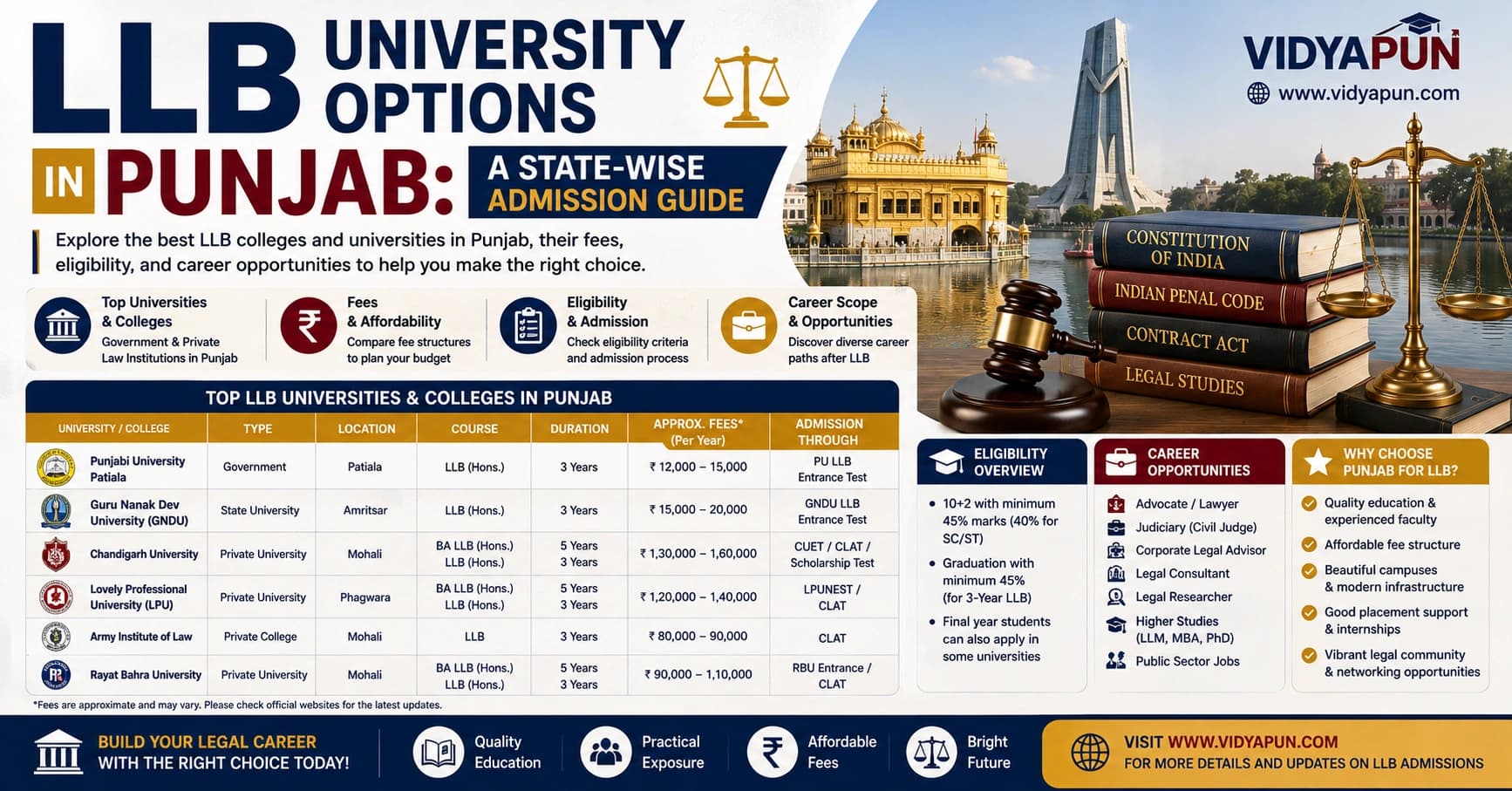
A note on the data below: Fee figures, cutoffs, and placement details in this guide are drawn from publicly available sources and are directional estimates for planning purposes. Always confirm current figures on the university's official website or through the LLB course guide before applying.
If you're a 12th-pass or graduate student in Punjab weighing your LLB options, you don't need to look only at Delhi, Bangalore, or Pune. Punjab has built a genuinely diverse legal education ecosystem of its own — anchored by a National Law University, several respected state universities, and a growing set of private institutions — that lets many students get a strong legal education without leaving the state.
This guide walks through the top LLB universities in Punjab, how their admission processes differ, what they cost, and how to decide which one fits your goals.
Why Punjab Is a Strong Choice for LLB Aspirants
Studying law within Punjab offers real advantages for local students: lower living costs compared to metro cities, proximity to family, familiarity with the regional judiciary and bar for those planning to practice locally, and — at the state's National Law University — a credential that competes with top NLUs elsewhere in India. For students who don't want to relocate across the country or who didn't secure a CLAT rank at a top-tier metro NLU, Punjab's universities offer a genuinely competitive alternative.
Types of LLB Programs Available in Punjab
Before comparing universities, it helps to understand that "LLB" in Punjab actually covers two distinct program structures.
5-Year Integrated BA LLB Programs
Most universities in Punjab, including RGNUL, Army Institute of Law, and Panjab University's UILS, offer the 5-year integrated BA LLB (or BCom LLB) taken directly after Class 12 — the same format followed by NLUs nationally.
3-Year LLB Programs (Post-Graduation)
Panjab University's Department of Laws, along with several affiliated colleges, also offers the traditional 3-year LLB for students who have already completed a bachelor's degree in any discipline. This route suits graduates who decide on law later or want to combine it with an existing degree.
Top Government Law Universities in Punjab
Government institutions remain the most sought-after route into legal education in Punjab, led by the state's only National Law University.
Rajiv Gandhi National University of Law (RGNUL), Patiala
RGNUL is the only National Law University in Punjab and consistently ranks among India's top law schools in NIRF rankings. It offers a 5-year BA LLB (Hons) and LLM, with admission entirely through CLAT — there is no separate state entrance test. RGNUL's total BA LLB fees have been reported in the roughly ₹7.5–10 lakh range across sources for the full five-year program, and CLAT cutoff ranks for the general category have recently fallen in the roughly 1,000–1,300 range.
Panjab University, Chandigarh (UILS & Department of Laws)
Panjab University runs two distinct law tracks: the University Institute of Legal Studies (UILS) offers the 5-year BA LLB and BCom LLB through the PU UGLAW entrance test (weighted equally with Class 12 marks), while the university's Department of Laws offers the 3-year LLB for graduates through a separate PU LLB entrance test. Panjab University also has regional centres offering law programs in Hoshiarpur and Ludhiana.
Army Institute of Law, Mohali
Affiliated with Panjab University and approved by the Bar Council of India, the Army Institute of Law (AIL) offers a 5-year BA LLB (Hons). Admission is primarily reserved for wards of army and ex-servicemen personnel through the AIL entrance process, with a portion of seats open to civilian candidates through CLAT.
Punjabi University, Patiala & Guru Nanak Dev University, Amritsar
Punjabi University's Department of Law, established in 1965, and Guru Nanak Dev University's law programs (including its Jalandhar regional centre) round out the state's major public university options, both offering long-established LLB programs with their own admission processes and regional recognition.
Top Private Law Universities in Punjab
Private universities have expanded law offerings significantly in Punjab over the past decade, with several building strong placement track records.
Lovely Professional University, Phagwara
LPU is one of the largest and most recognized private universities in Punjab, offering 5-year integrated law programs alongside a wide range of disciplines, with an emphasis on industry tie-ups and a large in-house placement infrastructure.
Chandigarh University & Chitkara University
Both Chandigarh University and Chitkara University have built out law schools with modern infrastructure and moot court facilities, and are frequently cited alongside NMIMS Chandigarh as among the stronger private options for placement outcomes in the region.
Admission Process and Entrance Exams
Admission routes vary significantly across Punjab's law universities, so confirming the right exam early is essential to your preparation timeline.
CLAT for RGNUL and Civilian AIL Seats
CLAT (Common Law Admission Test) is the primary route into RGNUL's BA LLB and LLM programs, and also covers the civilian quota at the Army Institute of Law.
State-Level Entrance Tests (PU UGLAW, PU LLB)
Panjab University conducts its own entrance tests — PU UGLAW for the 5-year integrated program and PU LLB (alongside PU-CET for PG-level admissions) for the 3-year LLB — both combined with qualifying marks to determine merit. Other state and private universities typically run their own entrance tests or admit based on qualifying marks, so checking each university's specific process is important.
LLB Fees in Punjab: Government vs Private
Government University Fee Range vs Private University Fee Range: Government institutions in Punjab span a wide range — RGNUL's 5-year program runs roughly ₹7.5–10 lakh in total, while Panjab University's 3-year LLB and other state university programs are typically far more affordable, often a fraction of RGNUL's cost. Private universities like LPU, Chandigarh University, and Chitkara generally charge more per year than state universities but less than RGNUL's total cost, with wide variation depending on the specific program and campus facilities — always request the current fee structure directly from the university before applying.
Placements and Career Outcomes
Career Outcomes: Judiciary, Litigation & Corporate Law: Graduates from Punjab's law universities pursue a genuine mix of pathways — RGNUL and Panjab University graduates regularly go on to judiciary exam preparation, litigation practice in Punjab and Haryana High Court and district courts, and corporate law roles at firms and companies, while newer private universities have been building corporate placement pipelines to compete with established institutions. RGNUL's own NIRF-reported placement figures show a meaningful share of graduates placed through campus recruitment each year, though numbers remain smaller than top metro NLUs.
How to Choose the Right LLB University in Punjab
With government and private options both on the table, matching your eligibility and goals to the right university is the final step.
Match Your Entrance Score and Eligibility
Compare your expected CLAT rank or PU entrance performance against recent cutoff trends for each university on your shortlist — RGNUL's competitive CLAT cutoffs mean many strong candidates also seriously consider Panjab University or a well-placed private option.
Use Admission Guidance Tools
Rather than guessing at your realistic options, use available prediction tools and expert guidance to narrow your shortlist based on your actual academic profile before you commit to entrance exam preparation for a specific university. Talk to an admission expert to get personalized guidance on which LLB universities in Punjab fit your profile.
Frequently Asked Questions
1. Which is the best LLB university in Punjab? Rajiv Gandhi National University of Law (RGNUL), Patiala is widely regarded as the top LLB university in Punjab, being the state's only National Law University, followed by Panjab University's UILS and the Army Institute of Law.
2. Does Punjab have a National Law University? Yes. RGNUL Patiala is Punjab's only National Law University, offering a 5-year BA LLB (Hons) and LLM through CLAT admission.
3. Can I pursue a 3-year LLB in Punjab after graduation? Yes. Panjab University's Department of Laws and several affiliated colleges offer the traditional 3-year LLB for students who have already completed a bachelor's degree, admitted through the PU LLB entrance test.
4. What is the eligibility for LLB admission in Punjab? For the 5-year integrated BA LLB, eligibility is typically 45–50% marks in Class 12 from a recognized board; for the 3-year LLB, candidates generally need a bachelor's degree with a minimum aggregate, which varies by university.
5. How much does an LLB cost in Punjab? Costs vary widely — RGNUL's 5-year program runs roughly ₹7.5–10 lakh in total, state university programs like Panjab University's 3-year LLB are considerably more affordable, and private universities fall somewhere in between depending on the institution.
6. Is CLAT required for all LLB admissions in Punjab? No. CLAT is required for RGNUL and the civilian quota at Army Institute of Law, but Panjab University and several other institutions conduct their own state-level entrance tests.
7. How do Punjab's law universities compare with national law universities elsewhere? RGNUL competes closely with mid-tier NLUs nationally on rankings and placements, while Panjab University and private universities in Punjab generally offer strong regional recognition and more affordable options, though placement outcomes at the very top metro NLUs remain stronger.
8. How can I find out which LLB university in Punjab I'm likely to get into? Comparing your expected CLAT rank or entrance exam score against recent cutoffs is a good starting point, and you can also talk to an admission expert for personalized guidance based on your academic profile.
🌐 Website: www.vidyapun.com 📞 Call / WhatsApp: +91 96438 02216