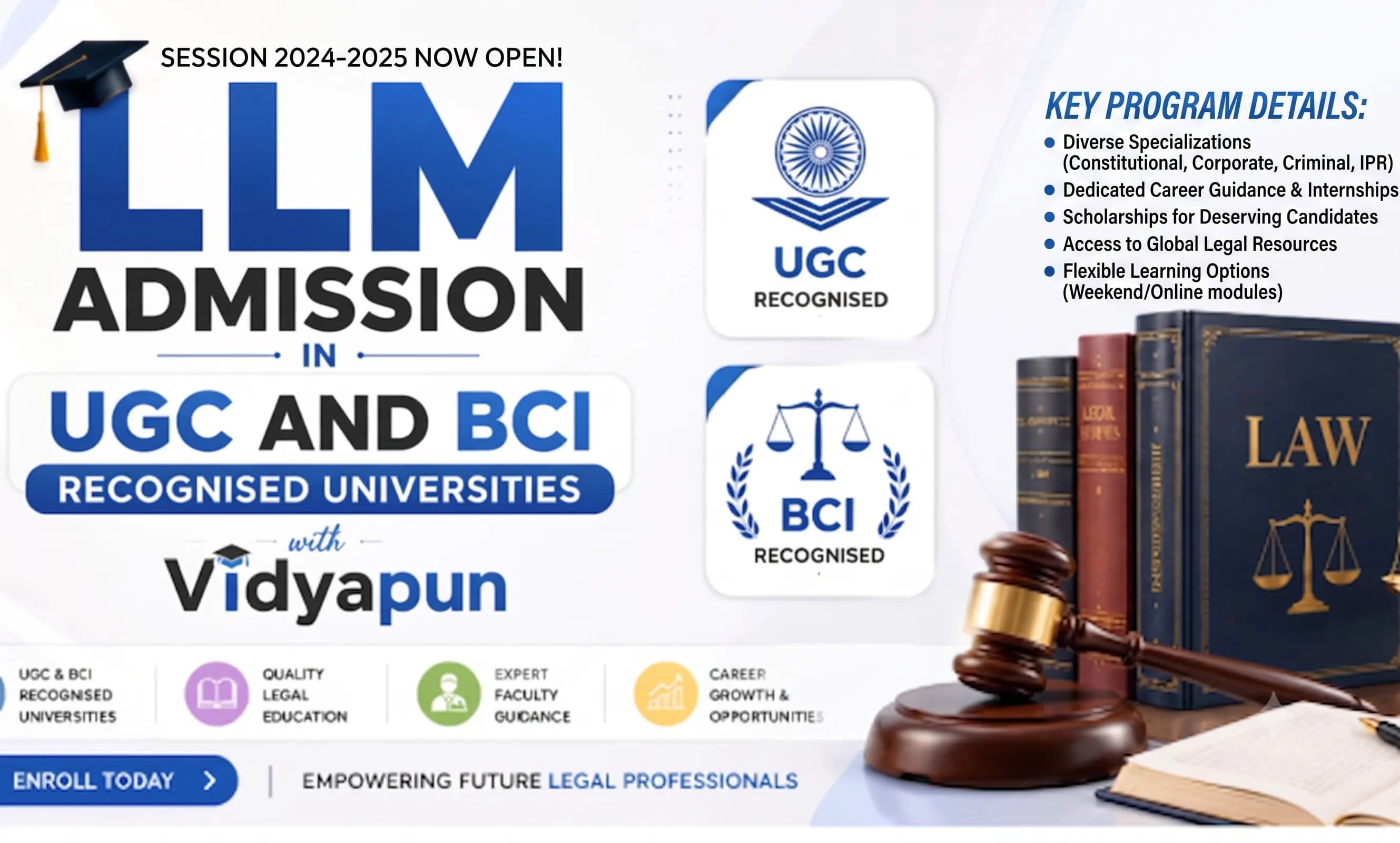
A Master of Laws (LLM) is one of the most respected postgraduate degrees for law graduates who want to deepen their legal expertise and expand their career opportunities. Whether you aim to work in corporate law, litigation, academia, legal research, or international organisations, an LLM can help you build specialised knowledge and improve your professional profile.
With many universities offering LLM programmes, selecting the right institution and specialisation can be challenging. Students must consider factors such as UGC recognition, BCI compliance, faculty expertise, curriculum, placement support, and career prospects before applying.
Vidyapun simplifies this journey by providing expert admission guidance, university comparison, eligibility assessment, documentation support, and personalised counselling to help students make informed decisions.
What is an LLM?
LLM (Master of Laws) is a postgraduate degree designed for students who have completed an LLB or an integrated law programme such as BA LLB, BBA LLB, or B.Com LLB.
The programme focuses on advanced legal studies and allows students to specialise in specific areas of law according to their career aspirations.
An LLM degree develops:
- Advanced legal knowledge
- Research skills
- Analytical thinking
- Legal drafting abilities
- Policy analysis
- Professional expertise
Graduates often pursue careers in law firms, multinational corporations, government departments, universities, think tanks, and international organisations.
Why Choose a UGC & BCI Recognised University?
Selecting a recognised university is essential because it ensures that your qualification is valid, credible, and widely accepted by employers and educational institutions.
Studying at a recognised university offers several advantages:
- Nationally recognised degree
- Better employment opportunities
- Eligibility for higher studies such as PhD
- Improved academic standards
- Experienced faculty
- Updated legal curriculum
- Better research facilities
- Industry-oriented learning
Recognition also enhances the value of your qualification when applying for jobs in India and abroad.
LLM Eligibility Criteria
Although admission requirements vary between universities, the general eligibility criteria include:
| Requirement | Details |
| Educational Qualification | LLB / BA LLB / BBA LLB / B.Com LLB from a recognised university |
| Minimum Marks | Usually 50–55% (varies by university) |
| Entrance Exam | Required by some universities |
| Age Limit | Generally no age restriction |
Always check the specific eligibility requirements of your chosen university before applying.
LLM Admission Process
The admission process generally involves the following steps:
Step 1: Career Counselling
Identify your career goals and choose a suitable specialisation.
Step 2: University Selection
Compare recognised universities based on:
- Accreditation
- Faculty
- Curriculum
- Fees
- Placement support
- Research opportunities
Step 3: Eligibility Verification
Confirm that you meet all academic requirements.
Step 4: Documentation
Prepare necessary documents such as:
- Graduation certificates
- Mark sheets
- Identity proof
- Passport-size photographs
- Category certificates (if applicable)
Step 5: Application Submission
Complete the online or offline application form before the deadline.
Step 6: Admission Confirmation
After document verification and fee payment, secure your admission.
Popular LLM Specialisations
Choosing the right specialisation is one of the most important decisions during LLM admission.
Corporate Law
Corporate Law focuses on company law, mergers and acquisitions, securities regulation, corporate governance, and commercial transactions.
Career Options
- Corporate Lawyer
- Legal Advisor
- Compliance Officer
- Company Secretary Support
- Legal Consultant
Criminal Law
Students learn about criminal justice, investigation procedures, evidence, prosecution, and criminal litigation.
Career Opportunities
- Criminal Advocate
- Public Prosecutor
- Legal Consultant
- Judicial Services Preparation
Constitutional Law
This specialisation focuses on constitutional principles, governance, judicial review, and fundamental rights.
Suitable careers include:
- Judiciary
- Government Services
- Research
- Academia
Intellectual Property Rights (IPR)
With increasing innovation and digital content creation, IPR specialists are in high demand.
Students study:
- Patents
- Copyright
- Trademarks
- Designs
- Licensing
Cyber Law
Cyber Law addresses legal issues related to:
- Data protection
- Cybercrime
- Digital contracts
- Privacy laws
- Artificial Intelligence regulation
Career opportunities continue to grow with digital transformation.
International Law
Students explore:
- International trade
- Human rights
- Diplomatic law
- Treaty law
- Global dispute resolution
Graduates may work with international organisations, multinational companies, or policy institutions.
Other Popular LLM Specialisations
Students can also consider:
- Banking and Finance Law
- Environmental Law
- Labour and Employment Law
- Human Rights Law
- Taxation Law
- Business Law
- Commercial Law
- Arbitration Law
Career Opportunities After LLM
An LLM degree opens diverse career paths.
| Career | Industry |
| Corporate Lawyer | Corporate Sector |
| Legal Advisor | MNCs |
| Compliance Officer | Banking & Finance |
| Legal Researcher | Universities |
| Assistant Professor | Higher Education |
| Policy Analyst | Government |
| Intellectual Property Lawyer | Technology Companies |
| Cyber Law Consultant | IT Sector |
| Legal Consultant | Law Firms |
| International Legal Advisor | International Organisations |
Skills Developed During an LLM
An LLM programme helps students build:
- Legal research
- Critical analysis
- Legal writing
- Courtroom preparation
- Negotiation skills
- Policy interpretation
- Drafting contracts
- Professional ethics
These skills improve employability across multiple sectors.
Factors to Consider Before Choosing an LLM University
Before applying, evaluate:
- UGC recognition
- BCI recognition (where applicable)
- Faculty qualifications
- Curriculum relevance
- Industry exposure
- Internship opportunities
- Placement assistance
- Alumni network
- Research facilities
- Fee structure
A careful comparison helps students choose the university that best aligns with their goals.
Why Choose Vidyapun for LLM Admission Guidance?
Applying to postgraduate law programmes can be overwhelming, especially when comparing universities, specialisations, eligibility requirements, and application procedures.
Vidyapun provides comprehensive admission support through:
- Personalised counselling
- University comparison
- Eligibility assessment
- Course selection guidance
- Documentation assistance
- Application review
- Career counselling
- Admission updates
Our goal is to simplify the admission journey and help students make informed academic decisions.
Frequently Asked Questions
Who can apply for an LLM programme?
Students who have completed an LLB, BA LLB, BBA LLB, or B.Com LLB from a recognised university can generally apply, subject to individual university requirements.
Is an entrance exam mandatory for LLM admission?
Some universities conduct entrance examinations, while others may offer admission based on merit. Requirements vary by institution.
Which LLM specialisation offers strong career opportunities?
Corporate Law, Cyber Law, Intellectual Property Rights, Constitutional Law, and International Law are among the most sought-after specialisations due to evolving industry needs.
Can I pursue a PhD after completing an LLM?
Yes. An LLM degree generally qualifies candidates to apply for doctoral programmes in law, provided they meet the eligibility criteria of the institution.
What is the typical duration of an LLM programme?
Most LLM programmes in India are completed in one or two years, depending on the university and programme structure.
Does an LLM improve career prospects?
Yes. An LLM provides advanced legal knowledge and specialised expertise, which can enhance opportunities in corporate legal departments, law firms, academia, research, public policy, and government services.
Conclusion
Pursuing an LLM is an excellent step for law graduates who want to specialise in a specific area of legal practice and strengthen their professional profile. Choosing the right university and specialisation plays a significant role in shaping future career opportunities.
By evaluating recognised universities, understanding eligibility requirements, and selecting a programme aligned with your goals, you can make a confident and informed admission decision.
Vidyapun is committed to supporting students throughout the admission process with expert guidance, university comparisons, and personalised counselling, helping them take the next step toward a successful legal career.
Advance Your Legal Career with Vidyapun
Looking for expert assistance with LLM admission?
Vidyapun can help you with:
- LLM Admission Guidance
- University Selection Support
- Eligibility Assessment
- Documentation Assistance
- Career Counselling
Website: www.vidyapun.com
Call / WhatsApp: +91 96438 02216